


JPMorgan Chase & Co Stock (JPM) Moved Down by 3.50% on Nov 5: What Investors Need To Know


JPMorgan Chase & Co (JPM) moved down by 3.50%. The Banking & Investment Services sector is down by 2.69%. The company underperformed the industry. Top 3 stocks by turnover in the sector: JPMorgan Chase & Co (JPM) down 3.52%; Bank of America Corp (BAC) down 1.99%; Goldman Sachs Group Inc (GS) down 6.97%.
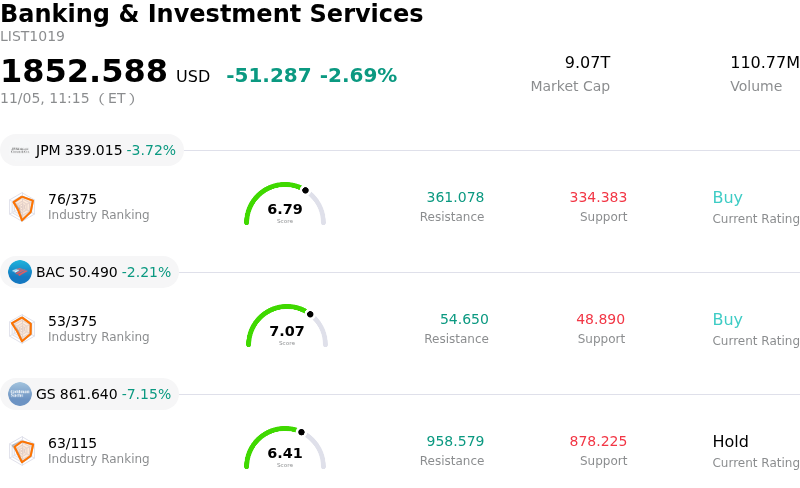
What is driving JPMorgan Chase & Co (JPM)’s stock price down today?
Shares of JPMorgan Chase experienced notable selling pressure today, driven by a confluence of macroeconomic headwinds and sector-wide concerns surrounding net interest margin trajectory. A shifting interest rate environment and adjustments along the Treasury yield curve prompted investors to recalibrate their expectations for net interest income across large-cap commercial banks. With persistent funding costs keeping pressure on deposit pricing, institutional sentiment grew cautious over the near-term expansion of asset yields, leading market participants to rotate out of heavyweight financial institutions.
Credit quality and balance sheet normalization also featured prominently in driving market skepticism. Investors are increasingly sensitive to indicators of potential asset quality deterioration, particularly in commercial real estate and select consumer lending segments. Expectations of rising provision expenses and higher charge-offs have led market participants to factor in more conservative credit cost trajectories. Despite the firm possessing industry-leading scale and an established fortress balance sheet, broader fears of a deceleration in loan demand and softening fee-based income across investment banking segments contributed to the intraday retrenchment.
Regulatory scrutiny and capital allocation constraints added a further layer of caution. Ongoing deliberations surrounding enhanced capital requirements and risk-weighted asset calculations continue to create uncertainty regarding future share buyback velocity and return on equity targets. As fund managers reassess exposure ahead of upcoming monetary policy milestones, tactical profit-taking and broader institutional portfolio de-risking disproportionately impacted liquid banking leaders. While long-term fundamentals remain anchored by operational strength and diversified revenue streams, short-term headwinds tied to rate dynamics, credit normalization, and regulatory overhang defined today’s downward movement.
Technical Analysis of JPMorgan Chase & Co (JPM)
Technically, JPMorgan Chase & Co (JPM) shows a MACD (12,26,9) value of 2.717, indicating a neutral signal. The RSI at 50.862 suggests neutral condition and the Williams %R at 57.501 suggests sell condition. Please monitor closely.
Fundamental Analysis of JPMorgan Chase & Co (JPM)
JPMorgan Chase & Co (JPM) is in the Banking & Investment Services industry. Its latest annual revenue is $181.82B, ranking 1 in the industry. The net profit is $55.68B, ranking 1 in the industry. Company Profile
Over the past month, multiple analysts have rated the company as Buy, with an average price target of $372.20, a high of $425.00, and a low of $312.00.
More details about JPMorgan Chase & Co (JPM)
Company Specific Risks:
- Heightened Regulatory Inquiries Over Digital Asset and Contagion Risks: Federal regulators, including the Federal Reserve and the OCC, have initiated inquiries into major money-center banks, specifically examining JPMorgan Chase's cybersecurity defenses and transactional exposure following massive cross-market digital asset disruptions.
- Escalating Compliance and Capital Constraints in Form 10-Q: Following its quarterly Form 10-Q filing, the bank expanded risk disclosures detailing that intensifying domestic and international supervisory mandates, evolving reporting requirements, and heightened capital obligations threaten to restrict strategic flexibility and inflate operational overhead.
- Elevated Debt-to-Equity Leverage and Refinancing Vulnerability: Institutional credit reviews flagged underlying balance sheet fragility, citing the bank's high debt-to-equity ratio of 3.42 and over $527 billion in multi-year debt obligations, leaving net interest spreads vulnerable to sustained liquidity costs and shifting monetary conditions.
- Valuation Compression Compounded by Sustained Insider Selling: Near 52-week highs and trading at a premium to modeled intrinsic value, the equity faces institutional profit-taking amplified by persistent net insider distributions totaling over $125 million without any recorded open-market insider purchases.
This article may include AI-generated content that is human-reviewed, which is for reference and general information purposes only and does not constitute investment advice.
Recommended Articles








Comments (0)
Click the $ button, enter the symbol, and select to link a stock, ETF, or other ticker.