


Costco Wholesale Corp Stock (COST) Moved Up by 3.25% on Nov 5: Key Drivers Unveiled


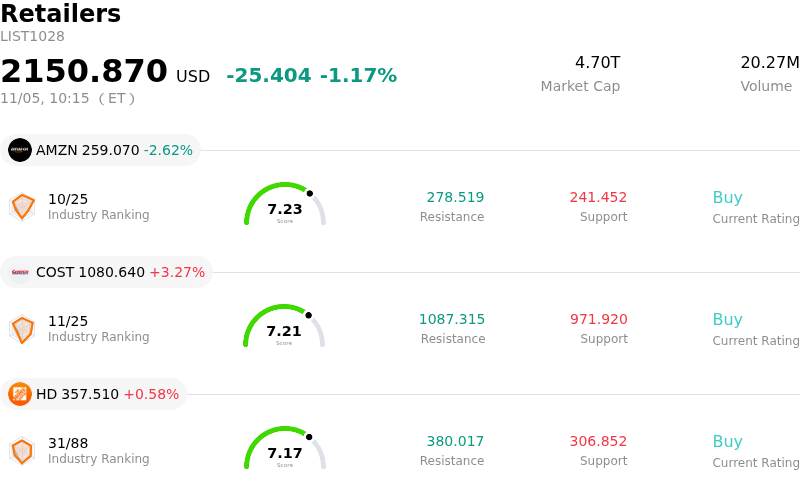
Costco Wholesale Corp (COST) moved up by 3.25%. The Retailers sector is down by 1.17%. The company outperformed the industry. Top 3 stocks by turnover in the sector: Amazon.com Inc (AMZN) down 2.52%; Costco Wholesale Corp (COST) up 3.27%; Home Depot Inc (HD) up 0.58%.
What is driving Costco Wholesale Corp (COST)’s stock price up today?
Costco Wholesale experienced robust upward momentum driven primarily by the release of its October monthly sales report, which delivered strong operational metrics across all operating segments. Net sales demonstrated double-digit year-over-year expansion, supported by broad-based comparable store sales gains both domestically and internationally. Even when stripping out volatile gasoline price impacts and foreign currency fluctuations, underlying core comparable sales remained exceptionally healthy. In addition, digitally-enabled sales accelerated sharply, easing investor concerns regarding online execution and confirming that digital enhancements, delivery partnerships, and app engagement are successfully translating into incremental revenue.
The strong operational print reinforced institutional conviction in Costco’s unique membership warehouse model. Amid ongoing macroeconomic uncertainty and selective consumer spending behavior, shoppers continue to prioritize value, bulk purchasing, and grocery essentials, effectively directing wallet share away from traditional retail peers. Costco’s recurring membership revenue stream, underpinned by record-high renewal rates and member loyalty, provides a high-margin buffer that shields profitability from input cost inflation and tariff-related supply chain friction. This predictability is viewed by portfolio managers as a critical competitive moat, especially entering the crucial holiday shopping season.
Broader capital allocation trends and positive sell-side sentiment further supported the advance. Institutional investors engaged in defensive sector rotation, moving capital toward high-quality, cash-generative consumer staples with fortress balance sheets. Analysts maintained constructive price targets and reiterated buy ratings following the volume figures, citing sustained warehouse footprint expansion and disciplined inventory turnover. Combined with steady foot traffic and sustained ticket growth, these factors prompted active institutional accumulation, fueling the stock’s decisive rally.
Technical Analysis of Costco Wholesale Corp (COST)
Technically, Costco Wholesale Corp (COST) shows a MACD (12,26,9) value of 11.740, indicating a buy signal. The RSI at 74.304 suggests buy condition and the Williams %R at 0.547 suggests overbought condition. Please monitor closely.
Media Coverage of Costco Wholesale Corp (COST)
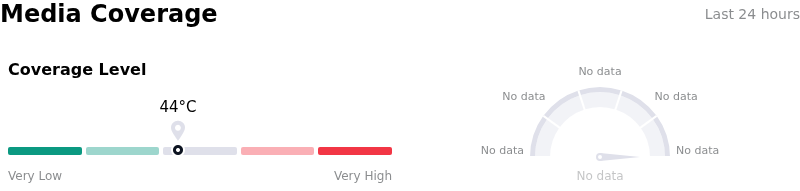
In terms of media coverage, Costco Wholesale Corp (COST) shows a coverage score of 44, indicating a moderate level of media attention. The overall market sentiment index is currently in extremely bullish zone.
Fundamental Analysis of Costco Wholesale Corp (COST)
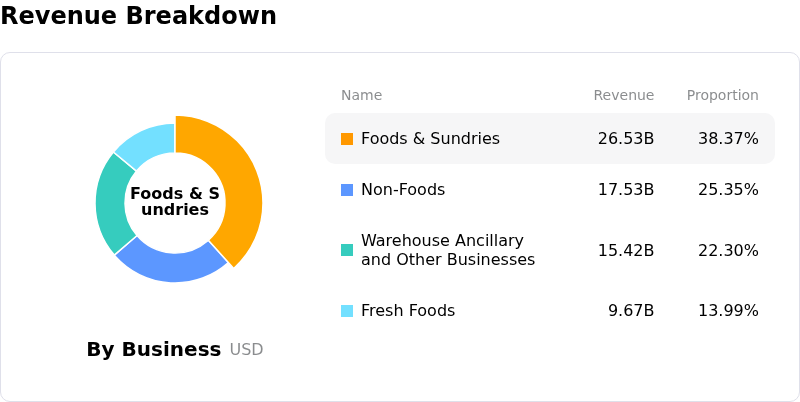
Costco Wholesale Corp (COST) is in the Retailers industry. Its latest annual revenue is $303.15B, ranking 2 in the industry. The net profit is $9.23B, ranking 2 in the industry. Company Profile
Over the past month, multiple analysts have rated the company as Buy, with an average price target of $1072.06, a high of $1315.00, and a low of $761.22.
More details about Costco Wholesale Corp (COST)
Company Specific Risks:
- Elevated Valuation Multiples and Downside Asymmetry: Trading near record highs above $1,050 with a price-to-earnings multiple exceeding 50x and a PEG ratio over 4.3x, institutional commentary notes that Costco's premium leaves zero margin of safety, creating heightened vulnerability to sharp multiple contraction on any macroeconomic deceleration or growth pause.
- Merchandise Margin Dilution from Low-Margin Fuel Contribution: Despite top-line sales expansion, recent sales prints indicate that growth remains disproportionately buoyed by high-volume, low-margin gasoline sales and grocery essentials rather than discretionary general merchandise, pressuring core merchandise gross margins and increasing operating expense sensitivity.
- Membership Fee Catalyst Exhaustion and Retention Plateau: Following the absorption of the late-2024 fee increase, institutional analysts express concern over diminishing incremental profit catalysts as North American renewal rates plateau near 92%, restricting expansion in the recurring membership fee income that constitutes the vast majority of Costco's operating profit.
- Tariff Pass-Through Friction and Supply Chain Vulnerability: Because Costco operates on razor-thin merchandise margins of less than 2% to preserve member price leadership, heightened cross-border trade friction and import tariff uncertainty threaten to force the company to either absorb steep cost spikes or raise shelf prices, risking member loyalty and volume traffic.
This article may include AI-generated content that is human-reviewed, which is for reference and general information purposes only and does not constitute investment advice.
Recommended Articles









Comments (0)
Click the $ button, enter the symbol, and select to link a stock, ETF, or other ticker.