


Johnson & Johnson Stock (JNJ) Moved Up by 3.48% on Oct 22: Facts Behind the Movement



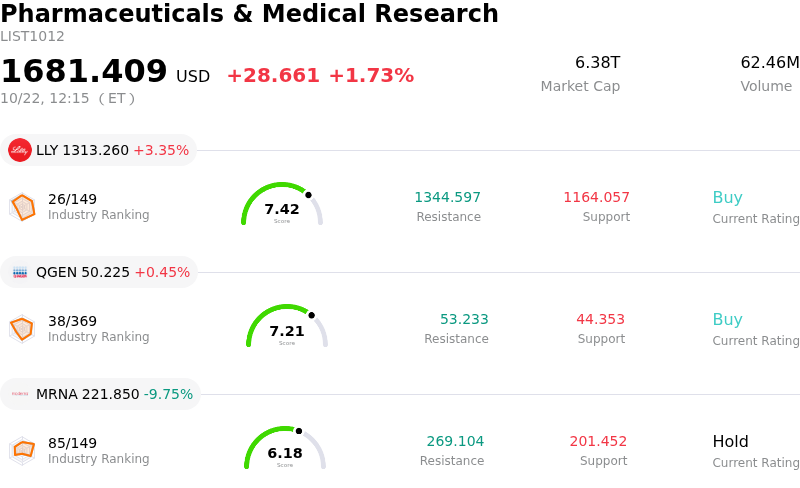
Johnson & Johnson (JNJ) moved up by 3.48%. The Pharmaceuticals & Medical Research sector is up by 1.73%. The company outperformed the industry. Top 3 stocks by turnover in the sector: Eli Lilly and Co (LLY) up 3.35%; Qiagen NV (QGEN) up 0.47%; Moderna Inc (MRNA) down 9.75%.
What is driving Johnson & Johnson (JNJ)’s stock price up today?
Johnson & Johnson advanced sharply as positive clinical trial data from its medical technology portfolio boosted investor optimism surrounding its high-growth electrophysiology franchise. The company presented groundbreaking real-world data from its VARIPURE and Omny-IRE studies at the Asia Pacific Heart Rhythm Society 2026 Annual Meeting. The VARIPURE study demonstrated complete acute procedural success and an exceptionally clean safety profile using the VARIPULSE Pro Platform for atrial fibrillation ablation, while the 12-month Omny-IRE trial confirmed strong long-term arrhythmia freedom. The peer-reviewed findings reinforced the company's technological leadership in cardiovascular care and highlighted expanding commercial potential in MedTech.
The bullish clinical momentum built upon a solid foundation established by the company's third-quarter financial results. Although GAAP net income was impacted by one-time legal settlement charges related to talc litigation and strategic M&A expenses, underlying operational performance proved resilient. Strong demand for key oncology therapies and immunology blockbusters offset headwinds from biosimilar competition. Furthermore, management's decision to raise full-year sales and adjusted earnings guidance, alongside maintaining a robust free cash flow outlook, reassured institutional investors regarding the company's long-term earnings durability and dividend coverage.
Broader market dynamics also provided a favorable tailwind. As major equity benchmarks faced downside pressure driven by volatility in high-valuation sectors, institutional capital rotated into defensive, high-quality healthcare leaders. Johnson & Johnson's stable balance sheet, combined with its 64-year streak of annual dividend increases, made it a primary recipient of safe-haven inflows. Coupled with recent price target upgrades from sell-side equity analysts, this defensive sector rotation fueled significant buying volume and intraday price expansion.
Technical Analysis of Johnson & Johnson (JNJ)
Technically, Johnson & Johnson (JNJ) shows a MACD (12,26,9) value of 1.704, indicating a neutral signal. The RSI at 56.843 suggests neutral condition and the Williams %R at 0.000 suggests overbought condition. Please monitor closely.
Fundamental Analysis of Johnson & Johnson (JNJ)
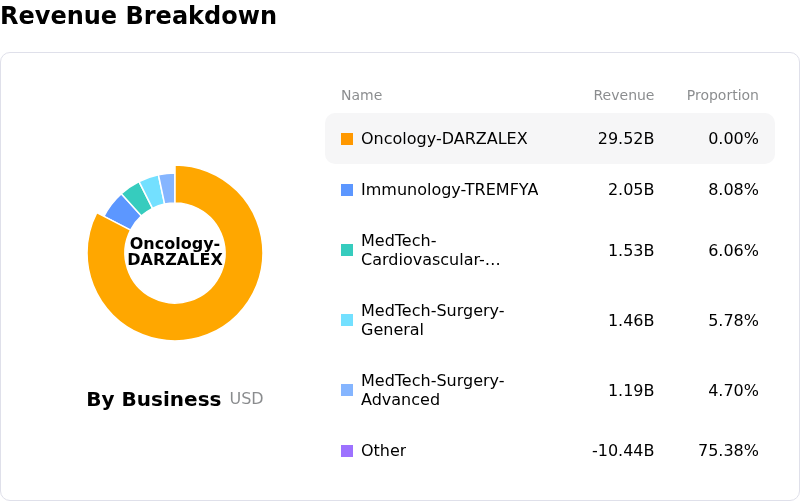
Johnson & Johnson (JNJ) is in the Pharmaceuticals & Medical Research industry. Its latest annual revenue is $94.19B, ranking 3 in the industry. The net profit is $26.80B, ranking 1 in the industry. Company Profile
Over the past month, multiple analysts have rated the company as Buy, with an average price target of $274.76, a high of $320.00, and a low of $170.00.
More details about Johnson & Johnson (JNJ)
Company Specific Risks:
- Litigation Charges & Unresolved Talc Liabilities: In its recent Form 8-K earnings report, Johnson & Johnson recognized a $5.5 billion litigation charge to resolve talc liabilities—contributing to roughly $7 billion in total legal and transaction costs—which caused Q3 GAAP net earnings to fall 95.9% year-over-year to $210 million ($0.09 per share); full resolution remains at risk pending a strict 95% claimant participation threshold.
- MedTech Segment Underperformance & Safety Drag: The MedTech division missed Wall Street sales expectations for a second consecutive quarter with just 2.5% growth to $8.64 billion, impacted by a 2.3% contraction in Abiomed sales following a U.S. Class 1 recall and safety/efficacy concerns surrounding Impella heart pumps, as well as China volume-based procurement pricing pressures.
- Severe Patent Cliff Erosion for Stelara: Revenues for flagship immunology drug Stelara plummeted 54% year-over-year to $716 million as cheap biosimilar competition rapidly eroded market share following its loss of exclusivity, placing heavy reliance on oncology offerings to offset top-line growth drags.
- Valuation Multiples Premium & Near-Term M&A Dilution: Trading at roughly 23x–28x forward earnings—a ~32.5% premium over intrinsic value estimates—JNJ faces valuation compression risk, amplified by an estimated $0.64 per share in near-term EPS dilution from recent transactions including the Firefly Bio acquisition and Sail Biomedicines collaboration.
This article may include AI-generated content that is human-reviewed, which is for reference and general information purposes only and does not constitute investment advice.
Recommended Articles









Comments (0)
Click the $ button, enter the symbol, and select to link a stock, ETF, or other ticker.