


AT&T Inc Stock (T) Moved Down by 6.74% on Oct 9: Key Drivers Unveiled



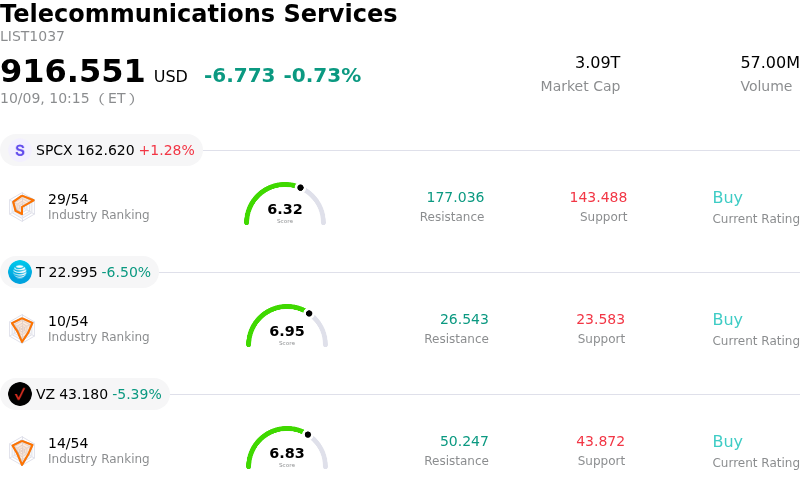
AT&T Inc (T) moved down by 6.74%. The Telecommunications Services sector is down by 0.73%. The company underperformed the industry. Top 3 stocks by turnover in the sector: SpaceX (SPCX) up 1.35%; AT&T Inc (T) down 6.50%; Verizon Communications Inc (VZ) down 5.39%.
What is driving AT&T Inc (T)’s stock price down today?
The primary catalyst behind the downward pressure on AT&T’s stock stems from a major disruptive development in the wireless telecommunications landscape. SpaceX announced a landmark agreement to acquire a nationwide low-band spectrum portfolio, providing Starlink Mobile with the terrestrial airwaves necessary to operate as a full-scale mobile carrier across the United States. This announcement rattled legacy telecom investors, raising concerns about heightened industry competition, prospective pricing power dilution, and long-term subscriber churn. The disruptive headline sparked a broad sector-wide sell-off that impacted major telecommunications operators simultaneously.
Compounding the negative intraday price action was the mechanical impact of AT&T reaching its quarterly ex-dividend date. The scheduled adjustment to account for the upcoming payout naturally reduced the stock’s opening reference price, reinforcing the visual downward move. Additionally, recent Wall Street commentary has reflected growing institutional caution, with analysts trimming price targets due to potential near-term risks involving average revenue per user compression and execution timelines surrounding expanded fiber footprints. Heavy capital outlay requirements for 5G and fiber rollouts continue to limit balance sheet flexibility.
Despite the heightened market anxiety, institutional investors are evaluating whether the immediate competitive threat may be overextended relative to AT&T’s core fundamentals. The company continues to generate consistent free cash flow supported by a stable dividend payout ratio and ongoing expansion in high-speed broadband. However, near-term sentiment remains muted as market participants await management’s upcoming quarterly earnings release to assess subscriber retention strategies and capital allocation priorities.
Technical Analysis of AT&T Inc (T)
Technically, AT&T Inc (T) shows a MACD (12,26,9) value of -0.314, indicating a sell signal. The RSI at 31.560 suggests neutral condition and the Williams %R at 76.009 suggests sell condition. Please monitor closely.
Media Coverage of AT&T Inc (T)
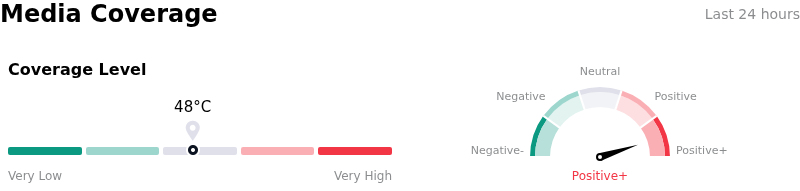
In terms of media coverage, AT&T Inc (T) shows a coverage score of 48, indicating a moderate level of media attention. The overall market sentiment index is currently in extremely bullish zone.
Fundamental Analysis of AT&T Inc (T)
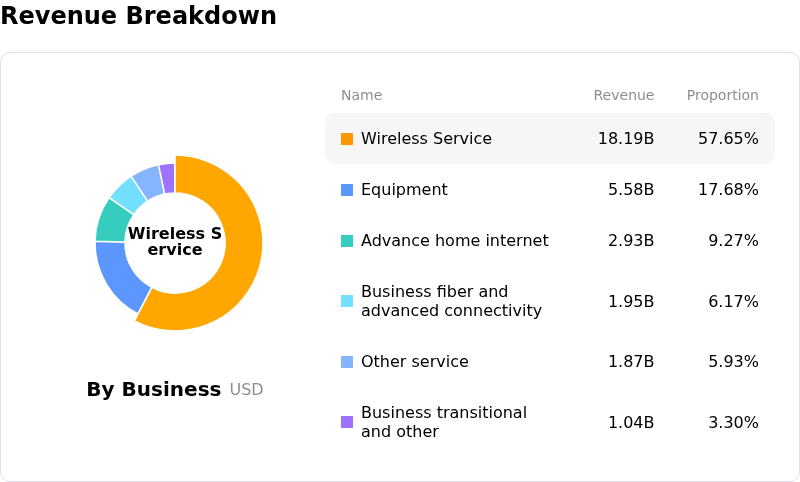
AT&T Inc (T) is in the Telecommunications Services industry. Its latest annual revenue is $125.65B, ranking 2 in the industry. The net profit is $21.89B, ranking 1 in the industry. Company Profile
Over the past month, multiple analysts have rated the company as Buy, with an average price target of $28.52, a high of $36.00, and a low of $20.00.
More details about AT&T Inc (T)
Company Specific Risks:
- Disruptive Satellite Competition: SpaceX's acquisition of Grain Management's 800 MHz low-band spectrum portfolio enables Starlink Mobile to operate as a direct wireless carrier, posing a structural threat to AT&T's core postpaid mobile subscriber base and wireless service revenues.
- High Balance Sheet Leverage & Debt Servicing Pressure: Carrying over $126 billion in net debt, AT&T remains vulnerable to elevated interest rate environments, where ongoing debt note issuances restrict capital flexibility and magnify equity valuation downside.
- Wall Street Target Price Revisions & Ex-Dividend Drag: Institutional analysts have issued price target downgrades following mounting competitive threats and subscriber growth concerns, amplifying intraday selling pressure alongside mechanical ex-dividend price adjustments.
- Broadband Fiber Infrastructure Execution Risk: Skepticism regarding AT&T's ability to achieve its ambitious fiber deployment targets—potentially falling short of its 60 million location goal by 2030—threatens long-term broadband customer acquisition and average revenue per user (ARPU) expansion.
This article may include AI-generated content that is human-reviewed, which is for reference and general information purposes only and does not constitute investment advice.
Recommended Articles








Comments (0)
Click the $ button, enter the symbol, and select to link a stock, ETF, or other ticker.