


Bank of America Corp Stock (BAC) Moved Down by 3.40% on Sep 16: Drivers Behind the Movement



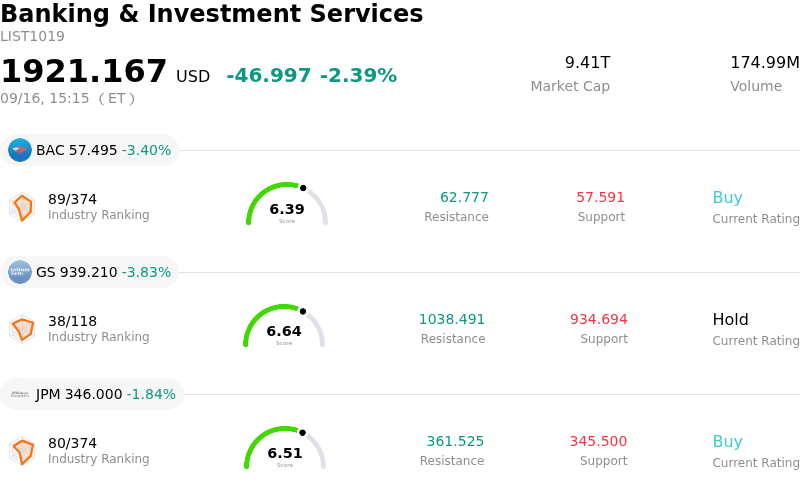
Bank of America Corp (BAC) moved down by 3.40%. The Banking & Investment Services sector is down by 2.39%. The company underperformed the industry. Top 3 stocks by turnover in the sector: Bank of America Corp (BAC) down 3.40%; Goldman Sachs Group Inc (GS) down 3.93%; JPMorgan Chase & Co (JPM) down 1.85%.
What is driving Bank of America Corp (BAC)’s stock price down today?
Bank of America experienced downside pressure and elevated intraday volatility primarily driven by cautious forward guidance regarding capital markets revenue delivered by management at a major financial industry conference. Chief Executive Officer Brian Moynihan signaled a sharper-than-expected slowdown in third-quarter investment banking fees alongside relatively flat sales and trading revenue compared to the prior-year period. This subdued forecast represents a stark deceleration from the robust capital markets performance posted in the preceding quarter, prompting institutional investors to re-evaluate near-term fee income expectations across the franchise.
The lower guidance triggered a broader repricing across money-center bank equities as market participants digested indications of cooling corporate dealmaking pipelines and sluggish fixed-income trading activity across Wall Street. The deceleration in fee-generating segments coincided with ongoing macroeconomic uncertainties regarding Federal Reserve monetary policy and the trajectory of interest rates. As rate expectations shift, concerns over funding costs, net interest margin compression, and potential balance sheet sensitivity have added to defensive positioning among financial sector investors.
Despite the pullback, Bank of America's underlying retail and commercial banking fundamentals remain relatively sound. Management noted that core credit metrics, consumer spending, deposit trends, and net interest income guidance continue to track within projected targets. However, with elevated operational expenses and diminished short-term capital markets visibility, the stock faced heightened selling pressure as market participants recalibrated earnings forecasts to account for softer top-line growth in fee-based divisions.
Technical Analysis of Bank of America Corp (BAC)
Technically, Bank of America Corp (BAC) shows a MACD (12,26,9) value of -1.040, indicating a neutral signal. The RSI at 27.722 suggests sell condition and the Williams %R at 99.531 suggests oversold condition. Please monitor closely.
Media Coverage of Bank of America Corp (BAC)
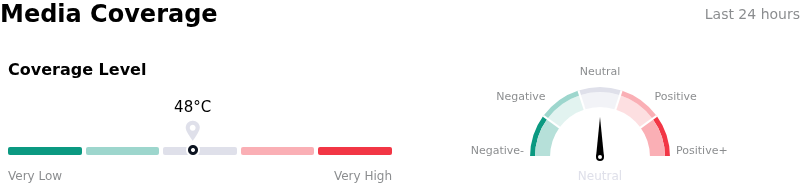
In terms of media coverage, Bank of America Corp (BAC) shows a coverage score of 48, indicating a moderate level of media attention. The overall market sentiment index is currently in neutral zone.
Fundamental Analysis of Bank of America Corp (BAC)
Bank of America Corp (BAC) is in the Banking & Investment Services industry. Its latest annual revenue is $104.06B, ranking 2 in the industry. The net profit is $29.05B, ranking 2 in the industry. Company Profile
Over the past month, multiple analysts have rated the company as Buy, with an average price target of $67.81, a high of $79.00, and a low of $48.00.
More details about Bank of America Corp (BAC)
Company Specific Risks:
- Q3 Investment Banking Fee Guidance Downgrade: CEO Brian Moynihan warned at the Barclays Financial Services Conference that Q3 investment banking fees are projected to fall by up to 20% year-over-year to between $1.6 billion and $1.8 billion, representing a sharp reversal from Q2's 50% growth and missing analyst consensus model estimates.
- Sales and Trading Revenue Stagnation: Management signaled that sales and trading revenue will remain essentially flat year-over-year near $5.4 billion, as unexpected fixed-income trading volatility offsets modest gains in equities trading, halting strong first-half revenue momentum.
- Capital Markets Exposure Disadvantage: Bank of America acknowledged that its current business mix is underrepresented in the most active capital market sub-sectors, exposing the bank to a steeper advisory fee decline than the broader 10% industry average and forcing analysts to revise full-year operating leverage targets downward.
- Elevated Operating Expenses and CRE Credit Overhang: Institutional analysts highlighted that Q3 operating expenses are tracking above street expectations, threatening H2 margin compression when coupled with $70.3 billion in commercial real estate exposure bearing elevated criticized asset ratios.
This article may include AI-generated content that is human-reviewed, which is for reference and general information purposes only and does not constitute investment advice.
Recommended Articles






Comments (0)
Click the $ button, enter the symbol, and select to link a stock, ETF, or other ticker.