


UBS Group AG Stock (UBS) Moved Down by 3.03% on Sep 14: Key Drivers Unveiled



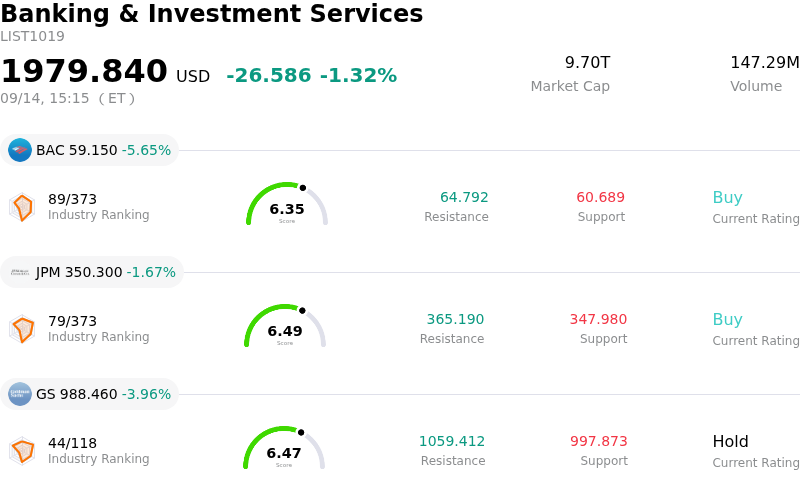
UBS Group AG (UBS) moved down by 3.03%. The Banking & Investment Services sector is down by 1.32%. The company underperformed the industry. Top 3 stocks by turnover in the sector: Bank of America Corp (BAC) down 5.65%; JPMorgan Chase & Co (JPM) down 1.70%; Goldman Sachs Group Inc (GS) down 3.96%.
What is driving UBS Group AG (UBS)’s stock price down today?
UBS is experiencing selling pressure as the Swiss parliament begins its autumn legislative session, bringing regulatory capital reform back to the forefront of investor concerns. Market sentiment is weighed down by uncertainty surrounding incoming capital rules following the Credit Suisse integration. Although a parliamentary committee recently proposed allowing UBS to meet a portion of its foreign subsidiary capital buffer requirements with convertible debt rather than pure equity, intense opposition from Swiss financial regulators and the ministry of finance increases the risk that these concessions could be overturned in upcoming parliamentary votes. The prospect of stricter, full-equity capital mandates threatens to tie up significant capital, potentially constraining future share buybacks and suppressing long-term return-on-equity expectations.
Compounding regulatory uncertainty is ongoing balance sheet restructuring related to the legacy Credit Suisse portfolio. The bank recently expanded its debt tender offers to redeem billions in legacy debt while simultaneously issuing new senior bonds to optimize its funding structure and manage regulatory loss-absorbing capacity. While these proactive liability management moves aim to lower long-term interest expenses and streamline the capital structure, large-scale debt repurchases and new debt issuance create short-term liquidity adjustments and margin considerations, prompting institutional investors to re-evaluate near-term net interest income trajectories.
In addition to company-specific regulatory and balance sheet factors, broader macroeconomic headwinds are weighing on global financial stocks. Evolving interest rate expectations and persistent inflation concerns have sparked renewed market volatility. With central bank policy paths remaining uncertain and global capital markets digesting higher funding costs, European and global banking majors are facing broader sector-wide repricing. For UBS, the combination of macroeconomic rate uncertainty and high-stakes regulatory debate creates an environment of elevated volatility and cautious positioning among institutional traders.
Technical Analysis of UBS Group AG (UBS)
Technically, UBS Group AG (UBS) shows a MACD (12,26,9) value of -0.434, indicating a neutral signal. The RSI at 43.412 suggests neutral condition and the Williams %R at 96.209 suggests oversold condition. Please monitor closely.
Fundamental Analysis of UBS Group AG (UBS)
UBS Group AG (UBS) is in the Banking & Investment Services industry. Its latest annual revenue is $75.76B, ranking 5 in the industry. The net profit is $7.77B, ranking 5 in the industry. Company Profile
Over the past month, multiple analysts have rated the company as Buy, with an average price target of $49.57, a high of $50.93, and a low of $48.20.
More details about UBS Group AG (UBS)
Company Specific Risks:
- Swiss Regulatory Capital Mandates: Proposed Swiss Capital Adequacy Ordinance reforms mandating up to $37 billion in total incremental CET1 capital—including $20 billion to $22 billion for foreign participations—impose an estimated $3 billion in annual capital costs, threatening long-term return on equity targets and capital return capacity.
- Credit Suisse Operational Integration & Execution Risks: The complex multi-year consolidation of legacy Credit Suisse IT infrastructure, legal entities, and client accounts through 2026 carries significant execution risks, potential cost overruns, and persistent legal liabilities stemming from AT1 bond wipeout lawsuits.
- Compliance and Regulatory Enforcement Overhang: Multi-million dollar fines imposed by regulators like FinCEN and FINRA over anti-money laundering and transaction monitoring deficiencies highlight legacy governance vulnerabilities, raising the risk of stricter supervisory oversight and higher compliance costs.
- Macroeconomic Volatility and Rate Sensitivity: Shifting central bank interest rate trajectories and elevated global yield volatility threaten to depress investment banking deal flow, equity underwriting revenues, and asset management net fee income across core wealth divisions.
This article may include AI-generated content that is human-reviewed, which is for reference and general information purposes only and does not constitute investment advice.
Recommended Articles







Comments (0)
Click the $ button, enter the symbol, and select to link a stock, ETF, or other ticker.