


EUR/USD (EURUSD) Is down 0.50% on Aug 28: What Is Driving the Move?



EUR/USD (EURUSD) is down 0.50% at Aug 28 12:10(ET), now at $1.15925, with a 7-day down of 0.72%.
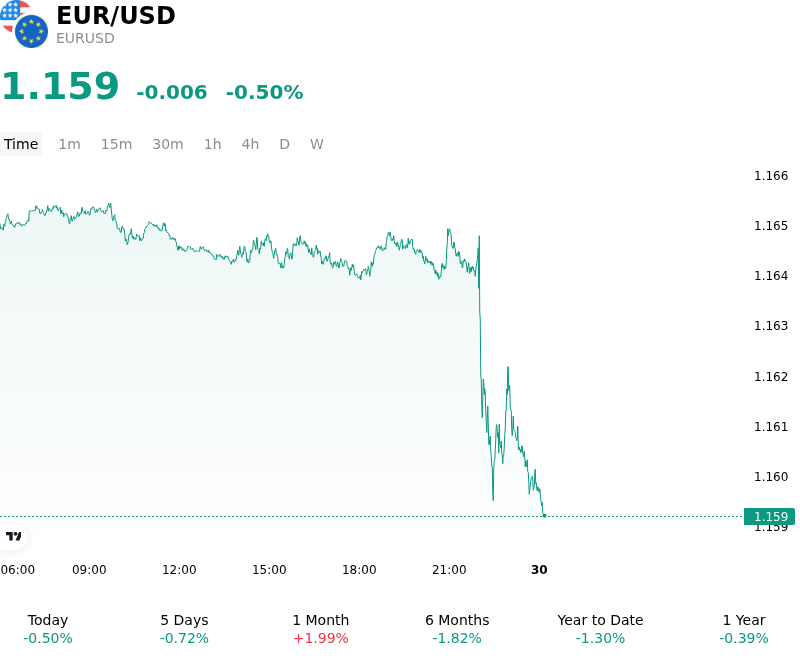
What is driving EUR/USD (EURUSD)’s stock price down today?
The euro's downside movement against the U.S. dollar was primarily driven by a hawkish tone from Federal Reserve Chair Kevin Warsh during his keynote address at the Jackson Hole economic symposium. Warsh underscored the central bank's firm commitment to bringing inflation down to its fixed two percent target, citing persistent price pressures across personal consumption expenditures measures. By declining to offer explicit forward guidance on monetary easing and emphasizing that monetary policy must remain disciplined until price stability is clearly restored, the Federal Reserve pushed back against premature market pricing for aggressive interest rate cuts. This hawkish rhetoric triggered a upward repricing of U.S. interest rate expectations and prompted a push higher in U.S. Treasury yields, providing broad support to the U.S. dollar.
The U.S. dollar's strength was further reinforced by macroeconomic data confirming that underlying U.S. inflation remains sticky, with personal consumption expenditures figures running well above target levels. Higher short-term U.S. bond yields widened interest rate differentials in favor of the greenback, absorbing institutional capital flows. On the European side, the euro struggled to maintain upside momentum despite hawkish messaging from European Central Bank officials reiterating the need for tighter policy to combat supply-side inflation risks. While market pricing had heavily discounted an ECB rate increase at its upcoming policy meeting, European growth concerns and stagnant economic readings in key member states limited the euro's capacity to absorb the U.S. dollar's policy-driven momentum.
Institutional rebalancing ahead of the month-end fixing added further bid tone to the U.S. dollar, while broader risk sentiment adopted a cautious posture. The shift toward a higher-for-longer U.S. interest rate environment muted risk appetite across major asset classes, prompting institutional market participants to pare back long euro positions. Looking ahead, the short-term trajectory for the currency pair will depend heavily on whether incoming U.S. labor market and activity indicators validate the Federal Reserve's restrictive stance or whether persistent Eurozone inflation obliges the European Central Bank to deliver a more aggressive tightening path.
Technical Analysis of EUR/USD (EURUSD)
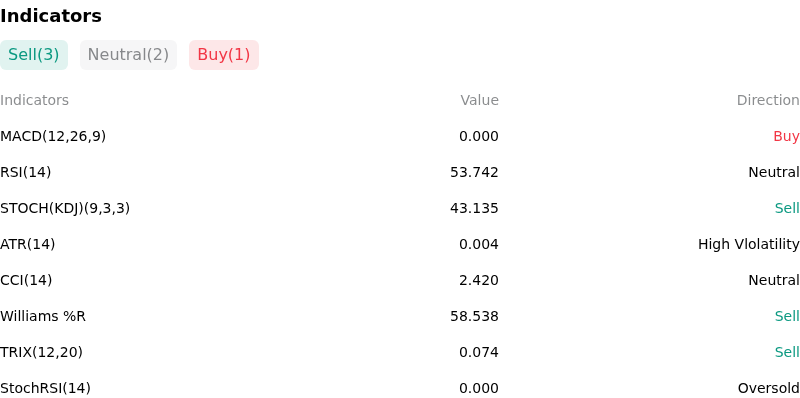
Technically, EUR/USD (EURUSD) shows a MACD (12,26,9) value of 0.000, indicating a buy signal. The RSI at 53.742 suggests neutral condition and the Williams %R at 58.538 suggests sell condition. Please monitor closely.
More details about EUR/USD (EURUSD)
Recent Events and Risks:
- Hawkish Fed Policy Tone: Federal Reserve Chair Kevin Warsh reaffirmed a firm stance on upholding the 2% inflation target alongside US PCE inflation printing above expectations at 3.7%, sparking US dollar buying and putting downside pressure on the euro.
- Eurozone Energy Shock and Stagflation Threats: Persistently high natural gas and crude oil prices stemming from Middle East geopolitical tensions threaten to trigger second-round inflation in the Eurozone while eroding consumer sentiment and growth prospects.
- European Political and Fiscal Vulnerabilities: Resurgent political frictions and budget concerns in key member states, particularly France, alongside sovereign yield spread volatility, continue to weigh on investor sentiment toward the single currency.
- Widening Yield Spreads and Rate Divergence: Market expectations that sticky US inflation could keep Fed rates higher for longer—contrasting with limited terminal rate upside for the European Central Bank—risk accelerating capital flows into US dollar assets at the euro's expense.
This article may include AI-generated content that is human-reviewed, which is for reference and general information purposes only and does not constitute investment advice.
Recommended Articles









Comments (0)
Click the $ button, enter the symbol, and select to link a stock, ETF, or other ticker.