


USD/CHF (USDCHF) Volatility Intensified on Aug 28: Factors to Watch



USD/CHF (USDCHF) is up 0.51% at Aug 28 11:20(ET), now at $0.80811, with a 7-day up of 0.91%.
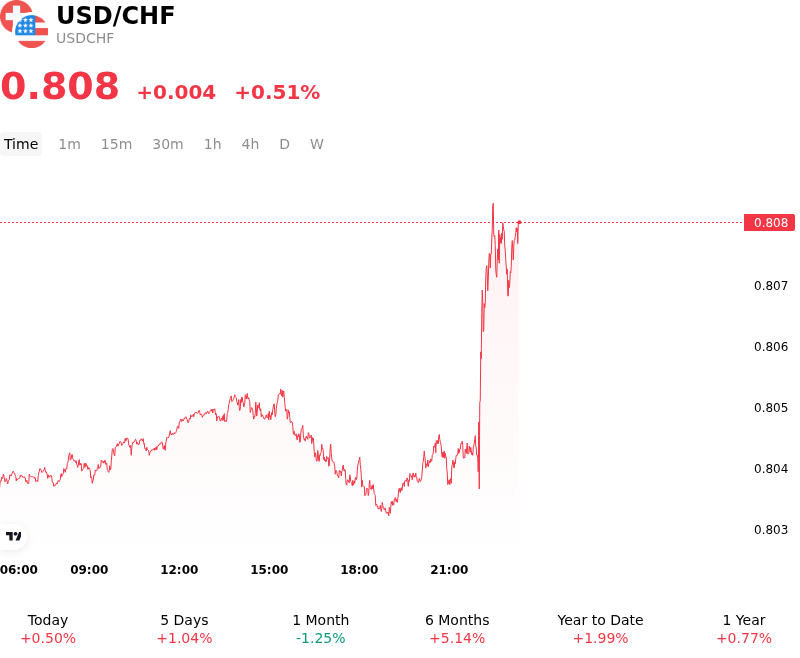
What is driving USD/CHF (USDCHF)’s stock price up today?
The advance in USDCHF was primarily driven by a sharp hawkish recalibration of Federal Reserve monetary policy expectations following the Jackson Hole economic symposium. Remarks from Federal Reserve Chair Kevin Warsh emphasized a firm commitment to restoring price stability, establishing the target as measured by personal consumption expenditures as a strict objective. By dismissing dovish forward guidance and signaling that policy interest rates could remain elevated for longer to curb persistent inflationary pressures, the Federal Reserve triggered an upward repricing in U.S. short-term rate expectations. This hawkish stance widened policy rate differentials between the United States and Switzerland, lifting U.S. Treasury yields and providing a strong upside impulse to the U.S. dollar relative to the Swiss franc.
Underpinning this move was recent U.S. macroeconomic data, which highlighted persistent underlying price momentum in core personal consumption expenditures. Sticky inflation figures reinforced the narrative that U.S. disinflation has slowed, forcing institutional investors to adjust expectations for monetary easing. Conversely, the Swiss franc faced headwinds due to the Swiss National Bank maintaining a significantly lower benchmark interest rate trajectory. With Swiss inflation remaining subdued and domestic monetary policy staying accommodative relative to the Fed, the substantial yield spread favoring the greenback encouraged carry-oriented capital flows out of the franc and into U.S. dollar-denominated assets.
A broader stabilization in global market risk sentiment further reduced demand for the Swiss franc. Improved investor risk appetite, supported by solid corporate earnings in technology sectors and reduced acute demand for safe-haven assets, dampened support for traditional haven currencies. The currency pair gained additional traction after finding dynamic support near key technical moving average levels, which triggered technical buying and momentum-driven covering of short dollar positions. Looking ahead, investors continue to monitor U.S. labor market conditions, upcoming Federal Reserve communications, and global economic sentiment for signs of medium-term directional clarity.
Technical Analysis of USD/CHF (USDCHF)
Technically, USD/CHF (USDCHF) shows a MACD (12,26,9) value of -0.001, indicating a sell signal. The RSI at 51.619 suggests neutral condition and the Williams %R at 34.633 suggests buy condition. Please monitor closely.
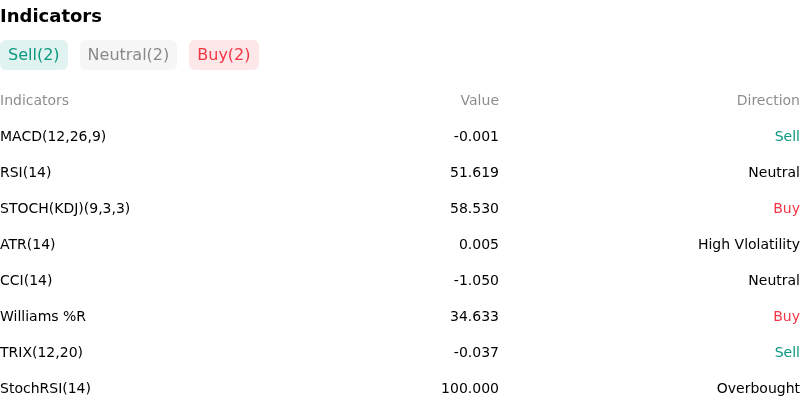
More details about USD/CHF (USDCHF)
Recent Events and Risks:
- US Treasury Bond Buyback Operations Capping Yields: The US Treasury Department's expanded long-dated debt buybacks of at least $4 billion per operation have suppressed long-end US bond yields, stripping the US dollar of yield support and imposing persistent downside volatility on the USD/CHF spot rate.
- Jackson Hole Federal Reserve Event Risk: Imminent policy commentary from Federal Reserve leadership at the Jackson Hole Symposium exposes the US dollar to sharp downside liquidations if monetary policy guidance leans dovish or fails to validate market rate expectations.
- Geopolitical Friction and Safe-Haven Franc Inflows: Ongoing regional volatility and security concerns in the Middle East and Persian Gulf continue to spur flight-to-safety flows into the Swiss franc as a premier safe haven, creating direct downside risk for USD/CHF during risk-off market episodes.
- Yield Differential Compression and Carry Trade Unwinds: Market anxieties surrounding US fiscal sustainability and sovereign debt issuance risk narrowing the US yield advantage over Swiss bonds, leaving USD/CHF vulnerable to sudden carry trade positioning unwinds.
This article may include AI-generated content that is human-reviewed, which is for reference and general information purposes only and does not constitute investment advice.
Recommended Articles








Comments (0)
Click the $ button, enter the symbol, and select to link a stock, ETF, or other ticker.