


Bank of Nova Scotia Stock (BNS) Opened Up by 3.45% on Aug 25: A Full Analysis



Bank of Nova Scotia (BNS) opened up by 3.45%. The Banking & Investment Services sector is down by 0.21%. The company outperformed the industry. Top 3 stocks by turnover in the sector: Bank of America Corp (BAC) down 0.26%; Goldman Sachs Group Inc (GS) up 0.89%; JPMorgan Chase & Co (JPM) down 0.59%.
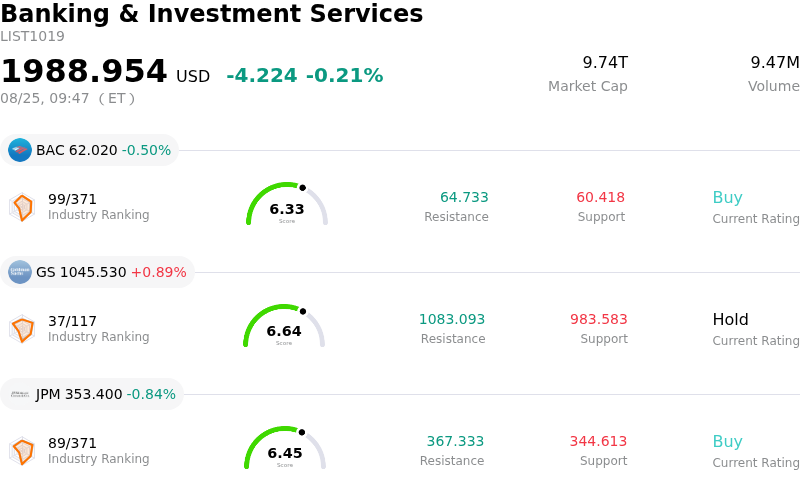
What is driving Bank of Nova Scotia (BNS)’s stock price up today?
The Bank of Nova Scotia experienced positive trading momentum driven primarily by stronger-than-expected fiscal third-quarter earnings results. Adjusted earnings per share and top-line revenue both significantly surpassed consensus expectations, anchored by a solid double-digit year-over-year increase in total revenue. Operational performance was bolstered across all major operating segments, with Global Banking and Markets delivering record quarterly earnings on robust capital markets activity, underwriting, and advisory fees. Additionally, the domestic Canadian Banking division delivered its fifth consecutive quarter of net interest margin expansion, while Global Wealth Management benefited from higher fee income and broad growth in assets under management.
Beyond headline financial metrics, investor enthusiasm was strengthened by Scotiabank reaching key profitability benchmarks earlier than anticipated. The bank reported an adjusted return on equity that successfully surpassed its medium-term target, reflecting disciplined expense management and strong operating leverage across core business lines. Balance sheet capital ratios remained solid, enabling the institution to maintain its quarterly common share dividend while continuing its capital return strategy through share buybacks. These operational developments reinforced institutional confidence in management's strategic execution.
Despite the overall upward trajectory, significant intraday volatility underscored investor deliberation surrounding underlying credit trends. Provisions for credit losses remained elevated due to persistent macroeconomic uncertainties impacting retail and commercial portfolios. Although credit provisions moderated relative to the preceding quarter, market participants actively balanced the bank's record revenue generation against potential credit degradation risks. Nevertheless, broad-based segment outperformance and resilient net interest income ultimately sustained investor buying interest.
Technical Analysis of Bank of Nova Scotia (BNS)
Technically, Bank of Nova Scotia (BNS) shows a MACD (12,26,9) value of -0.575, indicating a neutral signal. The RSI at 55.952 suggests neutral condition and the Williams %R at 36.491 suggests buy condition. Please monitor closely.
Fundamental Analysis of Bank of Nova Scotia (BNS)
Bank of Nova Scotia (BNS) is in the Banking & Investment Services industry. Its latest annual revenue is $26.44B, ranking 18 in the industry. The net profit is $5.20B, ranking 25 in the industry. Company Profile
Over the past month, multiple analysts have rated the company as Buy, with an average price target of $97.23, a high of $99.46, and a low of $95.00.
More details about Bank of Nova Scotia (BNS)
Company Specific Risks:
- Escalating Credit Losses and Impairments: Scotiabank's Q3 2026 earnings report revealed provisions for credit losses (PCL) rising to C$1.08 billion, alongside a quarter-over-quarter increase in gross impaired loans to C$7.80 billion driven by rising consumer and corporate default formations in Canadian and international retail portfolios.
- Core Capital Ratio Compression: The bank's Common Equity Tier 1 (CET1) capital ratio declined 20 basis points quarter-over-quarter to 13.1%, driven by risk-weighted asset expansion, aggressive share repurchases, and a recalled synthetic risk-transfer securitization, narrowing its regulatory capital cushion.
- Non-Interest Expense Overshoot: Non-interest expenses surged to C$5.56 billion in the quarter, significantly exceeding institutional analyst consensus expectations of C$5.30 billion and reflecting persistent operational overhead and technology expenditure pressures.
- Domestic Retail and Commercial Credit Vulnerability: Net impaired loans in the Canadian Banking division climbed C$90 million quarter-over-quarter to C$1.95 billion, exposing the bank to downside risk as lingering high rates strain consumer mortgage renewals and rising US-Canada trade friction creates headwinds for domestic corporate borrowers.
This article may include AI-generated content that is human-reviewed, which is for reference and general information purposes only and does not constitute investment advice.
Recommended Articles









Comments (0)
Click the $ button, enter the symbol, and select to link a stock, ETF, or other ticker.