


USD/CHF (USDCHF) Is down 0.59% on Aug 7: What Signals Does the Macro Data Send?



USD/CHF (USDCHF) is down 0.59% at Aug 7 08:40(ET), now at $0.8067, with a 7-day down of 0.01%.
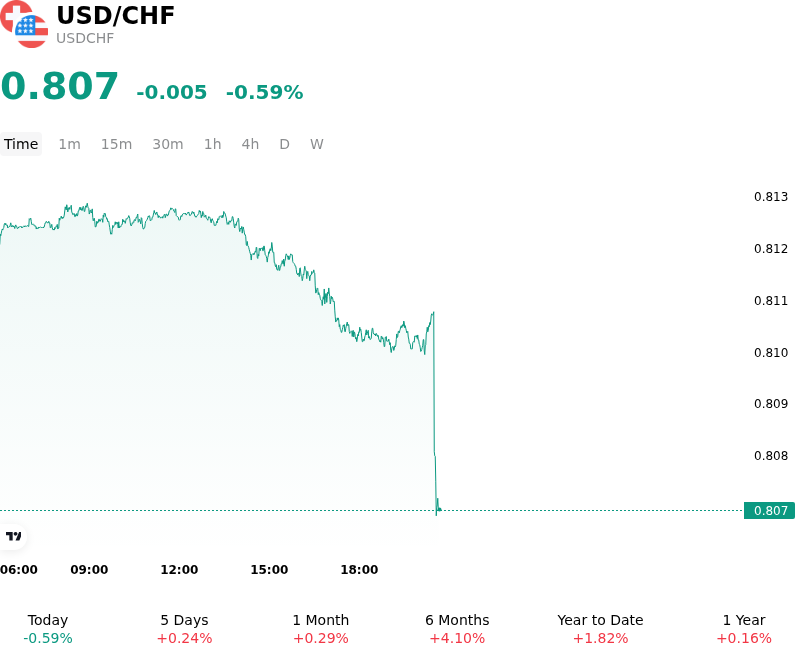
What is driving USD/CHF (USDCHF)’s stock price down today?
The downward pressure on USDCHF is primarily driven by a significant repricing of Federal Reserve policy expectations following weaker-than-anticipated U.S. labor market data. The release of the July employment report, showing a cooling in non-farm payroll growth and a tick higher in the unemployment rate, has led institutional investors to pull forward expectations for more aggressive interest rate cuts in the coming months. This shift in the macro outlook has triggered a sharp contraction in U.S. Treasury yields across the curve, significantly reducing the yield advantage that the U.S. dollar previously held over the low-yielding Swiss franc.
The Swiss franc is benefiting substantially from its status as a premier safe-haven asset as market participants react to mounting concerns over a potential slowdown in the U.S. economy. The combination of disappointing economic activity data and a shift toward a risk-averse sentiment has spurred capital flows into the franc, which traditionally outperforms during periods of global macro uncertainty and heightened recession risks. While the Swiss National Bank has previously indicated a preference for a stable exchange rate to protect the export-driven economy, the current move is largely a result of broad-based dollar weakness and the erosion of the dollar’s interest-rate cushion.
Furthermore, the narrowing interest-rate differential between the Federal Reserve and the Swiss National Bank is undermining the fundamental support for the dollar. As the Fed is perceived to be entering a more accommodative phase of its cycle to support the labor market, the carry-trade appeal of the dollar diminishes, particularly against currencies like the franc where the central bank has already largely normalized its policy stance. The pace of the decline suggests that systematic and discretionary traders are unwinding long-dollar positions as key technical support levels are breached, accelerating the intraday momentum of the pair.
Global macro investors are also closely monitoring the impact of lower U.S. yields on global capital flows. The depreciation of USDCHF reflects a broader trend of investors rotating out of growth-sensitive assets toward defensive currencies. Unless upcoming U.S. economic data or Fed commentary provides a reason for the market to moderate its expectations for rate cuts, the path of least resistance for the pair remains skewed to the downside, supported by the divergence in near-term growth expectations and the resurgence of the franc’s appeal as a hedge against volatility.
Technical Analysis of USD/CHF (USDCHF)
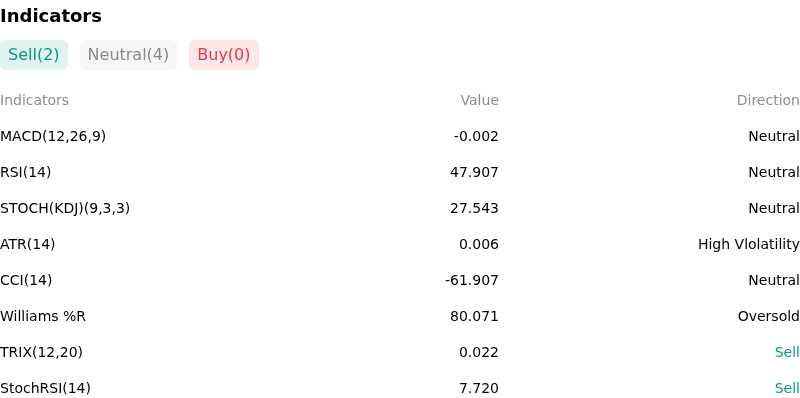
Technically, USD/CHF (USDCHF) shows a MACD (12,26,9) value of -0.002, indicating a neutral signal. The RSI at 48.982 suggests neutral condition and the Williams %R at 74.764 suggests sell condition. Please monitor closely.
More details about USD/CHF (USDCHF)
Recent Events and Risks:
- U.S. Disinflationary Momentum: Softer-than-anticipated Consumer Price Index (CPI) and Producer Price Index (PPI) readings over the last 72 hours have heightened expectations for a Federal Reserve rate cut, significantly weakening the USD’s yield advantage against the Swiss Franc.
- Safe-Haven Capital Rotation: Escalating geopolitical tensions in the Middle East and volatility in global equity markets have re-established the Swiss Franc’s appeal as a defensive asset, leading to aggressive capital inflows that pressure the USDCHF pair lower.
- SNB Policy Reassessment: Recent remarks from Swiss National Bank (SNB) officials indicating a reduced tolerance for Franc weakness to prevent imported inflation have led institutional desks to hedge against a hawkish shift in the SNB’s upcoming policy stance.
- Yield Spread Compression: A sharp retreat in the 10-year US Treasury yield, driven by signs of a cooling labor market, is narrowing the spread between U.S. and Swiss government bonds, undermining the attractiveness of the USDCHF carry trade and triggering stop-loss liquidations.
This article may include AI-generated content that is human-reviewed, which is for reference and general information purposes only and does not constitute investment advice.
Recommended Articles







Comments (0)
Click the $ button, enter the symbol, and select to link a stock, ETF, or other ticker.