


Solana (SOLUSD) Is down 1.09% on Aug 3: Key Drivers to Watch



Solana (SOLUSD) is down 1.09% at Aug 3 00:10(ET), now at $71.9, with a 7-day down of 4.11%.
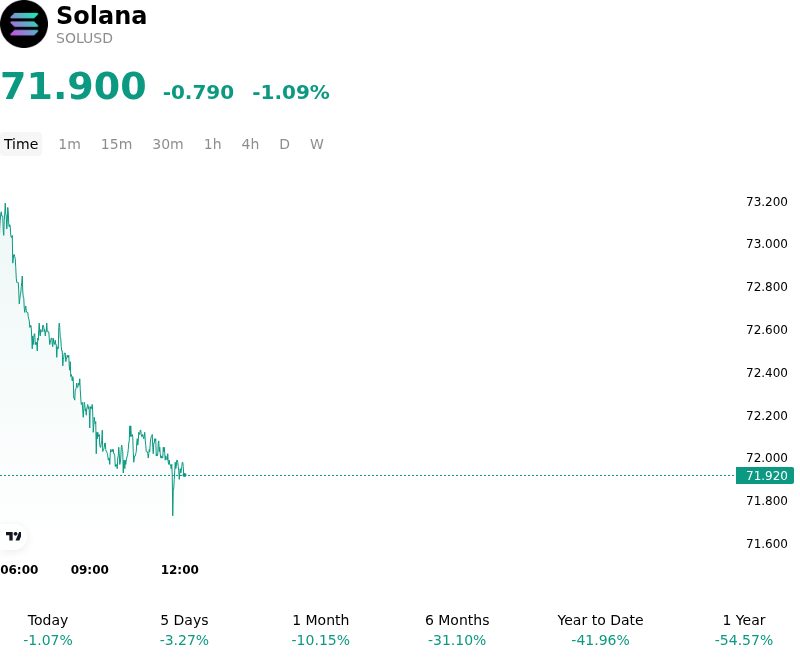
What is driving Solana (SOLUSD)’s stock price down today?
The retracement in SOLUSD reflects a broader rotation out of high-velocity Layer-1 assets as market participants react to shifting Treasury yields and a temporary stabilization in the U.S. Dollar Index. With global macro liquidity remaining sensitive to central bank signaling regarding the late-cycle stage of current monetary policy, Solana’s high-beta profile has led to a tactical de-risking phase among institutional desks. This movement appears more characteristic of a liquidity-driven consolidation following recent expansion rather than a fundamental shift in the network's growth trajectory.
A primary contributor to the intraday pressure stems from a deceleration in spot SOL ETF net inflows, which had previously provided a consistent bid for the asset. As institutional investors rebalance portfolios at the start of the month, the absence of aggressive spot buying has allowed technical sellers to dictate price action. Furthermore, the derivatives market has seen a modest reset in open interest, with a cluster of long liquidations triggered as the asset tested local support levels. This suggests that speculative positioning had become slightly overextended in the preceding sessions, necessitating a flush of levered participants to stabilize the market structure.
From an on-chain perspective, while Solana continues to maintain high levels of capital efficiency and active address counts, a marginal cooling in decentralized exchange volumes and fee generation suggests a temporary lull in the high-frequency trading activity that often drives outperformance. This shift, coupled with a broader risk-off sentiment across the digital asset landscape, has prompted investors to favor capital preservation over aggressive exposure to smart contract platforms. The current price action highlights a transition toward a more mature market phase where SOL is increasingly correlated with broader tech-heavy equity indices and institutional risk benchmarks.
Looking forward, market participants remain focused on the potential for increased institutional staking participation and the further expansion of decentralized physical infrastructure networks. The current decline highlights the asset's sensitivity to broader risk appetite and the ongoing maturation of its investor base. While macro liquidity conditions remain the primary driver of short-term volatility, the structural demand from corporate treasury adoption and ecosystem utility continues to provide a foundational floor for the asset despite temporary fluctuations in market sentiment.
Technical Analysis of Solana (SOLUSD)
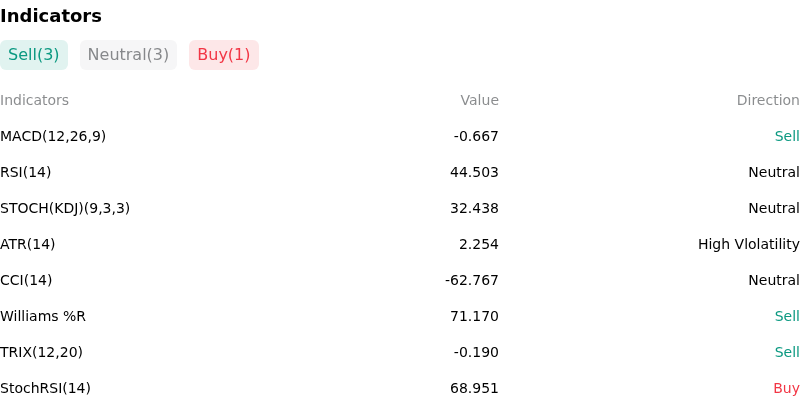
Technically, Solana (SOLUSD) shows a MACD (12,26,9) value of -0.667, indicating a sell signal. The RSI at 44.503 suggests neutral condition and the Williams %R at 71.170 suggests sell condition. Please monitor closely.
More details about Solana (SOLUSD)
Recent Events and Risks:
- Regulatory and ETF Approval Uncertainty: Despite recent spot ETF filings by major asset managers, the SEC’s long-standing classification of SOL as a security in ongoing litigation against exchanges remains a primary hurdle, creating significant downside risk if filings are formally delayed or rejected.
- Speculative Activity Deleveraging: Solana's recent volume is heavily concentrated in high-risk memecoin trading; a sharp decline in retail participation or a shift in sentiment within this speculative sector could trigger a rapid unwind of SOL positions used for transaction fees and liquidity pair collateral.
- Network Performance and Fee Volatility: Recurrent spikes in network congestion and priority fees during high-traffic periods threaten to degrade user experience and operational efficiency, potentially driving users to competing Layer-1 solutions and impacting the token’s utility-driven valuation.
- Institutional Liquidation Risk: The presence of large, dormant whale clusters and ongoing concerns regarding the liquidation of remaining assets from distressed estates continues to present a "sell-side" overhang that can amplify price volatility during periods of low market depth.
This article may include AI-generated content that is human-reviewed, which is for reference and general information purposes only and does not constitute investment advice.
Recommended Articles








Comments (0)
Click the $ button, enter the symbol, and select to link a stock, ETF, or other ticker.