


BHP Group Ltd Stock (BHP) Closed Up by 3.24% on Jul 30: What Investors Need To Know



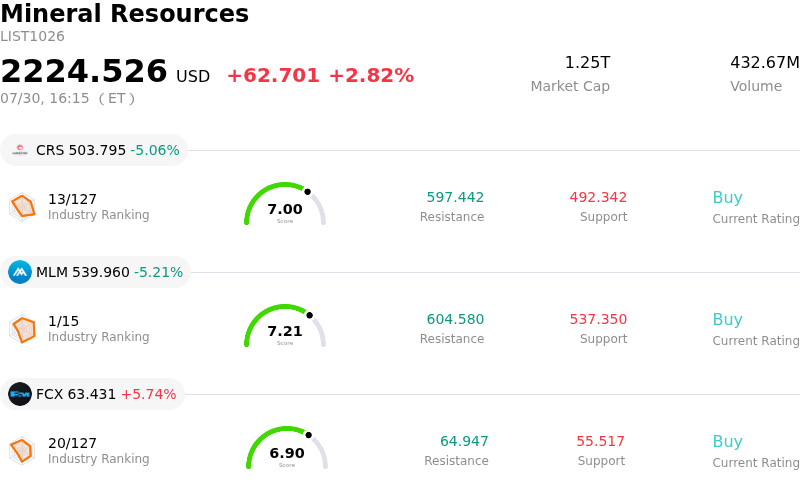
BHP Group Ltd (BHP) closed up by 3.24%. The Mineral Resources sector is up by 2.82%. The company outperformed the industry. Top 3 stocks by turnover in the sector: Carpenter Technology Corp (CRS) down 5.06%; Martin Marietta Materials Inc (MLM) down 5.21%; Freeport-McMoRan Inc (FCX) up 5.74%.
What is driving BHP Group Ltd (BHP)’s stock price up today?
The upward momentum in BHP today is primarily driven by a resurgence in iron ore and copper prices. Global markets are reacting to updated economic stimulus measures from major industrial consumers, which have revived demand expectations for steel-making raw materials. As a low-cost producer with significant scale, BHP is highly sensitive to these commodity price shifts, leading to increased institutional buying as industrial activity forecasts improve across major global manufacturing hubs.
Beyond iron ore, the company's strategic positioning in the copper market continues to attract significant institutional interest. Growing demand for electrification and renewable energy infrastructure has tightened the global copper supply-demand balance. BHP’s recent operational updates, indicating steady output from its Tier 1 assets and improved recovery rates, have bolstered investor confidence in its ability to capture higher margins during this critical phase of the global energy transition.
Institutional sentiment is further supported by the company's disciplined capital allocation strategy and robust balance sheet. Market participants are responding positively to expectations of healthy free cash flow generation, which suggests the potential for sustained returns to shareholders through dividends and strategic reinvestment. The lack of negative surprises in recent operational disclosures has allowed the market to focus on the company's fundamental strength and its competitive advantage in the diversified mining sector.
The significant intraday volatility observed reflects broader market sensitivity to fluctuating currency values and shifting macroeconomic policy expectations. While BHP remains a primary beneficiary of commodity-linked growth, investors are keeping a close watch on potential geopolitical risks and changes in mining regulations. Nevertheless, the current buying pressure suggests a tactical rotation by portfolio managers back into high-quality cyclical stocks as global growth projections show signs of stabilization.
Technical Analysis of BHP Group Ltd (BHP)
Technically, BHP Group Ltd (BHP) shows a MACD (12,26,9) value of 0.594, indicating a neutral signal. The RSI at 49.555 suggests neutral condition and the Williams %R at 44.231 suggests buy condition. Please monitor closely.
Fundamental Analysis of BHP Group Ltd (BHP)
BHP Group Ltd (BHP) is in the Mineral Resources industry. Its latest annual revenue is $51.26B, ranking 3 in the industry. The net profit is $9.02B, ranking 2 in the industry. Company Profile
Over the past month, multiple analysts have rated the company as Hold, with an average price target of $74.75, a high of $91.00, and a low of $56.50.
More details about BHP Group Ltd (BHP)
Company Specific Risks:
- Iron Ore Pricing Sensitivity: Recent data indicating a slowdown in Chinese infrastructure spending and weak steel mill margins has led to a sharp retreat in iron ore prices, directly impacting BHP’s highest-margin segment and triggering analyst downgrades on near-term cash flow projections.
- Chilean Labor Disputes: Intraday volatility is exacerbated by reports of stalled collective bargaining at the Escondida mine, where the threat of a union-led strike poses a direct risk to global copper supply and BHP's ability to meet its quarterly production guidance.
- Samarco Litigation Overhang: Market sentiment remains weighed down by recent developments in the UK High Court regarding the 2015 Samarco dam collapse, as the potential for increased settlement provisions and extended legal timelines threatens significant cash outflows.
- Operational Margin Compression: The company’s latest operational review highlighted persistent inflationary pressures in the Australian labor market and rising energy inputs in the Pilbara region, leading to higher-than-expected unit cost guidance and reduced free cash flow transparency.
This article may include AI-generated content that is human-reviewed, which is for reference and general information purposes only and does not constitute investment advice.
Recommended Articles









Comments (0)
Click the $ button, enter the symbol, and select to link a stock, ETF, or other ticker.