


Morgan Stanley Stock (MS) Moved Up by 3.49% on Jul 30: What Signal Does It Send?



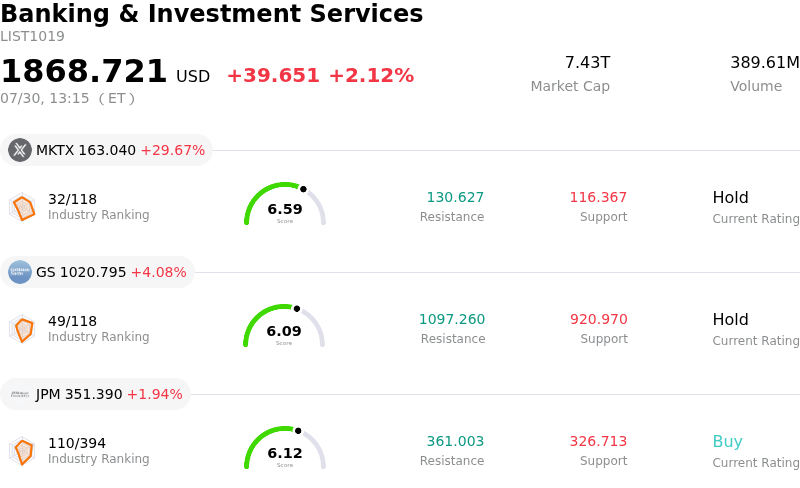
Morgan Stanley (MS) moved up by 3.49%. The Banking & Investment Services sector is up by 2.12%. The company outperformed the industry. Top 3 stocks by turnover in the sector: Marketaxess Holdings Inc (MKTX) up 29.48%; Goldman Sachs Group Inc (GS) up 4.08%; JPMorgan Chase & Co (JPM) up 1.94%.
What is driving Morgan Stanley (MS)’s stock price up today?
The upward momentum in Morgan Stanley shares is largely driven by a broader shift in macroeconomic sentiment following the Federal Reserve's latest policy communications. As the central bank signals a stabilization in interest rates and a clear path toward a soft landing, the financial sector has seen a significant influx of institutional capital. Morgan Stanley, with its high sensitivity to capital market activity, is a primary beneficiary of this renewed risk appetite.
Market participants are reacting positively to signs of a robust recovery in the global deal-making environment. Recent industry data indicates a surge in the initial public offering pipeline and a resurgence in cross-border mergers and acquisitions. For a firm like Morgan Stanley, which maintains a dominant position in advisory services and equities underwriting, the prospect of a normalized fee environment suggests a meaningful expansion in non-interest income for the remainder of the fiscal year.
A series of upward revisions to earnings estimates from major sell-side research houses has further catalyzed the stock. Analysts are increasingly optimistic about the firm's wealth management division, citing resilient net interest margins and strong client asset inflows despite recent market fluctuations. The combination of stabilized asset management fees and a recovering investment banking segment has led to a re-rating of the stock's forward valuation multiples by institutional investors.
Finally, the intraday volatility reflects a clearing of short positions as the stock breached key technical resistance levels during the session. Institutional portfolio adjustments, potentially linked to month-end rebalancing, have exacerbated the upward move. While geopolitical risks and potential currency headwinds remain relevant, the current fundamental backdrop suggests that the firm is well-positioned to leverage its diversified business model in a stabilizing interest rate environment.
Technical Analysis of Morgan Stanley (MS)
Technically, Morgan Stanley (MS) shows a MACD (12,26,9) value of -3.864, indicating a neutral signal. The RSI at 36.960 suggests neutral condition and the Williams %R at 99.352 suggests oversold condition. Please monitor closely.
Media Coverage of Morgan Stanley (MS)
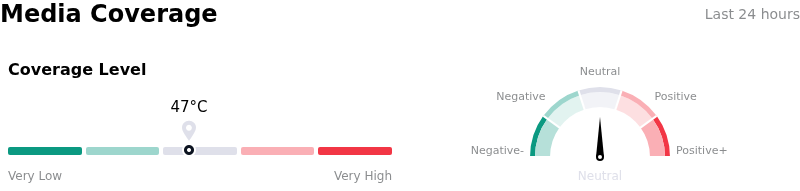
In terms of media coverage, Morgan Stanley (MS) shows a coverage score of 47, indicating a moderate level of media attention. The overall market sentiment index is currently in neutral zone.
Fundamental Analysis of Morgan Stanley (MS)
Morgan Stanley (MS) is in the Banking & Investment Services industry. Its latest annual revenue is $114.74B, ranking 3 in the industry. The net profit is $16.25B, ranking 2 in the industry. Company Profile
Over the past month, multiple analysts have rated the company as Buy, with an average price target of $235.79, a high of $262.00, and a low of $145.00.
More details about Morgan Stanley (MS)
Company Specific Risks:
- Regulatory Anti-Money Laundering Probe: Intensifying scrutiny from the SEC and Federal Reserve regarding the firm’s Wealth Management client-vetting processes and anti-money laundering (AML) controls poses significant legal liability and the risk of restrictive monitorships.
- Net Interest Income Erosion: Persistent "cash sorting" behavior, where wealth management clients shift idle funds from low-yield sweep accounts into higher-yielding money market alternatives, continues to compress net interest margins and undermine the firm's most stable revenue source.
- Institutional Securities Revenue Concentration: Dependence on volatile trading volumes and a sluggish, uneven recovery in global M&A advisory fees leaves the firm highly sensitive to sudden market liquidity shifts and a prolonged high-interest-rate environment.
- Capital Adequacy Pressures: Ongoing debates regarding Basel III Endgame implementation and potential increases to the Stress Capital Buffer (SCB) threaten to limit the firm’s excess capital, potentially forcing a reduction in planned share repurchases and dividend growth.
This article may include AI-generated content that is human-reviewed, which is for reference and general information purposes only and does not constitute investment advice.
Recommended Articles










Comments (0)
Click the $ button, enter the symbol, and select to link a stock, ETF, or other ticker.