


WTI Futures (USOIL-F) Is down 2.10% on Jul 24: What Is Driving the Move?



WTI Futures (USOIL-F) is down 2.10% at Jul 24 03:20(ET), now at $90.36, with a 7-day up of 10.57%.
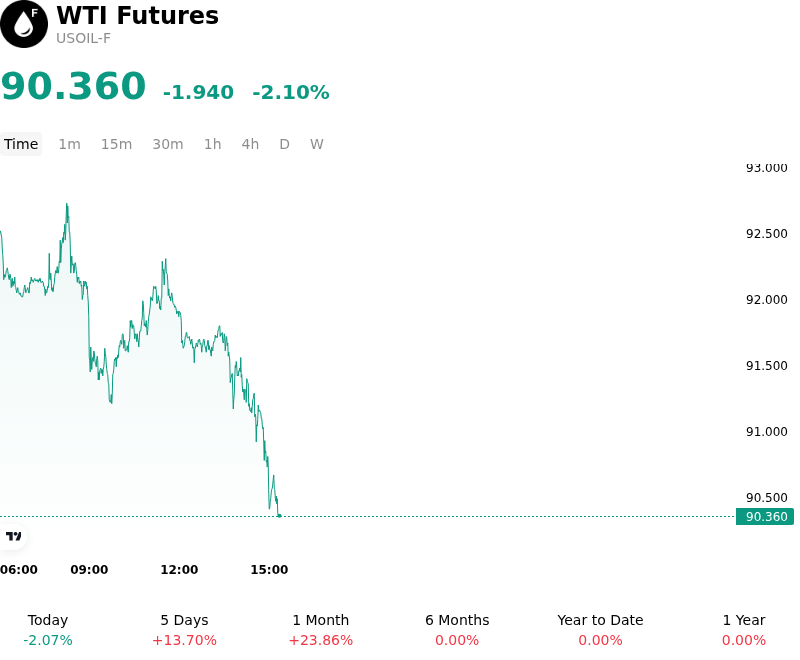
What is driving WTI Futures (USOIL-F)’s stock price down today?
The downward pressure on WTI crude futures is primarily driven by a shift in supply-side expectations following reports that major OPEC+ members are moving toward a more aggressive restoration of production capacity. This signals a potential departure from the disciplined curtailment strategy that has characterized the market for several quarters, raising concerns that global balances will tip into a surplus by the year's end. Investors are increasingly pricing in the return of sidelined barrels at a time when global inventory levels are showing signs of stabilization rather than the aggressive draws previously anticipated by the market.
Demand-side headwinds have intensified as recent industrial data from major Asian economies suggests a cooling in the manufacturing sector, which is failing to offset the seasonal peak in summer travel demand. Refining margins are also coming under pressure as high product inventories, particularly in middle distillates, limit the incentive for processors to maintain high run rates. This weakening in the physical market is providing a bearish signal to paper traders, prompting a liquidation of long positions by institutional participants who had previously bet on a tighter second-half balance.
Macroeconomic factors are further weighing on prices as the US dollar strengthens against a basket of currencies. Market expectations for central bank policy have been recalibrated, with the narrative shifting toward a more cautious approach to interest rate cuts. A stronger greenback makes dollar-denominated crude more expensive for international buyers, effectively dampening global spot demand. This currency headwind, combined with recent data showing a smaller-than-expected drawdown in commercial crude stocks, has eroded the geopolitical risk premium that had previously supported prices.
From a structural standpoint, the current price action reflects a transition from a supply-constrained environment to one defined by demand uncertainty. While geopolitical tensions in key producing regions remain a background factor, the absence of an immediate threat to physical flows has allowed the market to refocus on fundamental loosening. Technical selling has accelerated as prices breached key support levels, triggering automated stop-loss orders and exacerbating the volatility. Investors are now shifting their focus toward upcoming production data for clarity on whether the market can absorb the projected increase in supply.
Technical Analysis of WTI Futures (USOIL-F)
Technically, WTI Futures (USOIL-F) shows a MACD (12,26,9) value of 0.000, indicating a neutral signal. The RSI at 66.093 suggests neutral condition and the Williams %R at 12.164 suggests overbought condition. Please monitor closely.
More details about WTI Futures (USOIL-F)
Recent Events and Risks:
- Surprise Domestic Inventory Builds: Recent weekly data from the EIA and API indicated an unexpected increase in U.S. commercial crude oil and gasoline stockpiles, suggesting that domestic consumption is softening significantly as the peak summer travel season concludes.
- Chinese Demand Deterioration: Recent economic indicators and refinery throughput data from China show a sustained contraction in industrial activity, heightening fears among institutional analysts that the world's largest oil importer is entering a period of structural demand weakness.
- Libyan Production Normalization: The resolution of the administrative crisis within the Libyan Central Bank has triggered a rapid resumption of crude production and export operations, reintroducing significant supply into the Mediterranean market and erasing the supply-disruption premium.
- OPEC+ Production Policy Uncertainty: Market participants are increasingly concerned that the scheduled unwinding of voluntary production cuts starting in December will proceed despite weak global demand, potentially leading to an oversupplied market and further downward pressure on front-month futures.
This article may include AI-generated content that is human-reviewed, which is for reference and general information purposes only and does not constitute investment advice.
Recommended Articles









Comments (0)
Click the $ button, enter the symbol, and select to link a stock, ETF, or other ticker.