


Solana (SOLUSD) Volatility Intensified on Jul 23: What You Should Know



Solana (SOLUSD) is down 1.42% at Jul 23 08:50(ET), now at $75.71, with a 7-day up of 1.22%.
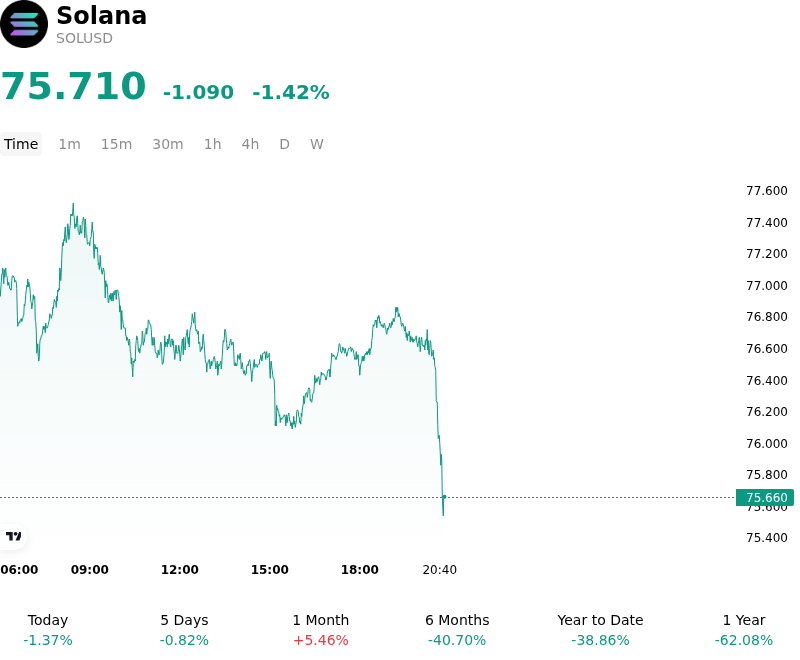
What is driving Solana (SOLUSD)’s stock price down today?
Solana experienced downward pressure during the current session as a combination of macro-driven risk aversion and a temporary cooling in network-specific catalysts led institutional and retail participants to trim exposure. Global liquidity conditions remain sensitive to shifting expectations regarding Federal Reserve policy, where a recent uptick in long-term Treasury yields has applied broad pressure across the high-beta digital asset landscape. As Solana typically exhibits a higher sensitivity to interest rate volatility compared to more established assets like Bitcoin, the firming of the US dollar has triggered a localized exit from aggressive growth-oriented positions within the Layer-1 sector.
Institutional sentiment appears to be in a consolidation phase following recent developments in the spot ETF narrative. Market participants are likely recalibrating their expectations for near-term capital inflows as regulatory scrutiny over the classification of certain ecosystem-native tokens continues to create a headline-driven environment. The absence of immediate positive catalysts regarding institutional-grade custody solutions or new major corporate integrations has led to a reduction in the premium previously assigned to the network’s scalability advantages.
On-chain metrics indicate a subtle deceleration in decentralized finance activity and transaction volumes, suggesting that speculative capital is rotating toward other emerging protocols or returning to stablecoins amid heightened uncertainty. While the long-term structural narrative surrounding network upgrades and improved validator diversity remains intact, the immediate lack of fresh liquidity entering the ecosystem has left the price vulnerable to technical selling. The move is further exacerbated by the exhaustion of buy-side momentum near key psychological resistance levels, prompting short-term traders to lock in profits.
Derivatives positioning has also contributed to the intraday weakness as a modest wave of long liquidations in the perpetual swap market intensified the downward trajectory. With funding rates stabilizing after a period of expansion, the market is currently seeking a new equilibrium. Investors remain focused on upcoming macroeconomic data releases and further clarity on the global regulatory landscape, which will likely determine if this move represents a temporary retracement or a more persistent shift in capital flows away from high-throughput blockchains.
Technical Analysis of Solana (SOLUSD)
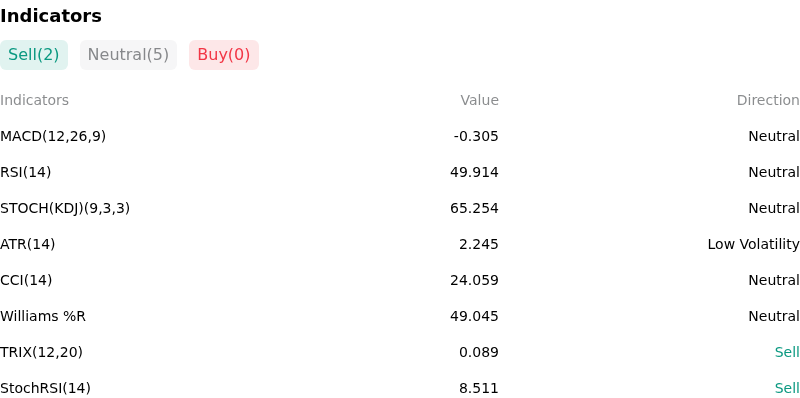
Technically, Solana (SOLUSD) shows a MACD (12,26,9) value of -0.305, indicating a neutral signal. The RSI at 49.914 suggests neutral condition and the Williams %R at 49.045 suggests neutral condition. Please monitor closely.
More details about Solana (SOLUSD)
Recent Events and Risks:
- Regulatory Classification Disparity: Despite shifting sentiment regarding Ethereum's status, the SEC has not rescinded its explicit classification of Solana (SOL) as an unregistered security in ongoing enforcement actions against major exchanges. This regulatory divergence creates a persistent legal overhang that prevents the immediate filing of Spot Solana ETFs and may deter risk-averse institutional allocators.
- Concentrated Capital Rotation: Market participants are observing a significant liquidity shift as traders rotate out of Solana and into Ethereum-linked assets ahead of critical SEC deadlines. This rotation risk is exacerbated by "sell-the-news" dynamics, where a positive regulatory outcome for ETH may lead to a sustained drain on Solana's market share and liquidity.
- Network Saturation and MEV Risks: Sustained high-intensity activity from decentralized exchange protocols and automated trading bots continues to stress the Solana mainnet. While the network remains operational, persistent transaction failure rates and high Maximum Extractable Value (MEV) activity create execution uncertainty for retail traders and increase the risk of slippage during intraday price spikes.
- Leverage Overhang and Liquidation Clusters: Recent price volatility has led to a build-up of leveraged long positions in the perpetual futures market. Elevated funding rates indicate a crowded trade, making the asset highly sensitive to "long squeeze" cascades if the price fails to sustain key support levels, potentially triggering automated sell-offs across major centralized exchanges.
This article may include AI-generated content that is human-reviewed, which is for reference and general information purposes only and does not constitute investment advice.
Recommended Articles










Comments (0)
Click the $ button, enter the symbol, and select to link a stock, ETF, or other ticker.