


BHP Group Ltd Stock (BHP) Moved Down by 4.86% on Jul 16: Facts Behind the Movement



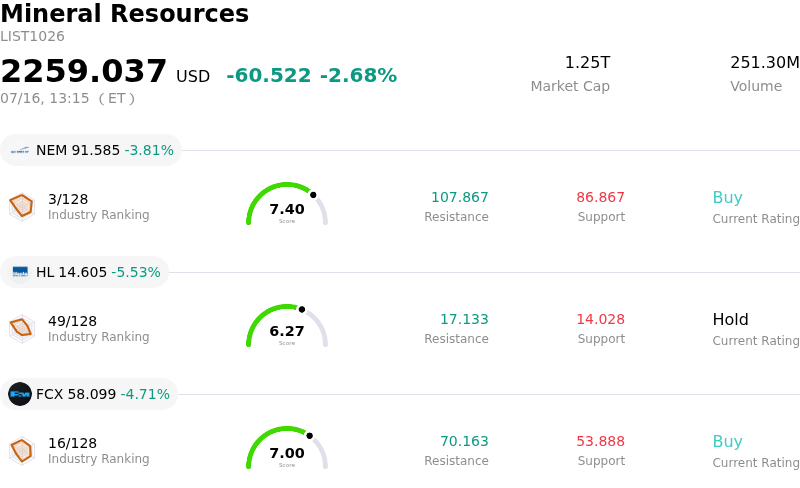
BHP Group Ltd (BHP) moved down by 4.86%. The Mineral Resources sector is down by 2.68%. The company underperformed the industry. Top 3 stocks by turnover in the sector: Newmont Corporation (NEM) down 3.81%; Hecla Mining Co (HL) down 5.53%; Freeport-McMoRan Inc (FCX) down 4.71%.
What is driving BHP Group Ltd (BHP)’s stock price down today?
The downward pressure on BHP shares during the current session is primarily driven by a broader retreat in industrial metal prices, particularly iron ore and copper. As a major global miner, the company’s valuation is inherently tied to the health of the Chinese manufacturing and construction sectors. Recent data from the region suggests a sharper-than-expected slowdown in steel production, which has directly impacted the demand outlook for iron ore. This macroeconomic headwind has been compounded by cooling sentiment across the commodities complex as global growth concerns outweigh previous supply-side optimism.
From an operational perspective, the market is reacting to the company’s latest production update and cost guidance. Investors appear concerned by rising unit costs at key assets, such as the Escondida copper mine and Western Australian iron ore operations. Increased labor expenses and higher energy inputs are squeezing margins, making it difficult for the firm to maintain its historical profitability levels in a lower-price environment. The realization that inflationary pressures remain sticky within the mining sector has led institutional desks to recalibrate their earnings expectations for the remainder of the fiscal year.
Furthermore, the strength of the U.S. dollar has acted as a significant headwind. Since commodities are priced in dollars, a stronger greenback makes these materials more expensive for international buyers, further dampening global demand. This currency dynamic, combined with a general rotation out of cyclical resource stocks into more defensive sectors, has accelerated the sell-off. The volatility is also being exacerbated by a series of analyst downgrades, as several major investment banks have revised their price targets downward, citing limited near-term catalysts and a cautious outlook for global industrial activity.
Lastly, geopolitical considerations and regulatory risks in South America continue to weigh on long-term investment sentiment. Uncertainty regarding mining royalties and environmental compliance costs in key jurisdictions adds a layer of risk premium that investors are currently unwilling to ignore. Given the absence of a strong stimulus signal from major economies, market participants are adopting a de-risking approach, leading to the significant intraday volatility and downward price action observed today.
Technical Analysis of BHP Group Ltd (BHP)
Technically, BHP Group Ltd (BHP) shows a MACD (12,26,9) value of 0.514, indicating a neutral signal. The RSI at 54.524 suggests neutral condition and the Williams %R at 8.924 suggests overbought condition. Please monitor closely.
Fundamental Analysis of BHP Group Ltd (BHP)
BHP Group Ltd (BHP) is in the Mineral Resources industry. Its latest annual revenue is $51.26B, ranking 3 in the industry. The net profit is $9.02B, ranking 2 in the industry. Company Profile
Over the past month, multiple analysts have rated the company as Hold, with an average price target of $72.58, a high of $91.00, and a low of $50.00.
More details about BHP Group Ltd (BHP)
Company Specific Risks:
- Strategic Growth Void Following Failed M&A: The formal withdrawal of the $49 billion bid for Anglo American has left BHP without a clear immediate path to significantly increase its copper exposure, leading to institutional concerns regarding the company’s ability to meet long-term "green metal" demand targets without overpaying for alternative assets.
- Heightened Exposure to Chinese Macroeconomic Volatility: BHP’s heavy reliance on iron ore exports to China makes it acutely vulnerable to the ongoing contraction in the Chinese property sector and fluctuating steel production caps, which have driven recent intraday price swings in the underlying commodity.
- Samarco Litigation and Financial Contingencies: Persistent legal uncertainty surrounding the multi-billion dollar settlement for the 2015 Fundão dam collapse continues to weigh on the balance sheet, as recent court developments in the UK and Brazil indicate potential increases in the final remediation and compensation payouts.
- Operational Margin Compression: Rising inflationary pressures on labor costs in Western Australia, combined with increased state mining royalties, are threatening to erode profit margins in the iron ore and coal divisions, triggering negative revisions in analyst earnings-per-share (EPS) estimates for the upcoming fiscal period.
This article may include AI-generated content that is human-reviewed, which is for reference and general information purposes only and does not constitute investment advice.
Recommended Articles







Comments (0)
Click the $ button, enter the symbol, and select to link a stock, ETF, or other ticker.