


WTI Futures (USOIL-F) Is up 3.05% on Jul 8: Key Drivers to Watch



WTI Futures (USOIL-F) is up 3.05% at Jul 8 04:35(ET), now at $74.34, with a 7-day up of 9.28%.
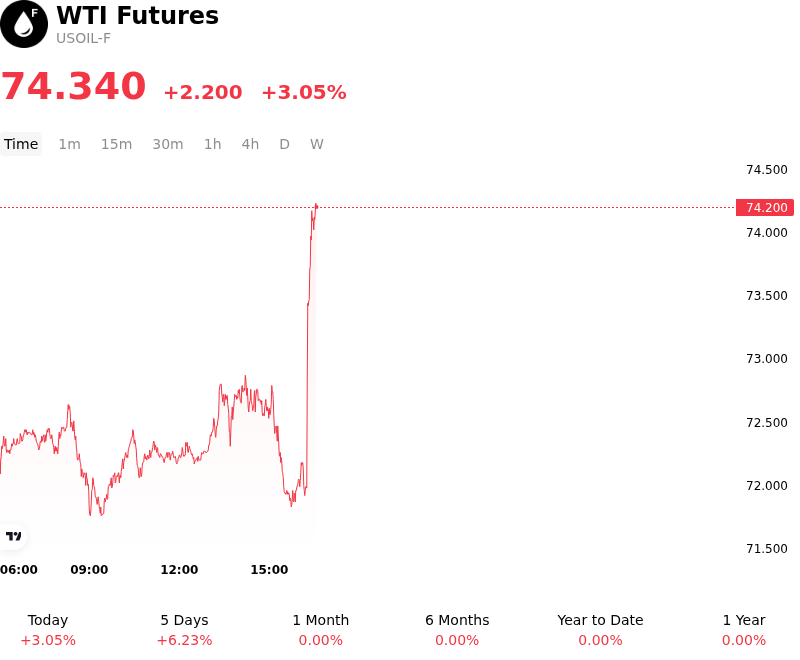
What is driving WTI Futures (USOIL-F)’s stock price up today?
The sharp intraday surge in WTI crude oil prices was primarily driven by a dramatic escalation of geopolitical tensions in the Middle East, forcing a swift repricing of the global oil risk premium. The primary catalyst was a series of targeted U.S. military retaliatory airstrikes against locations in Iran, following attacks on commercial shipping vessels, including a Saudi crude tanker and a Qatari LNG carrier, transiting the strategically vital Strait of Hormuz.
This military action was reinforced by the U.S. Treasury's sudden decision to revoke General License X. This critical sanctions waiver, issued during interim diplomatic talks, had temporarily authorized the production, delivery, and sale of Iranian crude oil on international markets. The swift re-imposition of these sanctions, coupled with direct military engagements, severely jeopardizes the fragile truce in the region and threatens to take a significant volume of Iranian crude exports back offline.
The escalation has completely upended recent market assumptions of a looming supply glut. Previously, global oil balances were expected to loosen following OPEC+ announcements of quota hikes and expectations of a sustained diplomatic reopening of the Strait of Hormuz. With the vital maritime choke point once again under threat, the risk of localized transit disruptions and broader regional conflict has taken center stage for commodity traders.
Adding fundamental support to the geopolitically driven rally, underlying inventory dynamics showed continued tightening. Recent industry reports pointed to further weekly declines in U.S. commercial crude inventories alongside a notable multi-million barrel drop in domestic gasoline stockpiles. This seasonal drawdown indicates that near-term physical demand remains resilient, which, when combined with the sudden threat to global supply security, provided a strong tailwind for long positioning.
From a technical standpoint, the geopolitical catalyst triggered aggressive short-covering and speculative buying. WTI successfully reclaimed the key psychological level of seventy dollars per barrel, breaking above short-term descending trendlines and moving averages that had previously capped gains. While the broader structural trend remains sensitive to OPEC+ production policy and global macroeconomic growth, the immediate horizon is dominated by supply security risks, with investors closely monitoring whether the conflict leads to prolonged bottlenecks in physical flows.
More details about WTI Futures (USOIL-F)
Recent Events and Risks:
- Substantial Non-OPEC Production Growth: Despite OPEC+ voluntary curbs, non-OPEC oil production has surged to record levels. The U.S. Department of Energy (DOE) recently raised its U.S. crude production forecast to 13.78 million barrels per day, creating a structural supply overhang that caps physical price rallies.
- Aggressive Global Demand Downgrades: The International Energy Agency (IEA) has severely worsened its global demand outlook, projecting that world oil consumption will contract by 1.1 million barrels per day this year, compared to its previous estimate of a 420,000 barrel-per-day decline, citing deep macroeconomic headwinds and accelerated efficiency gains.
- OPEC+ Quota Increases and Rising Exports: Over-supply worries are growing following OPEC+'s decision to increase production quotas by 188,000 barrels per day. Furthermore, key producers are actively capturing market share as regional exports rapidly recover; Saudi Arabian crude exports have already climbed back to 6.3 million barrels per day (90% of pre-war levels), while Saudi Arabia aggressively cut its Arab Light official selling prices to Asian customers.
- Worsening Macroeconomic Conditions and Contango Structure: Recent highly weak U.S. non-farm payroll data (showing a contraction in June) has heightened fears of a broad economic slowdown and reduced transport fuel demand. This demand erosion has caused the front-end of the oil forward curve to slip into a physical contango, indicating a near-term oversupplied cash market.
This article may include AI-generated content that is human-reviewed, which is for reference and general information purposes only and does not constitute investment advice.
Recommended Articles







Comments (0)
Click the $ button, enter the symbol, and select to link a stock, ETF, or other ticker.