


Natural Gas - Futures (NATGAS-F) Volatility Intensified on Jun 30: What to Watch



Natural Gas - Futures (NATGAS-F) is up 2.02% at Jun 30 06:30(ET), now at $3.228, with a 7-day up of 2.54%.
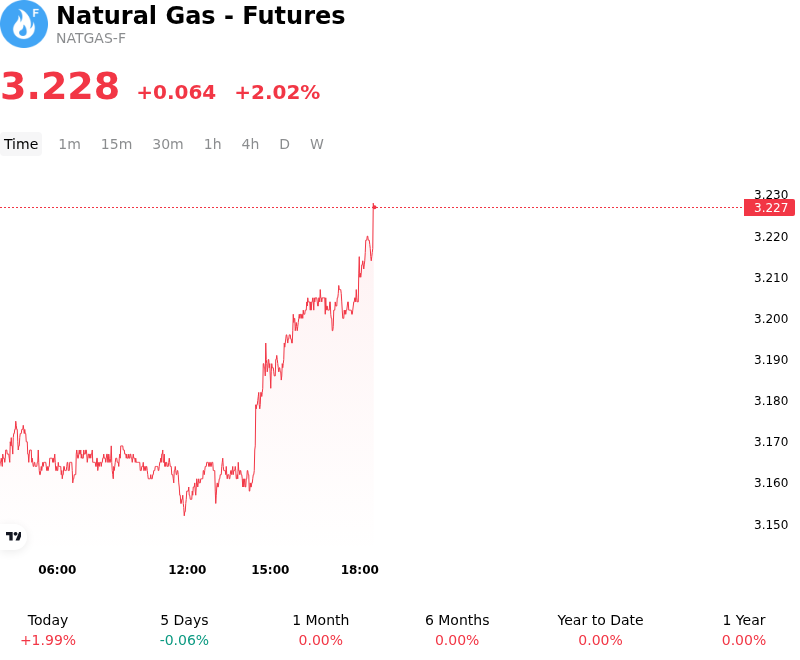
What is driving Natural Gas - Futures (NATGAS-F)’s stock price up today?
The advancement in natural gas futures is primarily driven by a robust reacceleration of weather-driven demand expectations. Near-term meteorological models predict an intense summer heat dome taking shape across major population centers in the eastern two-thirds of the United States, including the Midwest and Northeast. With temperatures forecast to hover in the upper 80s to over 100 degrees Fahrenheit through early July, power sector demand for air-conditioning is expected to reach fresh seasonal highs. Because gas-fired generation accounts for approximately 40 percent of the U.S. electricity mix, this surge in cooling degree days is prompting a sharp repricing of short-term power-burn demand, tightening near-term domestic balances.
Complementing the domestic demand surge is the continued strength in liquefied natural gas (LNG) export fundamentals. Daily feedgas flows to major U.S. Gulf Coast export terminals have remained highly resilient, averaging over 17 billion cubic feet per day throughout the month. This structural demand is further amplified by geopolitical disruptions in global markets. Tensions in the Middle East have spurred supply anxieties, highlighted by shipping bottlenecks through the Strait of Hormuz and past disruptions affecting key global facilities, such as Qatar's Ras Laffan plant. This global supply squeeze has kept international buyers highly dependent on U.S. exports.
Global gas markets are also providing a supportive tailwind. In Europe, benchmark Dutch TTF natural gas prices climbed to multi-week highs amid geopolitical uncertainty and a parallel heatwave that has accelerated gas-fired power generation. European gas storage levels remain below historical norms, driving concerns over the region's ability to adequately build inventories ahead of the winter season. This global backdrop of tight supply and rising demand has reinforced positive sentiment in the domestic market, helping offset the pressure of high domestic production and elevated baseline inventories.
While domestic dry gas production remains stable and near-term inventories continue to trade at a comfortable surplus relative to the five-year average, the sudden alignment of peak domestic cooling demand and robust global export pull has successfully catalyzed a bullish repricing. Looking forward, market participants will continue to monitor the longevity of the current heat dome, weekly storage injections, and the progression of international trade and geopolitical negotiations.
More details about Natural Gas - Futures (NATGAS-F)
Recent Events and Risks:
- Forecasts of Subsiding Heat Waves and Shorter-Lived Cooling Demand: Recent weather model updates indicate that the current summer heat wave may be short-lived. Forecasts showing temperatures cooling back to normal east of the Rockies by mid-July have trimmed near-term Cooling Degree Day (CDD) expectations and power-sector demand projections, causing the front-month August contract to shed 2.5% on its first day of trading.
- Robust Lower 48 Production and Upward Forecast Revisions: U.S. dry gas production remains highly resilient, averaging approximately 110.0 billion cubic feet per day (Bcf/d) in June. This output strength is reinforced by the EIA's upward revision of its 2026 domestic dry gas production forecast to 111.0 Bcf/d, largely driven by associated gas output in the Permian Basin, which acts as a major ceiling on price recovery.
- Persistent Inventory Cushion and Comfortable Storage Surpluses: Despite seasonal power burn, working natural gas in storage remains comfortably high at approximately 5.7% to 5.9% above the five-year average. This substantial storage buffer mitigates fears of physical shortages, leaving the market highly vulnerable to sharp price pullbacks whenever heat-driven demand softens.
- Technical Degradation and Front-Month Liquidation: Following the transition of the NYMEX front-month to the August contract, natural gas has faced heavy selling pressure after failing to sustain momentum above the $3.30–$3.35/MMBtu resistance zone. This failure has triggered long liquidation, forming a bearish outside day and exposing futures to a technical correction back toward key moving average support zones near $2.91–$3.02/MMBtu.
This article may include AI-generated content that is human-reviewed, which is for reference and general information purposes only and does not constitute investment advice.
Recommended Articles








Comments (0)
Click the $ button, enter the symbol, and select to link a stock, ETF, or other ticker.