


Natural Gas - Futures (NATGAS-F) Is up 2.18% on Jun 25: What Is Driving the Move?



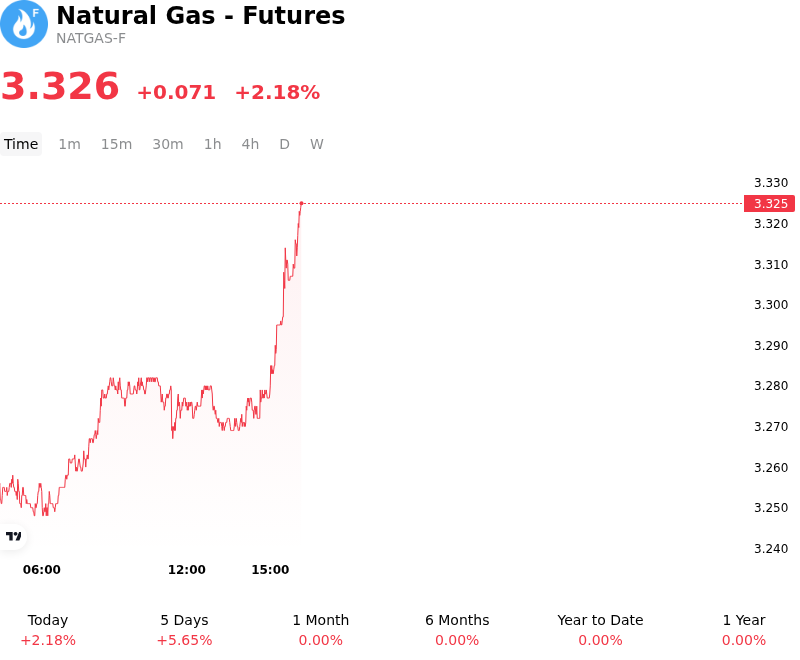
Natural Gas - Futures (NATGAS-F) is up 2.18% at Jun 25 04:05(ET), now at $3.326, with a 7-day up of 3.68%.
What is driving Natural Gas - Futures (NATGAS-F)’s stock price up today?
The upward momentum in US natural gas futures on June 25, 2026, was primarily driven by a combination of tightening supply-demand fundamentals, emerging weather-driven cooling demand, and expectations of smaller-than-average inventory injections.
Weather forecasts turned significantly hotter during the session, with meteorologists projecting above-average temperatures across key consuming regions, including the US Mid-Atlantic and Upper Midwest, heading into early July. This regional shift in weather patterns is expected to materially boost gas-for-power demand, as electricity providers prepare to ramp up gas-fired generation to meet surging air-conditioning loads.
In addition to the weather-driven demand outlook, market sentiment was bolstered by anticipated inventory developments. Ahead of the weekly government storage report, market participants braced for a tighter-than-average injection of around 67 billion cubic feet (Bcf) for the week ending June 19, which falls below the five-year seasonal average gain of 75 Bcf. Coming on the heels of the previous week's lower-than-expected 73 Bcf build, the decelerating pace of storage accumulation indicates that rising summer cooling demand is actively beginning to absorb the domestic supply surplus.
Further support came from the physical supply and export side. Domestic dry gas production in the US Lower 48 states showed a marginal tightening, averaging 109.5 Bcf/day so far in June, down slightly from the 109.7 Bcf/day recorded in May. Simultaneously, international demand remained a robust pillar of support, as average feedgas flows to major US liquefied natural gas (LNG) export facilities climbed to 17.3 Bcf/day in June, up from 17.1 Bcf/day in May, highlighting steady global off-take.
The intraday price advance was likely amplified by institutional capital flows and positioning. With money managers holding historically elevated net-short positions in natural gas futures, the convergence of hotter weather models and bullish inventory expectations triggered a wave of short-covering. While the market continues to face structural headwinds from a comfortable multi-year total inventory cushion and overall record-high US production guidance, the immediate supply-demand balance has tightened significantly, sparking a sharp, event-driven rally during the trading session.
More details about Natural Gas - Futures (NATGAS-F)
Recent Events and Risks:
- Subseasonal Weather Cooling and Weak Power Burn: Short-term weather models introduced cooler, below-average temperatures across the U.S. Mid-Atlantic and Midwest, reducing immediate gas-for-power air conditioning demand. This resulted in U.S. power burn trailing last June's levels by 0.7 Bcf/d and caused prompt-month (July '26) NYMEX futures to slide over 3% in recent sessions.
- Persistent and Bloated Domestic Inventory Surplus: U.S. working natural gas inventories stand at 2,759 Bcf—a structural overhang of 151 Bcf (roughly 6%) above the five-year historical average. This massive stockpile acts as a major physical barrier, capping any near-term spot and futures price recoveries.
- Surging Associated Gas and Record Dry Gas Production: Downside supply risks remain elevated after the EIA revised its 2026 U.S. dry natural gas production forecast upward to a record 111.0 Bcf/d. Strong associated gas output from the Permian Basin continues to provide a steady influx of cheap supply, risking an end-of-season inventory build that could test historical storage limits.
- Deflating Global LNG Risk Premiums: International supply-disruption premiums are rapidly unwinding after Qatar announced on June 24 that normal LNG operations at Ras Laffan would resume within weeks. Coupled with progress in U.S.–Iran peace talks and a temporary 60-day reopening of the Strait of Hormuz, global TTF and JKM benchmarks have fallen, tempering the export-driven demand pull for U.S. liquefied natural gas.
This article may include AI-generated content that is human-reviewed, which is for reference and general information purposes only and does not constitute investment advice.
Recommended Articles







Comments (0)
Click the $ button, enter the symbol, and select to link a stock, ETF, or other ticker.