


AUD/USD (AUDUSD) Drops on Jun 23: What Are the Key Reasons?



AUD/USD (AUDUSD) is down 0.51% at Jun 23 01:10(ET), now at $0.69638, with a 7-day down of 1.43%.
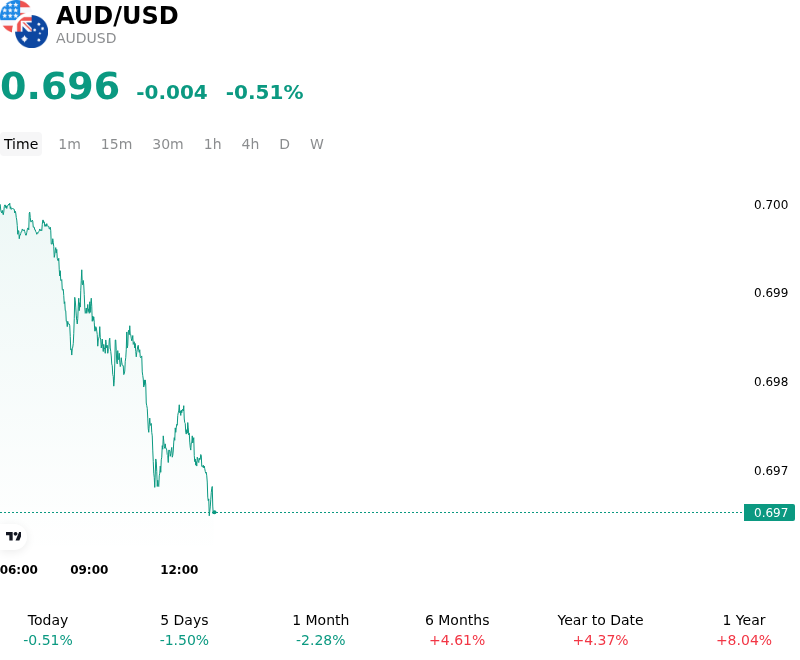
What is driving AUD/USD (AUDUSD)’s stock price down today?
The downtrend in the AUDUSD currency pair, which recently pushed the exchange rate to an eleven-week low below the key psychological level of 0.70, reflects a widening divergence in monetary policy expectations between the Reserve Bank of Australia and the Federal Reserve. This policy contrast has compressed interest rate differentials, shifting capital flows in favor of the US dollar. On one hand, the Reserve Bank of Australia elected to pause its tightening cycle, keeping the cash rate steady at 4.35 percent following three consecutive rate hikes earlier in the year. Although the central bank retained its long-term hawkish bias, Governor Michele Bullock struck a more balanced tone during her press conference, emphasizing that future tightening would only occur if required, rather than being actively debated. This wait-and-see stance has curbed expectations for an imminent rate hike.
In contrast, the US dollar continues to find robust support from a hawkish shift in Federal Reserve policy expectations. Under the leadership of the new Chair, Kevin Warsh, the Federal Open Market Committee recently delivered a hawkish surprise to market participants. The central bank removed its prior policy-easing language and revealed that a significant portion of the committee now projects at least one additional rate hike before the end of the year. This divergent outlook has reinforced US Treasury yields and intensified the downward pressure on the Australian dollar, as yield-seeking institutional investors favor the higher-yielding US fixed-income assets.
Adding to the Australian dollar's underperformance is the recent shift in the commodity complex. The easing of geopolitical tensions and potential resolution of oil supply disruptions in the Middle East have pushed global energy prices lower. While lower oil prices provide relief to global inflation expectations, they also strip away a key driver of domestic inflation in Australia, further justifying the Reserve Bank of Australia's decision to pause. Because the Australian dollar operates as a highly sensitive commodity currency, the retreat in energy and raw material prices has removed a critical pillar of support for the currency.
Furthermore, market participants are displaying heightened caution ahead of critical Australian macroeconomic data releases, specifically the monthly consumer price index and labor market reports. Investors are reluctant to build long positions in the Australian dollar until there is clearer evidence of persistent domestic inflationary pressures that would force the Reserve Bank of Australia back into a tightening stance. From a technical perspective, the breach of the critical 0.7000 support level has triggered stop-loss orders and fueled momentum-driven selling, cementing the dominant short-term bearish structure of the currency pair as it continues to trace lower along a descending trend line.
Technical Analysis of AUD/USD (AUDUSD)
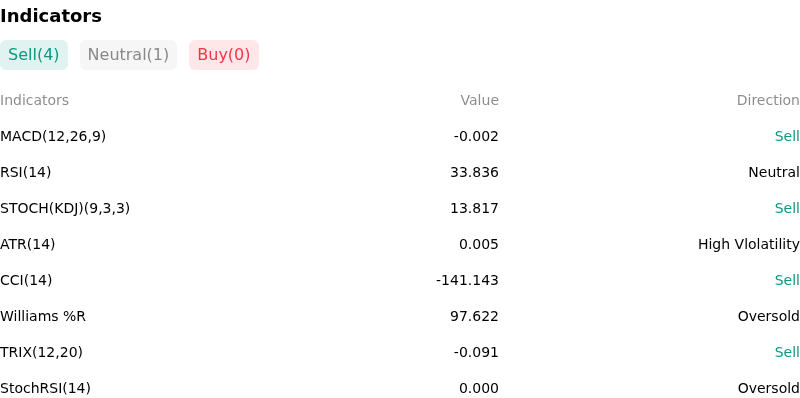
Technically, AUD/USD (AUDUSD) shows a MACD (12,26,9) value of -0.002, indicating a sell signal. The RSI at 33.836 suggests neutral condition and the Williams %R at 97.622 suggests oversold condition. Please monitor closely.
More details about AUD/USD (AUDUSD)
Recent Events and Risks:
- Divergent Central Bank Trajectories: While the Reserve Bank of Australia (RBA) recently left its cash rate unchanged at 4.35%, the Federal Reserve's hawkish surprise under its new leadership has signaled a potential rate hike in late 2026. This policy divergence has compressed the Aussie-US two-year yield spread in favor of the greenback, driving persistent downward pressure on the AUDUSD pair.
- Impending May CPI Volatility: Ahead of Australia's May Monthly CPI indicator release on June 24, the currency faces significant downside risk. Any cooler-than-expected print in underlying core inflation (trimmed mean)—which is forecast to edge up to 3.5%–3.6%—would weaken the RBA’s hawkish stance and accelerate AUD liquidations.
- Labor Market Softness and Economic Slowdown: With key Australian employment data scheduled for release on June 25, the pair remains highly vulnerable to signs of a domestic slowdown. Following the previous month’s surprise decline of 18,600 jobs and an unemployment spike to 4.5%, another soft labor print would underscore broader GDP per capita contraction and limit RBA rate expectations.
- Bearish Technical Topping Pattern: From a technical perspective, AUDUSD continues to struggle beneath an active head-and-shoulders topping pattern. Remaining capped below the critical neckline resistance band of 0.7000–0.7080 keeps near-term momentum skewed to the downside, with a clear breach of the 0.7000 psychological handle exposing the 200-day EMA near 0.6852.
This article may include AI-generated content that is human-reviewed, which is for reference and general information purposes only and does not constitute investment advice.
Recommended Articles







Comments (0)
Click the $ button, enter the symbol, and select to link a stock, ETF, or other ticker.