


EUR/USD (EURUSD) Moved Sharply on Jun 17: Are Central Bank Expectations Shifting?



EUR/USD (EURUSD) is down 0.54% at Jun 17 14:15(ET), now at $1.15443, with a 7-day up of 0.08%.
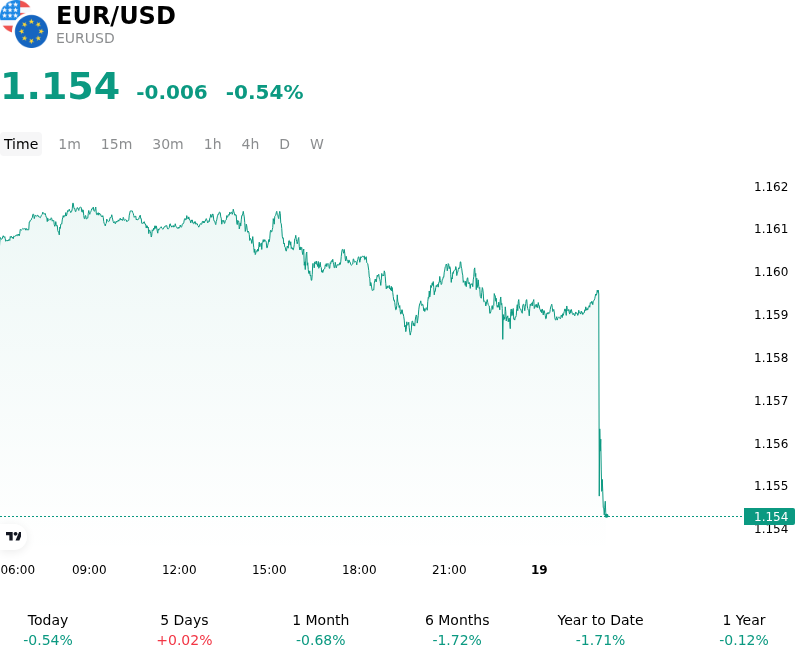
What is driving EUR/USD (EURUSD)’s stock price down today?
The decline in the EURUSD pair on June 17, 2026, was primarily driven by a significant hawkish shift in U.S. monetary policy expectations following the Federal Reserve's policy announcement, alongside exceptionally strong U.S. macroeconomic data. This combination of factors reinforced the narrative of economic divergence between the United States and the Eurozone, driving capital into the greenback and putting substantial downward pressure on the single currency.
The cornerstone of the session's volatility was the Federal Open Market Committee's decision, which marked the debut of the newly confirmed Federal Reserve Chairman Kevin Warsh. While the central bank kept its benchmark interest rate steady in the 3.50% to 3.75% range as expected, the accompanying statement and economic projections delivered a decidedly hawkish surprise. Under Warsh's influence, the Fed completely removed its prior easing-bias language and forward guidance, pivoting to a streamlined statement that left the door open for further policy tightening. More importantly, the updated Summary of Economic Projections revealed a major hawkish repricing, with nine policymakers now anticipating an interest-rate hike before the end of the year, effectively shattering any remaining expectations for rate cuts in 2026.
This hawkish central-bank signal was heavily supported by the morning's U.S. macroeconomic data. May retail sales surged by 0.9% month-on-month, far exceeding consensus estimates of a 0.6% gain, while core retail sales grew by a robust 0.7%. The data confirmed that the U.S. consumer remains highly resilient despite elevated interest rates, providing the Fed with ample fundamental justification to maintain a restrictive policy stance or even raise rates further to combat persistent inflation.
Conversely, the euro suffered from a lack of supportive domestic catalysts. The final release of the Eurozone's May Harmonised Index of Consumer Prices came in exactly in line with expectations at 3.2% year-on-year, failing to offer any hawkish surprises that might prompt the European Central Bank to match the Fed's aggressive tone. Furthermore, soft Eurozone industrial production and trade balance figures continue to highlight sluggish economic activity relative to the robust U.S. expansion.
Additionally, easing energy supply concerns—highlighted by a consecutive drop in crude oil prices amid prospects of a diplomatic agreement opening the Strait of Hormuz—failed to lift the euro, as currency markets remained firmly focused on the widening interest-rate differentials and monetary policy divergence. Ultimately, the Fed's hawkish policy update and the strength of the U.S. consumer continue to favor the dollar, limiting the scope for any near-term recovery in the EURUSD pair as long as the growth and rate trajectories of the two regions remain so deeply divided.
Technical Analysis of EUR/USD (EURUSD)
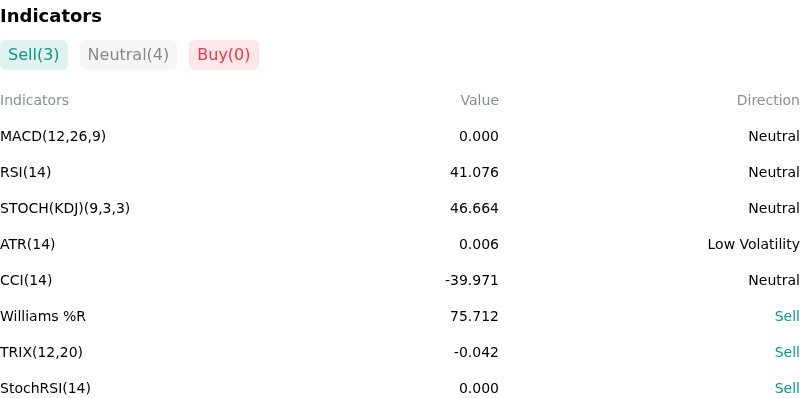
Technically, EUR/USD (EURUSD) shows a MACD (12,26,9) value of 0.000, indicating a neutral signal. The RSI at 41.899 suggests neutral condition and the Williams %R at 71.682 suggests sell condition. Please monitor closely.
More details about EUR/USD (EURUSD)
Recent Events and Risks:
- Hawkish Fed Guidance Under Warsh: The Federal Reserve's policy meeting on June 17, 2026, marks the first under new Chair Kevin Warsh. With U.S. inflation hovering at 4.2%, any hawkish shift in the Fed's dot plot or statement indicating a higher-for-longer rate path risks widening the U.S.-Eurozone yield spread, driving EURUSD downward.
- Eurozone Stagflation and Growth Headwinds: Recent downgrades to 2026 Eurozone growth forecasts (0.8%–0.9% GDP) by the ECB and IMF, coupled with elevated 3.0% inflation projections, highlight rising stagflation risks. This weak economic backdrop, especially in key manufacturing sectors like Germany, weighs heavily on Euro sentiment.
- Middle East Geopolitical and Energy Channel Disruptions: The ongoing conflict in the Middle East and its persistent threat to energy infrastructure and shipping routes present a severe terms-of-trade shock for the Eurozone. Unlike the energy-independent U.S., Europe's high reliance on imported energy leaves the Euro highly vulnerable to risk-off capital flows and energy-driven cost pressures.
- ECB Policy Constraints: Although the ECB recently raised its deposit rate to 2.25% to combat energy-driven inflation, further tightening risks triggering a deeper recession. This policy constraint limits the ECB's ability to keep pace with potential Fed rate hikes, intensifying downside pressure on EURUSD toward the 1.1580 support level.
This article may include AI-generated content that is human-reviewed, which is for reference and general information purposes only and does not constitute investment advice.
Recommended Articles









Comments (0)
Click the $ button, enter the symbol, and select to link a stock, ETF, or other ticker.