


Why the Canadian Dollar's rebound isn't just about rate-hike bets


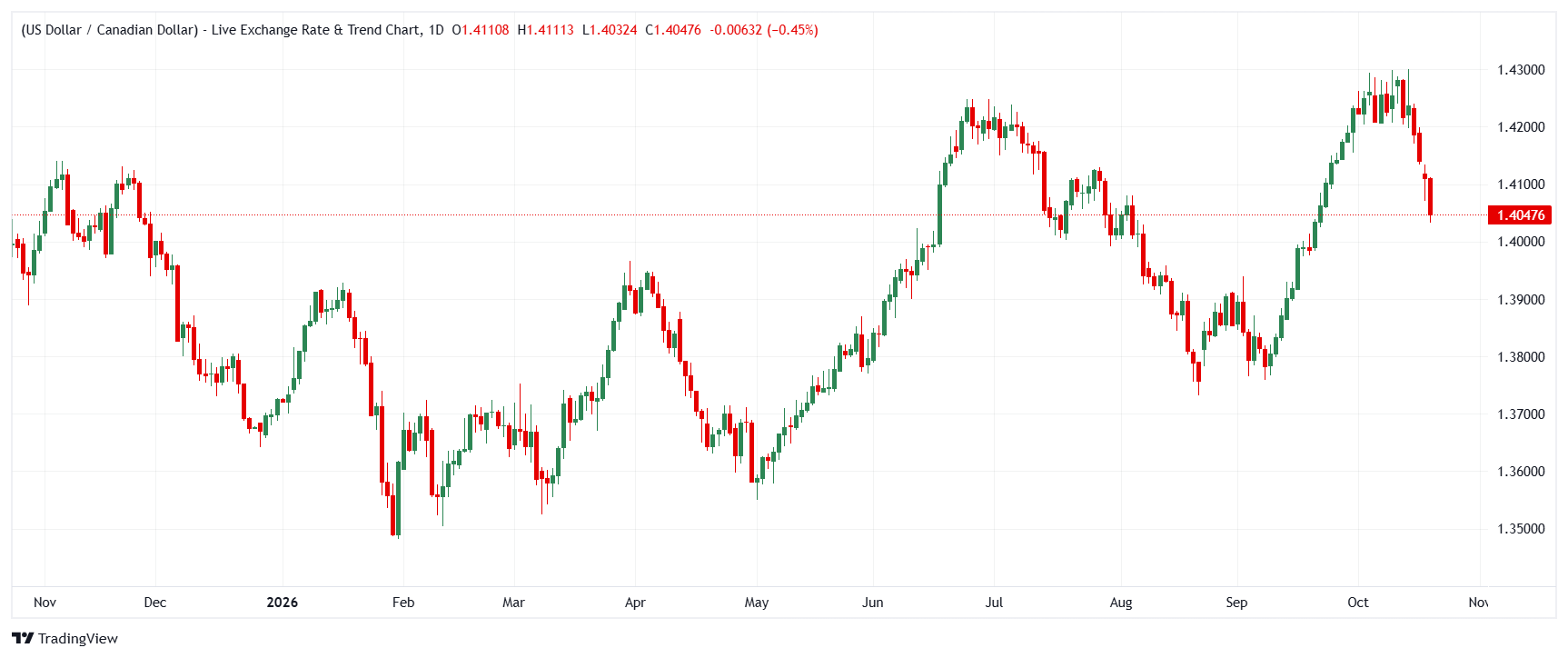
The Canadian Dollar (CAD) has become the focus of debate over the Bank of Canada's (BoC) next policy move. Markets have rushed to price in a rate hike at the upcoming meeting, dragging USD/CAD down to 1.4071, well below the 1.4300 high from October 14, and MUFG believes the BoC is likely to deliver — possibly with a second hike in December. Standard Chartered takes the opposite side, arguing the market's tightening bets are excessive and expecting the BoC to stay put at 2.25% through end-2026. Meanwhile, RBC's survey evidence explains why the hawkish repricing is happening at all: Canadian inflation expectations are rising sharply just as trade talks with the US collapse. For CAD, the next move hinges on whether the BoC validates those rate-hike bets.
Standard Chartered: The BoC has no need for the hikes markets are pricing
Standard Chartered economist Dan Pan expects the BoC to keep its policy rate at 2.25% through end-2026 and 2027, even with market pressure for hikes as early as this month. In his view, soft domestic demand, subdued core inflation and a weak labor market leave little risk of inflationary pressure broadening; an October interest rate move would be justified by "caution, not necessity," and the roughly 100bps of tightening priced in by the market has no strong growth catalyst behind it — a pricing he describes simply as "excessive."
"We now expect the Bank of Canada (BoC) to stay put at 2.25% until end-2026 and 2027 (versus a cut in 2026 and a hike in 2027 previously). High oil prices have lowered the likelihood of a near-term rate cut, but sustained economic slack and contained underlying inflation still make a case for the BoC to look through near-term energy price shocks."
MUFG: A hawkish repricing has already powered the Canadian Dollar's rebound
At MUFG, Lee Hardman notes the Canadian Dollar has continued to rebound against the US Dollar, with USD/CAD falling to a low of 1.4071, further below the October 14 high at 1.4300. The driver is a hawkish repricing of BoC expectations: the rate market now prices in around 21bps of hikes versus only 9bps at the end of last week, encouraged by three major Canadian banks all switching their calls to a hike at next week's meeting. The BoC's own business and consumer surveys, which found households' longer-term inflation expectations rising, reinforce the case — though Hardman concedes it is "not a done deal" given a second consecutive month of heavy job losses in September.
"The BoC has recently signalled that they are moving closer to hiking rates. If they place more weight on forward looking measures of inflation risks, and the Canadian rate market continues to price in a high probability of a hike heading into next week's meeting, we expect the BoC to pull the trigger and tighten policy."
RBC: Fading trade talks are pushing Canadian inflation expectations higher
Claire Fan at Royal Bank of Canada (RBC) reports that Canadian business sentiment improved through early August but weakened markedly after the breakdown of Canada-US trade talks on August 21. The deterioration in sentiment, exports and investment came alongside a turn in inflation expectations: firms' one- and two-year-ahead expectations resurged in September to 3.7% and 3.1% respectively, near spring highs, and half of surveyed firms — more than last quarter — plan to pass cost increases on to customers. On the consumer side, longer-term five-year-ahead expectations rose significantly to match shorter-term ones, driven primarily by the ongoing Middle East conflict.
"Conditions among firms generally improved through early August, but evidence collected after the breakdown of Canada-U.S. trade talks on August 21 pointed to renewed weakness in sentiment, exports and investment alongside rising inflation expectations."
Where the banks land on the Canadian Dollar's next move
The three banks share the same macro backdrop — rising inflation expectations, trade uncertainty and a fragile labor market — but diverge sharply on the BoC's response and what it means for CAD. MUFG expects the BoC to pull the trigger next week, with a second hike before December possible, which would further support the Canadian Dollar. Standard Chartered, by contrast, expects the BoC to stay put at 2.25% through 2026 and 2027 and views the market's priced-in tightening as excessive — a stance that implies the CAD could be vulnerable if those hike bets unwind. RBC sits in between: the data shows exactly the inflation-expectations pressures that justify the hawkish bid, but also renewed weakness in the real economy that complicates the BoC's decision.
The takeaway
The Canadian Dollar's near-term direction will be decided at the BoC's upcoming meeting. A hike — which MUFG expects — would likely validate the market's repricing, extend USD/CAD's slide and open the door to speculation of a December follow-up. If, as Standard Chartered argues, the BoC looks through the energy-price shock and holds at 2.25%, hawkish positioning could unwind and pull the CAD back. Either way, RBC's evidence that firms and consumers alike are raising inflation expectations — with half of firms planning to pass on costs — suggests the inflation-risk narrative will not fade quickly, keeping the BoC under pressure and the CAD sensitive to every hint about its next move.
(This article was created with the help of an Artificial Intelligence tool and reviewed by an editor. Know more.)
Recommended Articles







Comments (0)
Click the $ button, enter the symbol, and select to link a stock, ETF, or other ticker.