


Bitcoin Weekly Forecast: Is BTC setting up for an Uptober rally?



- Bitcoin extends gains, trading near $86,000 on Friday after closing September with a 6.33% gain.
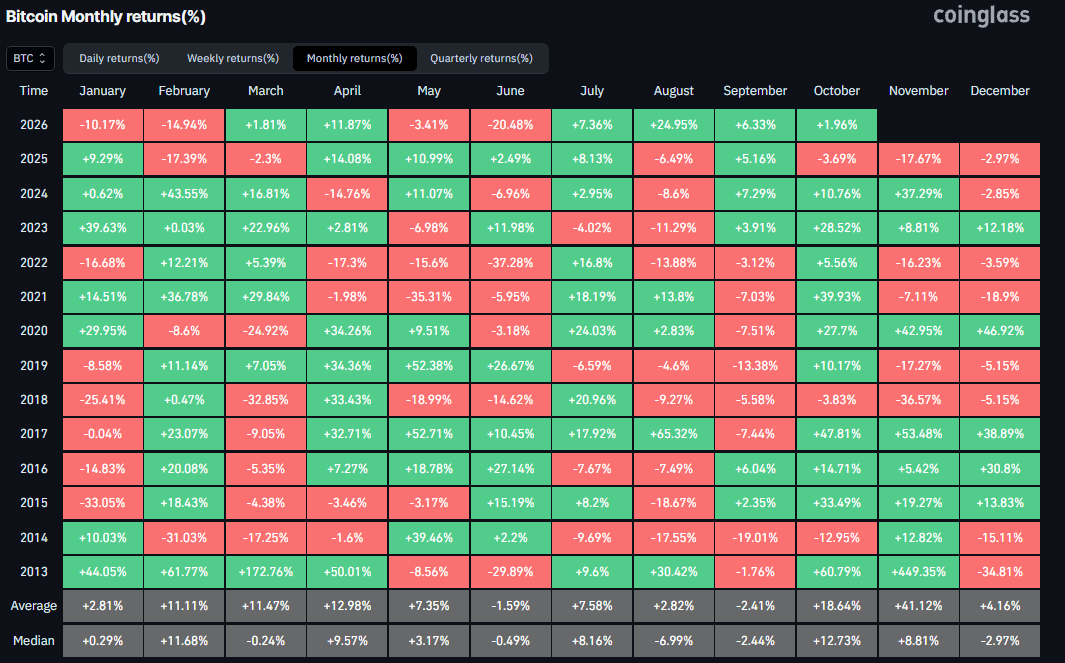
- Historical data shows BTC has generally returned gains in October, averaging over 18%, a seasonal trend termed Uptober rally.
- Institutional demand recorded a mild inflow of $51.25 million through Thursday, as investors remain cautious amid key economic data releases.
Bitcoin (BTC) extends its gains, trading near $86,000 at the time of writing on Friday after closing September 6.33% up, reversing its seasonal weakness. Historical data suggest October could be a strong month for BTC, especially after a positive September. However, modest Exchange Traded Funds (ETFs) inflows indicate that institutional demand remains cautious amid key economic data releases this week.
Traders now watch whether the Crypto King can sustain its bullish momentum and the Uptober narrative plays out.
What’s there for BTC in October?
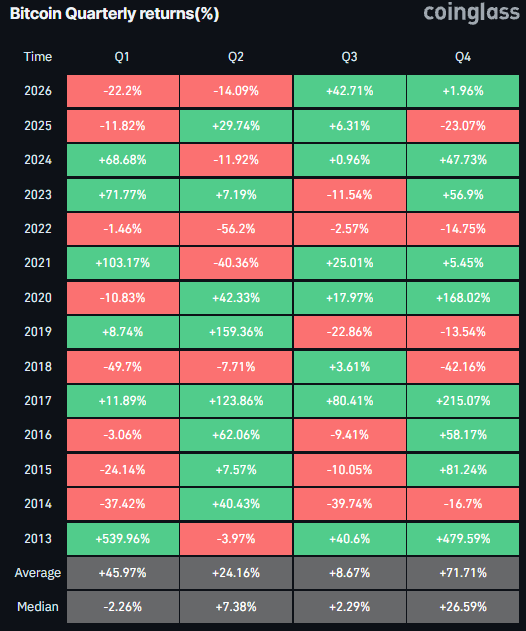
Bitcoin is heading into October with renewed bullish momentum, extending its gains, trading above $86,000 on Friday after reaching its highest level since late January last week. BTC closed Q3 with a 42.71% gain, marking its strongest third-quarter performance since 2017 and best quarterly return since Q4 2024. In addition, Bitcoin ended September with a 6.33% gain, reversing its seasonal weakness.
Historical data show that since 2013, September has closed higher five times, except for 2025. Bitcoin has followed a green September with a positive October averaging over 18%, which led to a strong Q4.
If the pattern repeats, BTC could enter October on a stronger footing, reinforcing the seasonal optimism behind the crypto market’s Uptober narrative.
Institutional demand supports BTC
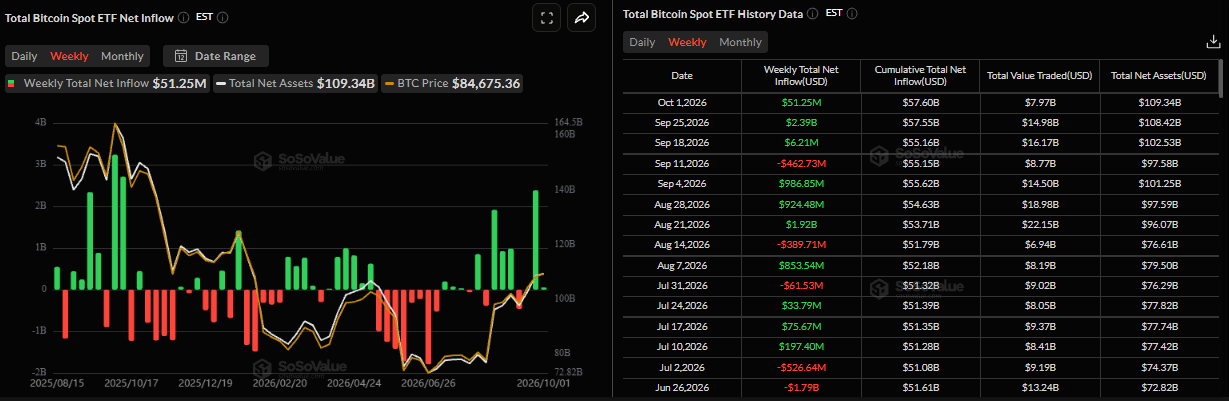
Bitcoin’s institutional and corporate demand continues to support its price. SoSoValue data show that BTC spot Exchange Traded Funds (ETFs) recorded mild inflows of $51.25 million through Thursday.
If this inflow trend continues and intensifies on Friday, BTC would mark a third consecutive week of positive flows, indicating robust demand, and could extend the ongoing rally.
On the corporate side, Michael Saylor announced on Monday that his firm, Strategy, acquired another 1,665 BTC after buying 950 BTC the previous week. The company currently holds 847,666 BTC and its total reserves are $6.02 billion in USD Assets. The move suggests Saylor’s company is returning to its familiar approach of aggressively accumulating BTC, supporting a bullish outlook for BTC, after spending much of the summer strengthening its liquidity position.
Why are rising Treasury yields and a stronger US Dollar weighing on Bitcoin?
In an exclusive interview, Iliya Kalchev, Nexo Dispatch analyst, told FXStreet that “rates and the bond market are weighing on BTC, and for now they are sending mixed signals.”
The softer Personal Consumption Expenditures (PCE) reading lowers the likelihood of further Federal Reserve (Fed) tightening. Yet, US Treasury yields above 5% continue to rise, while the US Dollar (USD) has strengthened.
“For momentum to return, Bitcoin needs a steadier rate backdrop, stronger ETF demand and continued accumulation from holders,” Kalchev added.
The analyst explained that the pressure persists because one inflation reading does not settle the rate outlook. Core PCE - Price Index YoY came in at 3% against 3.3% expected, yet the 10-year yield closed the day higher at 5.29%, while Brent crude remained around $100 a barrel amid constrained flows through the Strait of Hormuz. Since September 8, the 10-year yield has climbed from 4.8% to 5.3% and the US Dollar Index (DXY) from 98.8 to 101.5. At these levels, Treasuries offer a competitive, low-risk return, and investors with a lower risk appetite may keep some capital in bonds instead of Bitcoin. A stronger Greenback can further tighten financial conditions and weigh on risk appetite.
Overall, Bitcoin’s recovery will depend on a combination of stabilizing Treasury yields and the US Dollar, renewed ETFs demand and continued holder accumulation. Friday’s Nonfarm Payrolls report, US Consumer Price Index (CPI) due on October 14, and the Fed Interest Rate Decision on October 28 will be key catalysts for BTC’s next move.
BTC’s structure remains relatively healthy
A K33 Research report published this week highlighted that BTC has absorbed a major derivatives deleveraging event without a sharp price decline, keeping its technical structure relatively healthy.
The report explained that BTC’s derivatives markets have undergone an orderly reset, with Chicago Mercantile Exchange (CME) and perpetual Open Interest (OI) falling by 49,028 BTC over the past seven days, the largest weekly decline since October 2025.
The reset appears to have been driven by profit-taking, while spot trading volumes remained below yearly averages despite higher prices, suggesting limited sell-side pressure.
“With little leverage left to trigger forced liquidations and holders reluctant to sell 33% below all-time high (ATH), we see considerable upside asymmetry,” the analyst said.
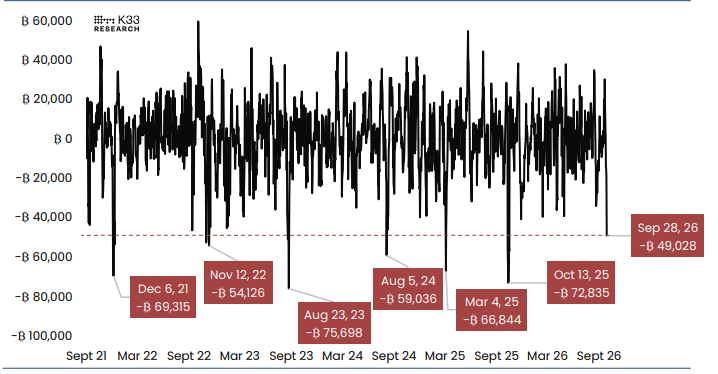
In addition, past orderly unwinds offer few directional signals, but they have tended to precede periods of low forward volatility as traders remain on the sidelines. Structurally, however, the market remains sound, the report noted.
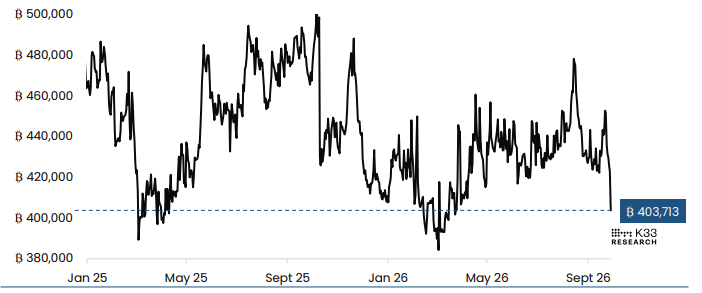
Aggregate OI is approaching 400K BTC, a level visited only twice in the past two years: between March 9 and April 10, 2025, and between February 15 and March 15, 2026, as shown in the chart below.
Both periods marked consolidation phases that were followed by solid BTC appreciation as traders returned to the market.
“With leverage this low, the risk of an imminent long squeeze is limited, a welcome backdrop for a BTC trend that remains solid above its major moving averages,” the report stated.
Bitcoin technical outlook: Bulls aiming for $90K
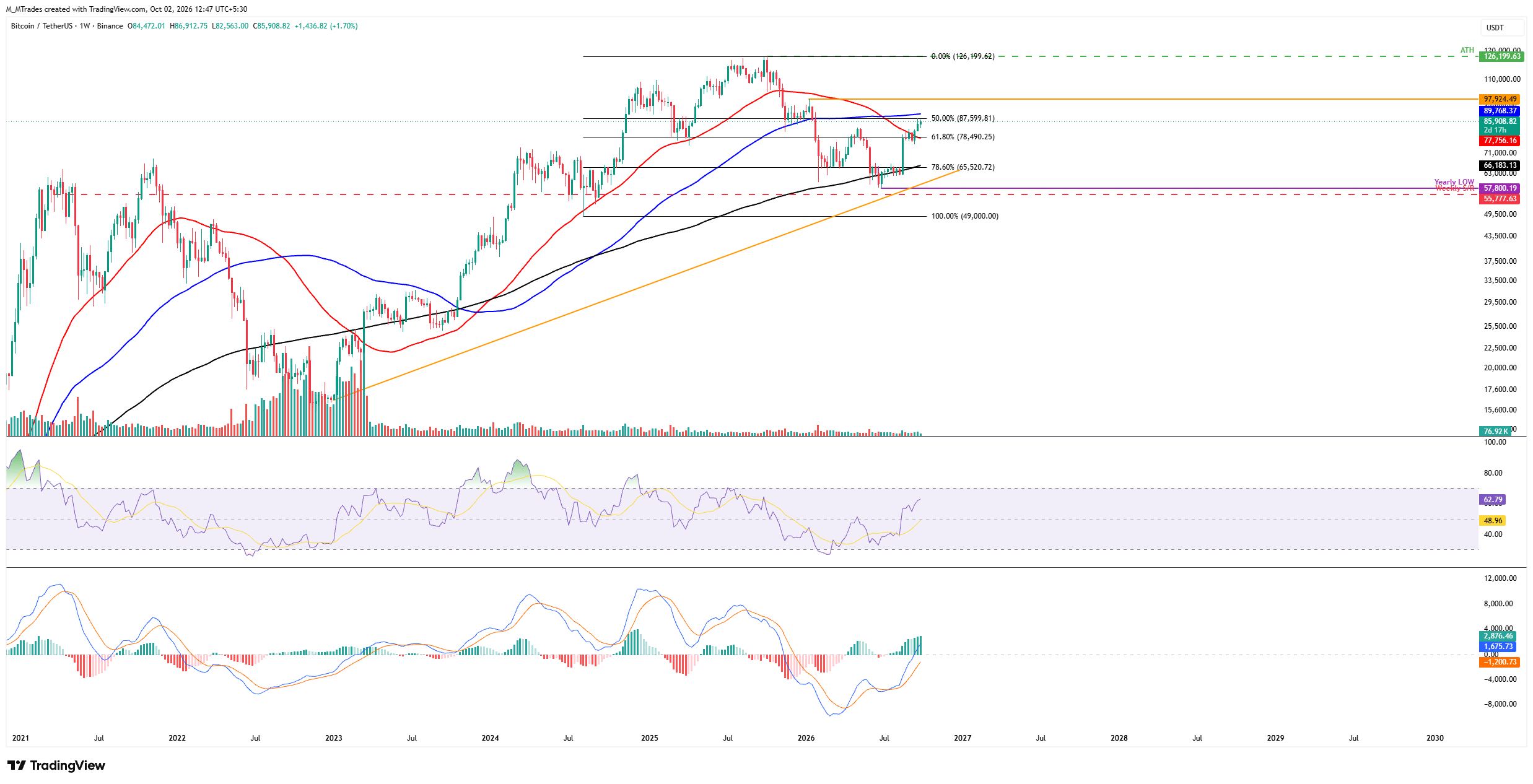
The Crypto King extends gains, trading above $85,900 on Friday and nearing the immediate resistance at the 50% Fibonacci retracement level at $87,599 (drawn from the August 2024 low of $49,000 to the October 2025 record high of $126,199), followed by the 100-week Simple Moving Average (SMA) at $89,768.
If BTC continues its upward move, it could rally toward the 50% Fibo. retracement level at $87,599. A successful close above it could extend gains toward the 100-week SMA at $89,768, then the key psychological level at $90,000.
The Relative Strength Index (RSI) on the weekly chart is around 62 and rising, indicating strong bullish momentum. At the same time, the Moving Average Convergence Divergence (MACD) shows rising green histogram bars, further supporting the bullish outlook.
If BTC fails to overcome the 50% Fibo. retracement level at $87,599 resistance and corrects, it could extend the decline toward the 50-day SMA at $77,756, which coincides with the 61.8% Fibonacci retracement level at $78,490.
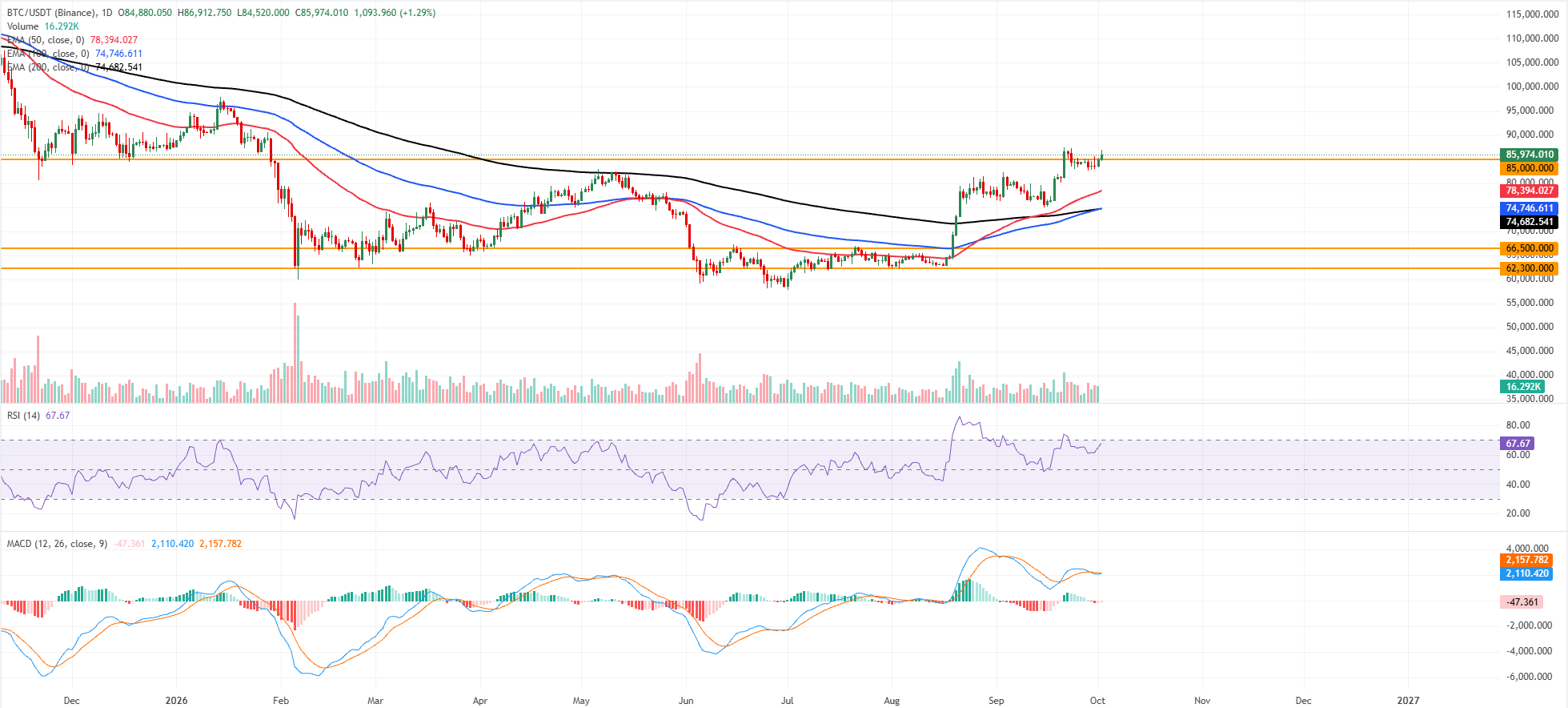
On the daily chart, BTC holds a clear bullish bias as price extends well above the 50-day, 100-day, and 200-day Exponential Moving Averages (EMAs), clustered between roughly $74,700 and $78,400.
The pair is consolidating near recent highs after a strong impulsive leg from the mid-$70,000s, with the daily RSI at 67 suggesting robust but not extreme upside momentum. Meanwhile, the MACD histogram has slipped marginally negative, hinting at a slowing phase rather than an outright trend reversal at this stage.
On the downside, immediate support is seen at the prior horizontal level around $85,000, which guards the recent breakout zone before deeper pullbacks towards the 50-day EMA near $78,394. Below there, the 100-day EMA at $74,746 and the 200-day EMA at $74,682 form a dense medium-term demand band, ahead of more distant structural floors at $66,500 and $62,300.
As long as BTC holds above the short- and medium-term EMAs, the technical backdrop favors continued dip-buying interest, with any corrective phases likely to be absorbed before those supports are materially challenged.
(The technical analysis of this story was written with the help of an AI tool. Know more.)
Bitcoin, altcoins, stablecoins FAQs
Bitcoin is the largest cryptocurrency by market capitalization, a virtual currency designed to serve as money. This form of payment cannot be controlled by any one person, group, or entity, which eliminates the need for third-party participation during financial transactions.
Altcoins are any cryptocurrency apart from Bitcoin, but some also regard Ethereum as a non-altcoin because it is from these two cryptocurrencies that forking happens. If this is true, then Litecoin is the first altcoin, forked from the Bitcoin protocol and, therefore, an “improved” version of it.
Stablecoins are cryptocurrencies designed to have a stable price, with their value backed by a reserve of the asset it represents. To achieve this, the value of any one stablecoin is pegged to a commodity or financial instrument, such as the US Dollar (USD), with its supply regulated by an algorithm or demand. The main goal of stablecoins is to provide an on/off-ramp for investors willing to trade and invest in cryptocurrencies. Stablecoins also allow investors to store value since cryptocurrencies, in general, are subject to volatility.
Bitcoin dominance is the ratio of Bitcoin's market capitalization to the total market capitalization of all cryptocurrencies combined. It provides a clear picture of Bitcoin’s interest among investors. A high BTC dominance typically happens before and during a bull run, in which investors resort to investing in relatively stable and high market capitalization cryptocurrency like Bitcoin. A drop in BTC dominance usually means that investors are moving their capital and/or profits to altcoins in a quest for higher returns, which usually triggers an explosion of altcoin rallies.
Recommended Articles









Comments (0)
Click the $ button, enter the symbol, and select to link a stock, ETF, or other ticker.