


Kenyan users turn on Binance as DCI requests lock out traders



Kenyan crypto traders have gone on record about the freezing of their Binance accounts, which has persisted for over two months since the DCI made its request. No charges have been filed, no court order has been issued, and no time frame has been given for when the problem will be resolved.
This has sparked debate once again on the issue of striking the fine line between cooperation and user protection in Kenya’s dynamic crypto space.
Kenyan traders’ silent struggles with frozen assets
As mentioned in the X thread by the affected user, he received an email from Binance stating that the funds were frozen on their platform on behalf of the DCI by the National Police Service. However, when he requested more information, Binance replied bluntly that he should contact the police department for further details.
“No complainant identified. No formal charges. No timeline given,” the trader wrote. “Funds remain inaccessible. Meanwhile, real life doesn’t pause. Bills are piling up. Debt is growing.”
The complaint brought to light the frustration of Kenyan traders who see crypto as a path to financial inclusion but suddenly find themselves restricted by an unclear policy.
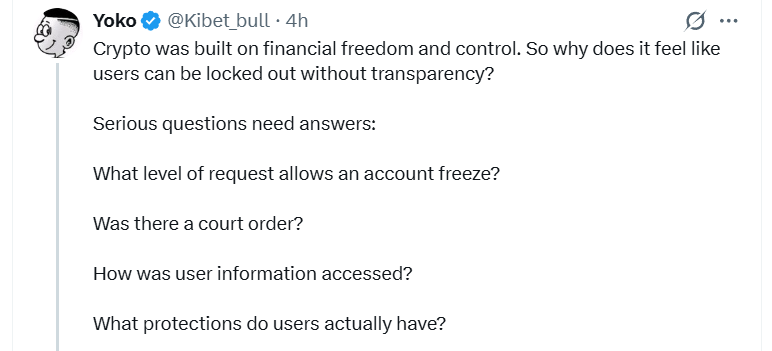
This is happening at a time when the Kenyan government is increasingly focusing on regulating peer-to-peer trade and virtual asset transfers, especially amid widespread fraud in the country. However, the lack of openness has raised doubts on whether such freezes serve legitimate investigations or risk becoming tools of arbitrary control.
One X user has questioned how the DCI knows Kenyans’ Binance accounts.
Yaani DCI wanajua accounts za Binance how is this even possible? pic.twitter.com/aqQV8cr0Ri
— ︎︎︎︎︎︎︎ ︎Mary Kwamboka (@MaryKwamboks) April 20, 2026
Kenyans stand ready to boycott the exchange if they cannot explain the matter or unfreeze the affected accounts. The #BinanceUnmasked hashtag is already in motion.
Binance’s global pattern of account locks in partnership with governments
Binance has positioned itself as a leader in compliance, processing over 71,000 law enforcement requests in 2025 alone. It has assisted in the seizure of more than $752 million in illegal crypto assets globally.
However, the exchange routinely freezes accounts flagged by agencies investigating fraud, terrorism financing, or money laundering. This is often in coordination with bodies like the US authorities, Israeli police, and Asia-Pacific task forces.
In particular, Binance has helped freeze accounts associated with North Korea-based hackers and recover stolen funds from various fraud schemes.
While the exchange touts its importance in the fight against crime with immediate interaction with such agencies as the Beacon Network, there are many others who report the same problems. Their account remains inaccessible for an indefinite period of time, receiving hardly any correspondence and being redirected to some far-flung authority on crime.
However, this compliance-first strategy, although mandated by law, frequently leaves average investors in a state of purgatory, particularly in nascent regulatory environments such as Kenya’s. There is no solace in the typical instruction found on the website to “contact the requesting agency.”
Kenya’s crypto regulations oversight tempered by corruption concerns
Kenya is working to formalize its crypto laws using the VASP Act of 2025 and the VASP Regulations 2026. Both the CBK and CMA are responsible for overseeing regulations that require exchanges, wallets, and stablecoin issuers to obtain licenses, as well as KYC, AML, and CFT regulations.
As it stands, the platforms should report any suspicious transactions to the FRC and also work with the DCI in investigations.
However, there is concern that, given the focus on collaboration between law enforcement agencies, the new reforms will exacerbate current weaknesses in the country’s system.
The corruption cases in Kenya involving law enforcement have made citizens fearful that the freezing of bank accounts could potentially be abused. This year, losses from crypto fraud totaled $43.3 million.
If you're reading this, you’re already ahead. Stay there with our newsletter.
Recommended Articles









Comments (0)
Click the $ button, enter the symbol, and select to link a stock, ETF, or other ticker.