


WTI regains ground near $80 amid continued energy supply risks



- The Oil price attracts bids after a two-day correction amid continued energy supply disruption.
- Iran says that it is not involved in any discussions with the US regarding the Hormuz reopening.
- OPEC has downwardly revised its global oil demand forecast for 2026 to 580,000.
West Texas Intermediate (WTI), futures on NYMEX, trades 0.4% higher around $81.40 during the early European trading session on Friday. The oil price regains ground after a two-day corrective move as financial markets remain worried regarding the closure of key energy supply passages in the Middle East.
Analysts at TD Securities have highlighted that fundamental tightness across crude and product markets should ultimately support further upside,” suggesting that the latest bout of selling is viewed as a temporary setback within an otherwise constructive medium-term outlook for Oil prices.
Commodity vessel transits at the Hormuz picked up slightly on Thursday, but remained lower than the month's daily average of 12, based on Kpler data in August so far, Reuters reports. This remains a massive decline from pre-war levels of 130 to 140 ships daily.
Navigation through the Strait of Hormuz and the Bab al-Mandab Strait, which collectively account for 27% of global energy supply, is nominal, with the straits being closed due to blockades by the United States (US) and the Iran-aligned Houthis, respectively.
Meanwhile, Iran has also stated that Tehran is in no discussions with the US regarding the reopening of the Hormuz, but is in the final stages with Oman about collective management of navigation through the strait.
On the demand front, OPEC has revised its global oil demand forecast for 2026 to 580,000 barrels per day (bpd) from the prior estimate of 780,000 bpd.
Oil Technical Analysis
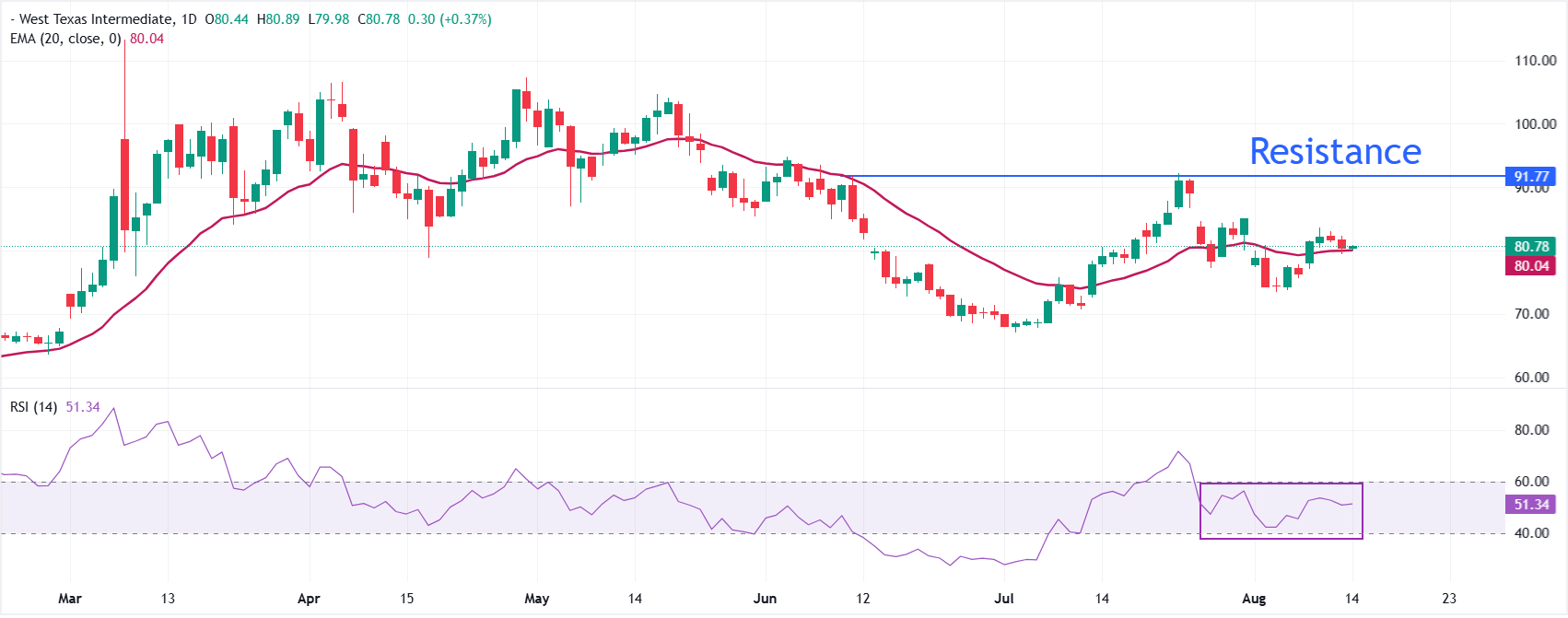
In the daily chart, WTI US Oil trades at $80.76. The contract holds a constructive near-term bias as it remains above the 20-day exponential moving average (EMA) at $80.04, suggesting underlying demand after the recent recovery from the mid-$70s. The Relative Strength Index (14) around 51 stays near neutral territory, hinting that bullish momentum is present but not overstretched.
On the downside, initial support is seen at the 20-day EMA at $80.04, where buyers have recently re-emerged, while a daily close below this area would weaken the current positive tone and expose lower levels toward the mid-$70s consolidation zone. On the topside, the absence of nearby technical resistance on the provided metrics implies that further gains could unfold as long as price holds above $80.04, with traders likely watching psychological barriers and prior swing highs to gauge the next upside objectives.
(The technical analysis of this story was written with the help of an AI tool. Know more.)
WTI Oil FAQs
WTI Oil is a type of Crude Oil sold on international markets. The WTI stands for West Texas Intermediate, one of three major types including Brent and Dubai Crude. WTI is also referred to as “light” and “sweet” because of its relatively low gravity and sulfur content respectively. It is considered a high quality Oil that is easily refined. It is sourced in the United States and distributed via the Cushing hub, which is considered “The Pipeline Crossroads of the World”. It is a benchmark for the Oil market and WTI price is frequently quoted in the media.
Like all assets, supply and demand are the key drivers of WTI Oil price. As such, global growth can be a driver of increased demand and vice versa for weak global growth. Political instability, wars, and sanctions can disrupt supply and impact prices. The decisions of OPEC, a group of major Oil-producing countries, is another key driver of price. The value of the US Dollar influences the price of WTI Crude Oil, since Oil is predominantly traded in US Dollars, thus a weaker US Dollar can make Oil more affordable and vice versa.
The weekly Oil inventory reports published by the American Petroleum Institute (API) and the Energy Information Agency (EIA) impact the price of WTI Oil. Changes in inventories reflect fluctuating supply and demand. If the data shows a drop in inventories it can indicate increased demand, pushing up Oil price. Higher inventories can reflect increased supply, pushing down prices. API’s report is published every Tuesday and EIA’s the day after. Their results are usually similar, falling within 1% of each other 75% of the time. The EIA data is considered more reliable, since it is a government agency.
OPEC (Organization of the Petroleum Exporting Countries) is a group of 12 Oil-producing nations who collectively decide production quotas for member countries at twice-yearly meetings. Their decisions often impact WTI Oil prices. When OPEC decides to lower quotas, it can tighten supply, pushing up Oil prices. When OPEC increases production, it has the opposite effect. OPEC+ refers to an expanded group that includes ten extra non-OPEC members, the most notable of which is Russia.
Recommended Articles










Comments (0)
Click the $ button, enter the symbol, and select to link a stock, ETF, or other ticker.