


Gold holds steady as traders weigh US-Iran talks, Fed outlook



- Gold lacks direction as uncertainty over the Middle East and Fed policy keeps traders cautious.
- Elevated energy prices keep inflation and Fed rate-hike concerns in focus.
- XAU/USD continues to trade inside a $4,000-$4,200 range, with a breakout setup taking shape.
Gold (XAU/USD) trades flat on Tuesday, extending its sideways grind as uncertainty surrounding US-Iran peace efforts and the Federal Reserve’s (Fed) monetary policy path keeps traders cautious.
At the time of writing, XAU/USD trades around $4,056 after touching an intraday high near $4,072. The precious metal has moved largely between $4,000 and $4,200 over the past month, with buyers and sellers showing little conviction.
Diverging comments from Washington and Tehran suggest that lasting peace in the Middle East remains unlikely in the near term. US President Donald Trump says talks with Iran are taking place, while Tehran denies negotiating with Washington. Trump has also warned that his latest offer is Iran’s “last chance” to reach a deal.
Oil prices remain elevated as energy shipments through the Strait of Hormuz stay heavily restricted, although Iran and Oman are discussing a temporary safe shipping route.
Higher energy costs are adding to inflation pressures, forcing worldwide central banks to maintain restrictive monetary policy or consider raising interest rates. However, the Fed does not appear to be in a hurry to raise borrowing costs. The US central bank left them unchanged within the 3.50%-3.75% range at its July meeting.
Fed Chair Kevin Warsh reiterated the commitment to bringing inflation back to its 2% target, but his move away from forward guidance leaves traders guessing about what the central bank will do next.
Markets still expect the Fed to raise interest rates in September, with the CME FedWatch Tool showing a 62.7% chance of a rate hike. These hawkish expectations keep the US Dollar (USD) and US Treasury yields supported, limiting Gold’s upside attempts.
Beyond geopolitics, attention now turns to this week’s US employment data. The economic calendar begins with the JOLTS Job Openings on Tuesday, followed by ADP Employment Change on Wednesday and Nonfarm Payrolls on Friday. These figures could influence Fed rate expectations and drive the next move in Gold.
Technical analysis: Momentum stabilizes as Gold consolidates above $4,000
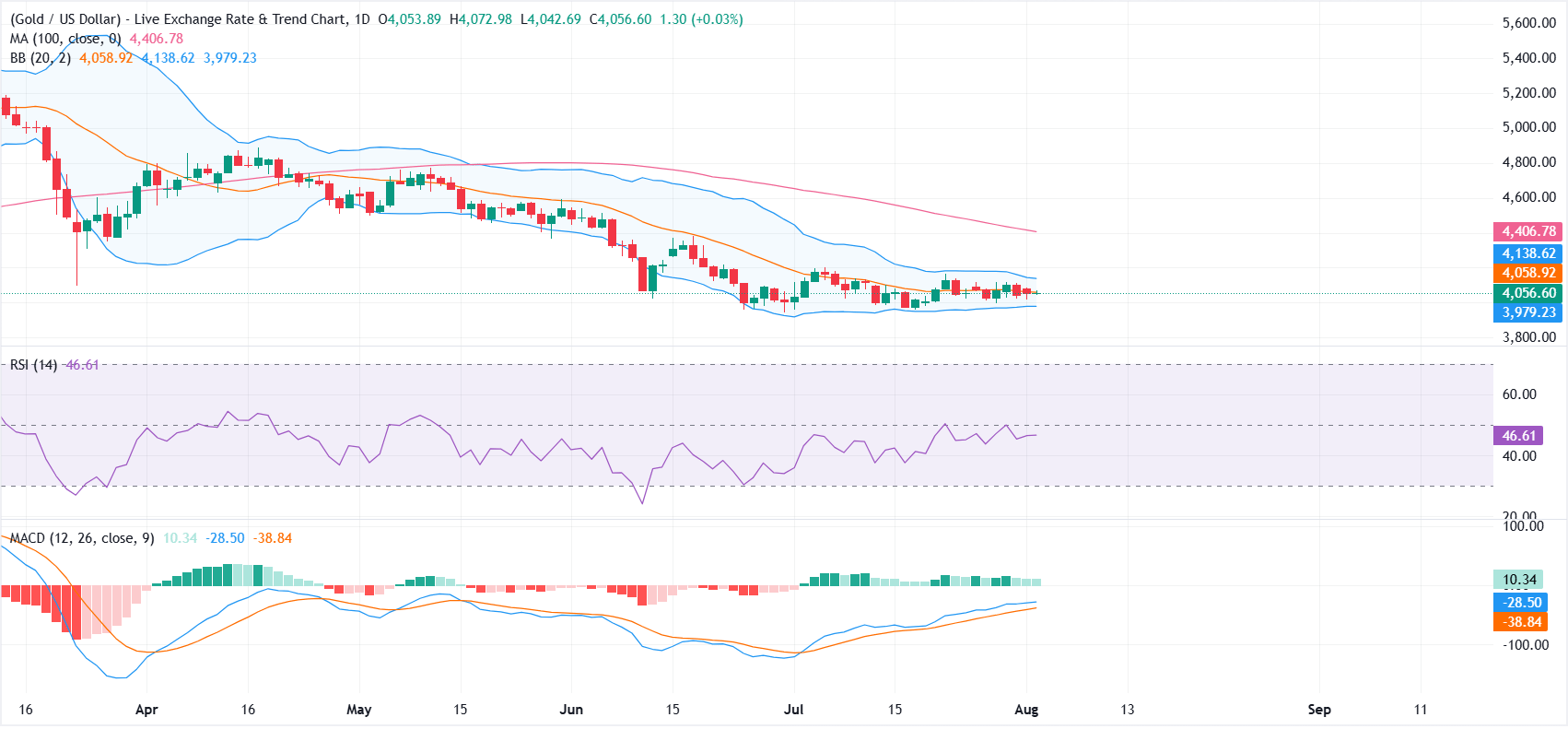
On the daily chart, XAU/USD remains largely range-bound between $4,000 and $4,200, pointing to an extended consolidation phase. Gold sits near the Bollinger Bands’ 20-period Simple Moving Average (SMA) at $4,058, while the narrowing Bollinger Bands suggest that volatility is easing and a breakout could be brewing.
The Relative Strength Index (RSI) is at 46 and the Moving Average Convergence Divergence (MACD) is in positive territory, hinting that selling strength is waning rather than reversing outright.
Initial resistance is seen at the middle Bollinger Band near $4,058, which also serves as the 20-day Simple Moving Average (SMA), followed by $4,100 and the upper Bollinger Band at $4,138. A clear move above these levels could bring the upper end of the range at $4,200 into focus. Meanwhile, the 100-day SMA at $4,406 remains a distant upside barrier.
On the downside, the $4,000 psychological mark and the lower Bollinger Band at $3,979 provide immediate support.
(The technical analysis of this story was written with the help of an AI tool. Know more.)
Nonfarm Payrolls FAQs
Nonfarm Payrolls (NFP) are part of the US Bureau of Labor Statistics monthly jobs report. The Nonfarm Payrolls component specifically measures the change in the number of people employed in the US during the previous month, excluding the farming industry.
The Nonfarm Payrolls figure can influence the decisions of the Federal Reserve by providing a measure of how successfully the Fed is meeting its mandate of fostering full employment and 2% inflation. A relatively high NFP figure means more people are in employment, earning more money and therefore probably spending more. A relatively low Nonfarm Payrolls’ result, on the either hand, could mean people are struggling to find work. The Fed will typically raise interest rates to combat high inflation triggered by low unemployment, and lower them to stimulate a stagnant labor market.
Nonfarm Payrolls generally have a positive correlation with the US Dollar. This means when payrolls’ figures come out higher-than-expected the USD tends to rally and vice versa when they are lower. NFPs influence the US Dollar by virtue of their impact on inflation, monetary policy expectations and interest rates. A higher NFP usually means the Federal Reserve will be more tight in its monetary policy, supporting the USD.
Nonfarm Payrolls are generally negatively-correlated with the price of Gold. This means a higher-than-expected payrolls’ figure will have a depressing effect on the Gold price and vice versa. Higher NFP generally has a positive effect on the value of the USD, and like most major commodities Gold is priced in US Dollars. If the USD gains in value, therefore, it requires less Dollars to buy an ounce of Gold. Also, higher interest rates (typically helped higher NFPs) also lessen the attractiveness of Gold as an investment compared to staying in cash, where the money will at least earn interest.
Nonfarm Payrolls is only one component within a bigger jobs report and it can be overshadowed by the other components. At times, when NFP come out higher-than-forecast, but the Average Weekly Earnings is lower than expected, the market has ignored the potentially inflationary effect of the headline result and interpreted the fall in earnings as deflationary. The Participation Rate and the Average Weekly Hours components can also influence the market reaction, but only in seldom events like the “Great Resignation” or the Global Financial Crisis.
Recommended Articles










Comments (0)
Click the $ button, enter the symbol, and select to link a stock, ETF, or other ticker.