


 Discount


Amazon Stock Holds $235.98 After Bernstein's Cloud Warning, but $247.46 Caps the Rebound



AI Podcast


Amazon shares fell 3.12% to $244.43 on Wednesday, November 25, following a Bernstein note warning of a 16% drop in holiday cloud usage that could pressure early 2027 AWS revenue. Higher October PCE inflation and proposed tariffs compounded macro pressures, while negative free cash flow stems from heavy AI infrastructure spending. Although the stock recovered from an intraday low of $235.96, technical indicators remain cautiously bearish below the $247.46 pivot resistance. Investors now eye the upcoming AWS re:Invent conference for clarity on cloud demand, with key support established at $235.98.

TradingKey - Amazon (NASDAQ: AMZN) fell $7.86, or 3.12%, to $244.43 on Wednesday, November 25, after a Bernstein note warned that cloud usage has dropped sharply going into the holidays. At its low of $235.96, the stock was down 6.47%, but buyers stepped in and cut the loss by more than half before the close.
US markets are closed today, Thursday, November 26, for Thanksgiving, and Friday's session ends early. That makes next week's AWS re:Invent conference in Las Vegas the next real test for the stock, because it gives Amazon's cloud unit a chance to answer the slowdown worry directly.
Bernstein's 16% Warning Hit Amazon's Profit Engine
Bernstein said web activity on usage-based cloud platforms, including AWS, is running about 16% below third-quarter levels in mid to late November, according to Investing.com. Business customers are freezing system updates and shutting down workloads before the holidays, and the firm said this could slow AWS revenue growth by several hundred basis points in the first quarter of 2027. A basis point is one hundredth of a percentage point, so the warning points to AWS growth several percentage points slower in early 2027.
AWS earned $17.8 billion of Amazon's $28.1 billion operating income in the third quarter, about 63% of the total, by my calculation. So a slower AWS hits the part of the company that produces most of the profit, not just one business line.
Inflation data added to the pressure on Wednesday. October PCE inflation, the Fed's preferred price gauge, rose 3.8% from a year earlier, and core PCE, which leaves out food and energy, rose 3.3% against a 3.2% forecast. Traders priced a 97% chance of a December Fed rate hike, according to Fox Business, and higher rates raise the cost of funding big spending plans. The Trump administration also proposed new tariffs on imports from 14 major trading partners.
Six Amazon executives, including CEO Andy Jassy, AWS CEO Matt Garman and CFO Brian Olsavsky, sold about $16.6 million of stock at an average of roughly $256, according to 24/7 Wall St. All the sales were made under Rule 10b5-1 plans, trading schedules set up in advance, after restricted stock vested on November 21.
Buyers Stepped In Where the Selling Stopped
Notice what did not happen, though. Amazon did not close near its low. The stock climbed 3.59% off $235.96 to finish at $244.43, and the wider market also recovered, with the Nasdaq Composite ending down only 0.62% and the Dow finishing 0.33% higher.
Even after the bounce, Wednesday's close is 8.7% below the November 18 close of $267.74 and about 15% below the 52-week high of $287.20. It also sits only slightly above the $240.35 close on October 30, the day after Amazon reported third-quarter results, so most of the November rally has now been given back.
What AWS Delivered, and What re:Invent Needs to Show
Bernstein's note comes right after AWS posted its fastest growth in nearly five years, according to Amazon. In the third quarter, Amazon's net sales rose 12% to $201.9 billion, and operating income reached $28.1 billion. That is a 13.9% operating margin, meaning the share of sales left as profit from operations, and the highest Amazon has reported. AWS sales rose 39% to $46.0 billion, while AWS operating income jumped 55% to $17.8 billion, a margin of about 38.7%.
Management has also given its own view of what comes next. CEO Andy Jassy said AWS has "projected revenue growth rates of over 40% both in 2027 and in 2028." Bernstein's usage data points to slower growth in early 2027, so the two views now pull in opposite directions.
Source: Amazon.com Q3 2026 earnings release, Form 8-K Exhibit 99.1, October 29, 2026 (sec.gov)
Free cash flow, the cash left after capital spending, has turned negative as Amazon spends heavily. It was an outflow of $42.4 billion over the trailing 12 months, against an inflow of $14.8 billion a year earlier. Amazon said this mainly reflects a $94.8 billion increase in purchases of property and equipment, largely for AI infrastructure. That is why a usage slowdown at AWS worries investors: the spending only pays off if cloud demand keeps growing.
For the fourth quarter, Amazon guided net sales of $240 billion to $247 billion, up 12% to 16%, and operating income of $28.5 billion to $33.5 billion, against $25.0 billion a year earlier. It also still expects 2026 cash capital spending of about $220 billion.
Source: Amazon.com Q3 2026 earnings release, Form 8-K Exhibit 99.1, October 29, 2026 (sec.gov)
AWS re:Invent runs from November 30 to December 4, with Garman's keynote on Tuesday, December 1, at 8:30 am Pacific time. Investors will listen for any comment on customer usage and AI demand that confirms or pushes back on Bernstein's numbers. Black Friday and Cyber Monday will test the retail side in the same week.
Amazon Technical Analysis: 4-Hour Close Above $247.46 Could Open $256.29
That bounce shows up on the 4-hour chart, but it has not repaired the damage. AMZN has dropped back below the $247.46 pivot, a zone that has acted as both support and resistance since July. Sellers pushed price below both moving averages, lines that track the average price over recent candles, at $256.85 and $256.29, after the November rally failed near $274.58. The long lower wick in the last session shows buyers defending $235.98 for now.
RSI, a gauge of buying and selling strength that runs from 0 to 100, has fallen to about 38, below its signal line. The MACD, another momentum indicator, is widening to the downside, which confirms that bearish momentum is building.
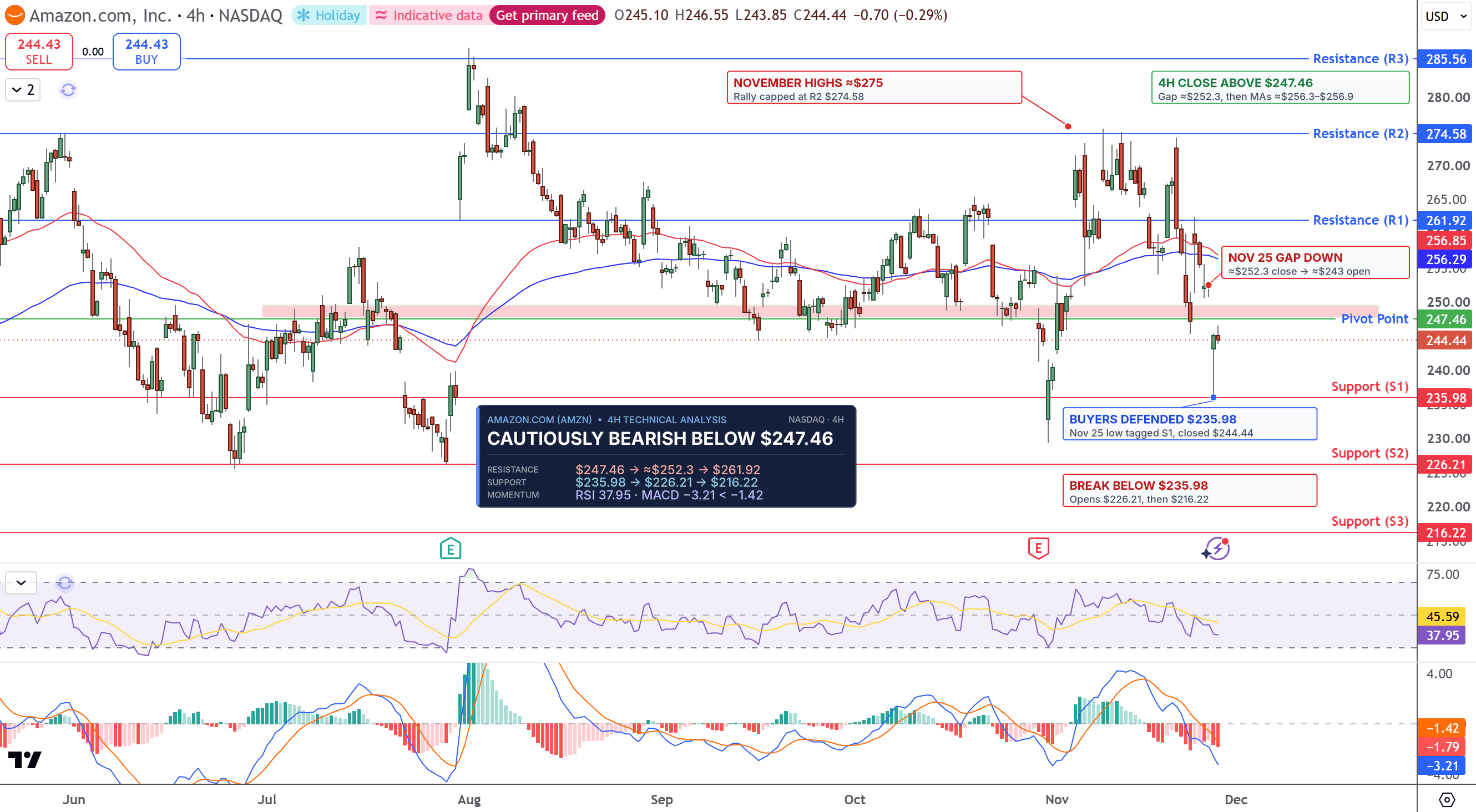
AMZN Price Chart - Source: Tradingview
A 4-hour close back above $247.46 could open $256.29, followed by $261.92. On the downside, a 4-hour close below $235.98 could send AMZN toward $226.21, followed by $216.22.
I'm cautiously bearish while AMZN stays below $247.46, and $235.98 is the key support to watch.
Key Levels
- Last close: $244.43, down 3.12% on Wednesday, November 25 (US markets closed Thursday for Thanksgiving)
- Support: $235.98, $226.21, $216.22
- Resistance: $247.46, $256.29, $256.85, $261.92, $274.58
- RSI: 37.95
- Bullish trigger: 4-hour close above $247.46
- Bearish trigger: 4-hour close below $235.98
FAQs
Why did Amazon stock fall on November 25?
Amazon fell 3.12% to $244.43 after Bernstein said web activity on usage-based cloud platforms, including AWS, was running about 16% below third-quarter levels, which could slow AWS growth in early 2027. Hot inflation data and new tariff proposals added pressure, though the stock recovered from a 6.47% intraday drop.
What is the Amazon stock forecast now?
The bias is cautiously bearish while AMZN stays below $247.46. A 4-hour close above $247.46 could open $256.29 and $261.92, while a 4-hour close below $235.98 could send the stock toward $226.21 and $216.22.
Bottom Line
Bernstein's cloud warning hit the part of Amazon that earns most of its profit, but buyers defended $235.98 and cut Wednesday's loss by more than half. The level that matters now is $247.46. In my view, a 4-hour close above it after re:Invent would suggest the AWS worry is fading, while a 4-hour close below $235.98 would open the way toward $226.21.
Recommended Articles












Comments (0)
Click the $ button, enter the symbol, and select to link a stock, ETF, or other ticker.