


 Discount


US Stocks Diverge as Dow Rises 400 Points, Nasdaq Drops 1.5%; Tech Stocks Lead Declines, Anthropic Falls Below $83 Issue Price



AI Podcast


On Tuesday, November 24, Eastern Time, U.S. stocks diverged as tech shares and semiconductor firms declined, led by losses in Nvidia and Micron amid governance scrutiny and tariff uncertainties, while the Dow gained. Key corporate developments included Sanofi’s $41 billion acquisition of Insmed to offset upcoming patent expirations, and potential merger prospects for SpaceX and Tesla. Macroeconomically, the U.S. prepared trade overcapacity probe results and tariff adjustments across major economies. Meanwhile, JPMorgan projected a potential gold rebound to $4,500 by Q4 2027 and diverging trends in industrial metals.
TradingKey - On Tuesday, November 24, Eastern Time, U.S. stocks diverged. Nvidia gave back some of its gains from the previous trading day, while chip stocks such as Micron and AMD also moved lower, weighing on the Nasdaq and the S&P 500. Meanwhile, the possibility that the U.S. may raise tariffs on economies including China and the European Union added uncertainty to the market.
At the close, the Dow Jones Industrial Average rose 0.85% to 50,018.70 points; the Nasdaq Composite Index fell 1.48% to 23,733.54 points; and the S&P 500 Index fell 0.50% to 7,201.09 points.
Tech Stock Performance
Anthropic (ANT) fell 6.54% intraday, breaking below its IPO offering price of $83. Wedbush remains optimistic about Anthropic's prospects in the AI investment cycle, noting that the company is poised to benefit from enterprise demand for advanced AI models.
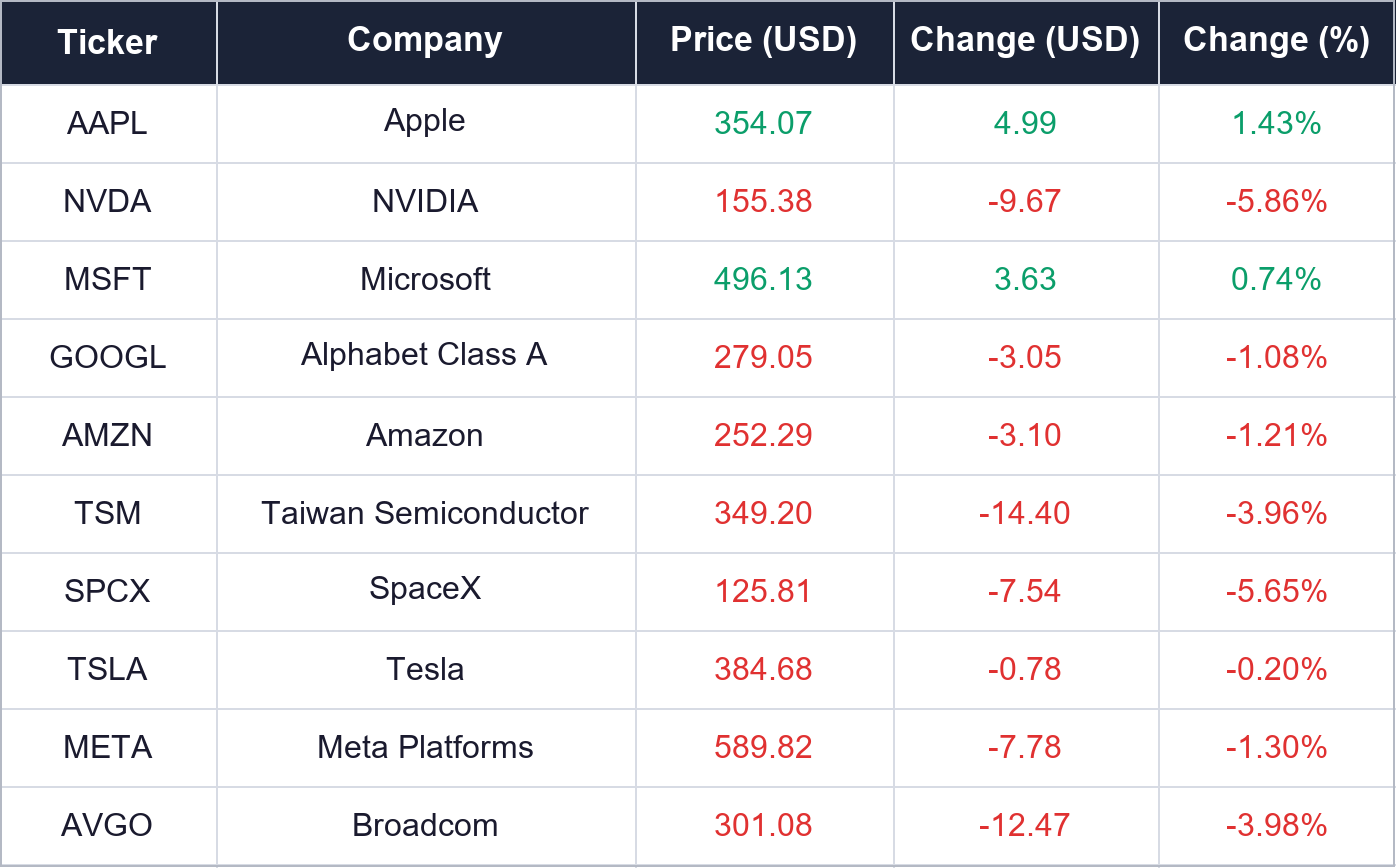
Nvidia fell 5.86% to $155.38.
Tom Hulick, CEO of Strategy Asset Managers, believes that Jensen Huang may currently still be the right person to lead Nvidia, but corporate governance issues remain unresolved. Diana Baechle of SimCorp pointed out that given Nvidia's influence on U.S. equities far exceeds that of an ordinary single stock, the company's future moves will affect the market alongside factors such as policy changes following the U.S. midterm elections and potential interest rate hikes by the Federal Reserve. Until these matters become clearer, investors may reduce risk exposure, and market volatility could persist.
The performance of mega-cap tech stocks today is shown in the chart below:
The Philadelphia Semiconductor Index fell 7.88% to 8,832.5 points, with all 30 constituent stocks declining across the board. Among them, Texas Instruments (TXN) fell 11.25%, Micron Technology (MU) fell 10.97%, Advanced Micro Devices (AMD) fell 8.86%, Intel (INTC) fell 8.15%, Applied Materials (AMAT) fell 6.66%, Lam Research (LRCX) fell 6.47%, and ASML (ASML) fell 3.45%.
Company News
Jensen Huang Apologizes to Employees After Reinstatement; Congress to Hold Hearing on Export Controls
Jensen Huang reportedly apologized to employees on Tuesday during his first all-hands meeting since returning as CEO, acknowledging that his actions violated Nvidia's code of conduct and let down employees. He described it as the toughest company meeting he had ever experienced and thanked Chief Financial Officer Colette Kress for leading the company during his nearly two-week absence.
In Washington, Huang's reinstatement and the Trump administration's role in it continue to face scrutiny from lawmakers of both parties. Senate Democratic Leader Chuck Schumer stated that once Democrats take control of Congress next year, they will investigate the Trump administration, Huang, and other Nvidia executives. Democratic Senator Elizabeth Warren demanded that the White House explain which officials were involved in the reinstatement decision and what advice they provided to the board. Meanwhile, Senate Banking Committee Chairman Tim Scott announced that Huang will appear at a public hearing on chip export controls on December 3.
Sanofi to Acquire Insmed for $41 Billion to Prepare for Core Drug Patent Expirations
Sanofi (SNY) announced that it will acquire U.S. biotechnology company Insmed (INSM) for $175 per share in cash, representing an equity value of approximately $41 billion and a premium of about 46% over the closing price on the last trading day before news of a potential deal surfaced. The transaction has been approved by the boards of directors of both companies and is expected to close in the first half of 2027, subject to approval by Insmed shareholders and relevant regulatory authorities.
The transaction will add commercialized drugs such as Brinsupri and Arikayce to Sanofi's respiratory disease portfolio. Sanofi's top-selling drug, Dupixent, is expected to begin losing patent protection in the early 2030s. Jefferies analyst Michael Leuchten believes the acquisition is poised to extend Sanofi's earnings growth into the 2030s and buy time for the company to replenish its R&D pipeline.
JPMorgan: SpaceX Could Qualify for S&P 500 Inclusion Sooner If Merged with Tesla
JPMorgan believes that if SpaceX (SPCX) and Tesla (TSLA) complete a merger, the S&P Dow Jones Indices committee could waive certain eligibility requirements based on past precedents, paving the way for SpaceX's inclusion in the S&P 500 Index. The bank estimates that if ultimately included, passive buying could amount to approximately 10% of SpaceX's float.
Even without a merger, as share lockup periods expire, S&P will also raise SpaceX's float-adjusted market capitalization in stages, potentially allowing it to enter certain broader-coverage S&P Dow Jones indices earlier. JPMorgan previously estimated that related passive buying might not emerge until September 2027 at the earliest. The two companies have not yet announced any merger agreement.
Industry & Macro News
US Set to Release Overcapacity Probe Results on 16 Economies, New Tariffs May Vary by Trading Partner
The Office of the United States Trade Representative (USTR) is preparing to release the findings of an investigation into manufacturing overcapacity across 16 economies, including China, the European Union, Japan, and South Korea. Launched in March this year under Section 301 of the US Trade Act of 1974, the probe focused on whether policies such as industrial subsidies have created structural overcapacity and harmed American manufacturers. Based on the findings, the US may propose a new round of import tariffs, some of which could be layered on top of existing duties. Specific tariff rates, covered products, and effective dates have not yet been announced.
Tariff rates may reportedly be set individually by trading partner, and the US is expected to adhere to the rate caps established in existing agreements, including 15% for the EU, Japan, and South Korea, and 19% for Malaysia. For China, the key factor is whether the trade truce set to expire on January 10, 2027, can be renewed. If extended, the 20% cap on new tariffs on Chinese goods during Trump's second term is expected to remain in place; if not renewed, the US could propose higher duties. Meanwhile, the US and China are also discussing mutually lowering import tariffs on approximately $30 billion of non-strategic goods each.
US Administration Reportedly Weighs Expanding Military Action Against Iran, Trump Has Yet to Decide
Discussions are reportedly underway within the Trump administration on whether to launch strikes against senior Iranian leaders. Proponents argue that such an action could weaken Iranian hardliners and force concessions, while opponents worry it could harden the stance of the remaining Iranian leadership, undermine the credibility of diplomatic talks, and increase security risks for US personnel. Trump is still weighing his options, including the resumption of larger-scale military actions, and has not yet reached a final decision.
JPMorgan: Gold Expected to Rebound to $4,500 in Q4 2027, Copper and Aluminum to Diverge
JPMorgan expects that if crude oil prices decline and the Federal Reserve pauses interest rate hikes starting in the first quarter of 2027, gold prices could rebound to $4,500 per ounce in the fourth quarter of 2027, while silver could return to around $55 per ounce.
In industrial metals, as the US enters a destocking phase in 2027, the bank expects copper prices to gradually climb to $11,000 per metric ton, while aluminum prices may fall to $2,500 per metric ton by the end of 2027 due to supply pressures. In platinum group metals, stronger investment demand could create a supply deficit for platinum in the second half of 2027, potentially lifting prices to $1,800 per ounce; palladium supply remains relatively loose, with prices expected to hold within the $1,000 to $1,200 per ounce range.
This content was translated using AI and reviewed for clarity. It is for informational purposes only.
Recommended Articles






Comments (0)
Click the $ button, enter the symbol, and select to link a stock, ETF, or other ticker.