


ASML Drops 3% as Positive Earnings Priced In, May Test $1,500 Level Short-Term



AI Podcast


ASML's stock dropped 3% to $1,640.95 following its Q3 earnings release, reflecting a "sell the news" reaction despite beating most profit and margin expectations. Strong forward guidance failed to prevent the decline, as pre-earnings rallies had already priced in positive news. Downstream memory sector pullbacks, potential fab capital expenditure slowdowns, and geopolitical export restrictions affecting its Chinese market share contributed to the selling pressure. Lacking fresh catalysts, the stock faces continued consolidation and may retrace another 10% toward the $1,500–$1,530 support range amid constrained short-term upside.

TradingKey - ASML Faces Profit-Taking as Earnings Good News Is Priced In, Stock Drops 3%, May Fall Another 10% in Short Term
On October 14, semiconductor equipment giant ASML (ASML) experienced a classic "sell the news" pattern after releasing its third-quarter earnings. Its stock price dropped 3% during US overnight trading, rapidly breaking below the $1,700 mark and falling as low as $1,640.95.
According to the latest financial results, ASML's core financial metrics generally beat market expectations, except for net sales, as detailed below:
Financial Metric | Official Reported Data | Wall Street Consensus Estimate | Expectation Gap |
Total Net Sales | €11.662 billion (approx. $131.6B) | €11.735 billion | Slightly below expectations |
Net Profit | €4.960 billion | Approx. €4.65 billion | Better than expected |
Gross Margin | 57.5% | 51%–53% (Original official guidance) | Significantly beat expectations |
Earnings Per Share | €12.95 (approx. $12.13) | $12.01–$12.13 | Beat expectations |
Even though ASML's revenue and EPS significantly beat Wall Street estimates, and management provided strong forward guidance predicting Q4 revenue of €14.2 billion to €15.2 billion, higher than the market consensus of around €14.0 billion, the stock price still declined. The primary reason is that earlier gains had already priced in the positive news. ASML's stock price surged to $1,900 prior to the earnings release, bringing its year-to-date gain to over 50%, as the market had already priced extremely high performance expectations into the stock.
Recently, China's ChangXin Memory Technologies (CXMT) unexpectedly announced advances in 4F² DRAM technology, triggering Micron (MU) to drop below the $1,000 mark, SK Hynix (SKHY) to plunge, and the entire Philadelphia Semiconductor Index (SOX) to undergo a continuous pullback. As an ultra-upstream equipment vendor for major memory giants, the plunge in their stock prices raised market concerns over whether fab capital expenditures might slow at the margin, causing ASML to be swept up in sector-wide programmatic selling.
Geopolitical export restrictions and concerns over the weight of the Chinese market are also key reasons for ASML's stock price weakness. Although current deliveries remain strong, investors worry that under export controls, the revenue share from the Chinese market could experience a structural decline in the coming quarters, dropping to around 20%. This has prompted long-term funds to moderately reduce their positions following the positive announcements.
Simply put, ASML's own fundamentals have not deteriorated; the pressure stems more from external factors. This also means that unless downstream demand and export restrictions improve, ASML's stock price upside will remain constrained. From a technical analysis perspective, ASML failed twice in August and October to break above $1,900 and is currently consolidating at high levels. Lacking new catalysts, the stock may drop another 10% to the $1,500–$1,530 range, which represents a pullback low from historical highs and serves as a strong line of defense.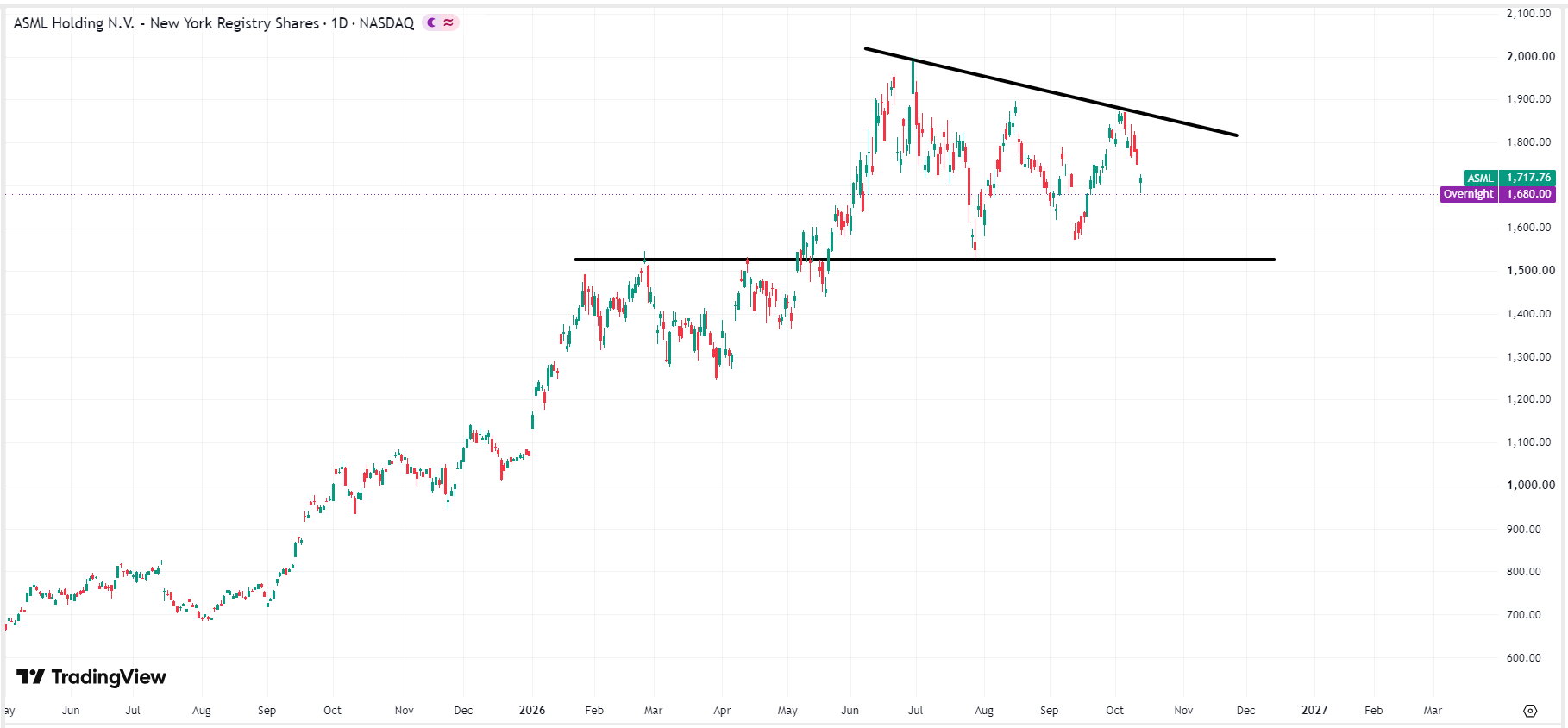
ASML Stock Price Chart, Source: TradingView
This content was translated using AI and reviewed for clarity. It is for informational purposes only.
Recommended Articles










Comments (0)
Click the $ button, enter the symbol, and select to link a stock, ETF, or other ticker.