


Circle Internet Stock Slides 11% as Arc Launch Puts $83 Support in Focus



AI Podcast


Circle Internet shares declined 11.4% following the Senate’s failure to advance the CLARITY Act, compounded by pending Fed rate decisions. Despite strong Q2 USDC circulation, approximately 95% of revenue stems from reserve income, highlighting high revenue concentration and substantial distribution costs tied to Coinbase. Key near-term catalysts include the scheduled Arc public mainnet launch and expansion of the Circle Payments Network with Tazapay. Technically, momentum remains bearish with the RSI at 43. Immediate support sits at $83.00, with a critical downside test at $77.71, while a sustained recovery requires reclaiming the $89.74 resistance level.
TradingKey - Circle Internet enters September 16 with the latest completed close around $86.30-$86.33 on September 15, down about 11.4%, after hitting an intraday low around $84.80-$84.81. The stock was selling off following the failure of the U.S. Senate to advance the CLARITY Act. The markets two biggest events today have the potential to move Circle stock, both being Arc’s scheduled public mainnet launch and a possible Fed announcement that will have direct effect on Reserve income economics. CRCL remains below $89.74 after having been rejected from $103.60; $83.00 is the next downside test.
CLARITY Act Failure Hit Sentiment, Not the Stablecoin Framework
The failure of the CLARITY Act occurred when the U.S. Senate failed to advance the broader digital-asset market-structure bill after the procedural vote fell short of the 60 votes required. The CLARITY Act is not the payment-stablecoin bill; the existing GENIUS Act already provides the federal framework for payment stablecoins.
For CRCL, the failed vote should be seen more as a setback to the crypto markets and less as a setback to Circle’s regulated stablecoin model.
Arc Is Today’s Biggest Company-Specific Catalyst
Circle has set Arc’s public mainnet launch for September 16. At the time of this writing, neither the press nor the investor sections of the company have confirmed that public mainnet is live, so I will consider Arc as a pending catalyst.
Arc is a network for payments, tokenized assets, financial institutions, and transactions with AI-agents at Layer 1. Its founding validator cohort includes BlackRock, DTCC, Galaxy, Global Payments, ICE, Mastercard, MoneyGram, SBI Group, Standard Chartered, Sumitomo Corporation and Visa. Over 100 institutional builders and ecosystem partners have worked on the private mainnet.
Arc’s ability to go beyond Circle’s USDC reserv Yield is a significant strategic consideration because it may facilitate the development of real transactions, settlements, and applications. Should Circle successfully do this, digital dollars may begin providing a much larger and higher quality infrastructure.
USDC Circulation Remains the Core Earnings Driver
USDC circulation was $74.2 billion as of September 14, slightly higher than the circulation of $73.3 billion at the end of Q2. There were $14.8 trillion of on-chain USDC transactions in Q2, an increase of 151% over the previous year.
While impressive, Circle continues to have concentrated revenue.About $701 million was the company total revenue and reserve income for Q2, with $668 million coming from reserve income.
This indicates that in Q2, approximately 95% of total revenue and reserve income was from the reserve income.
The main problem in the current Circle narrative is the gap between income and expenditure. Income is more diversified than the revenue.
A Fed Hike Could Actually Help Near-Term Earnings
All growth stocks are likely to have valuation suffer from the expected 25-basis point rate increase by the Fed today. Interest-rate markets are pricing about a 90% probability of a 25-basis-point increase to 3.75%-4.00%. For most stocks, this is a negative. Circle is different in that their operating metrics are actually impacted in a positive way from an increase in short term interest rates. When short term rates increase, the cash/Treasury reserves backing USDC will also increase in yield.
Increasing short term rates will also increase reserve income potentially even if circulation stability is maintained or improves.
The Treasury rate increase will also increase discount rates, affecting the equity valuation of CRCL even if the reserve economics improve. This makes Circle unique from most software companies.
Payments Network and Tazapay Matter for Diversification
Circle Payments Network has the potential to be the least reliant pathway for pure interest income. Currently, CPN has 175 financial institutions enrolled and trailing-30-day annualized transaction volume of $14.7 billion, up 76% quarter over quarter.
Circle’s agreement to acquire Tazapay builds off the existing 60+ banking and fintech partners, 100+ payout markets and more than $25 billion of annualized payment volume.
Arc can potentially be the settlement layer, and CPN can be the payments layer with Tazapay potentially building the local banking and payout infrastructure over USDC.
If these payment networks begin to generate significant revenue for Circle, the valuation becomes clearer.
Distribution Costs and Competition Remain Major Risks
Circle retains some of the economics from reserve income. Distribution, transaction, and other expenses totaled roughly $412 million in Q2, with a significant portion attributable to various Coinbase agreements. Circle incurred about $324.6 million of Q2 distribution costs related to Coinbase.
This matters because as USDC continues to grow, not all of the incremental economics will accrue to Circle shareholders.
Competition is increasing. Regulatory clarity is making stablecoins more attractive to banks, fintechs, and payment networks as well as Circle. In the long run, a deep moat from a regulation-adjacent advantage is likely to be from liquidity, infrastructure, distribution, and developer advantage, in addition to the basic dollar-backed token issuance.
Circle Internet Technical Analysis: $83.00 Is the Immediate Downside Test
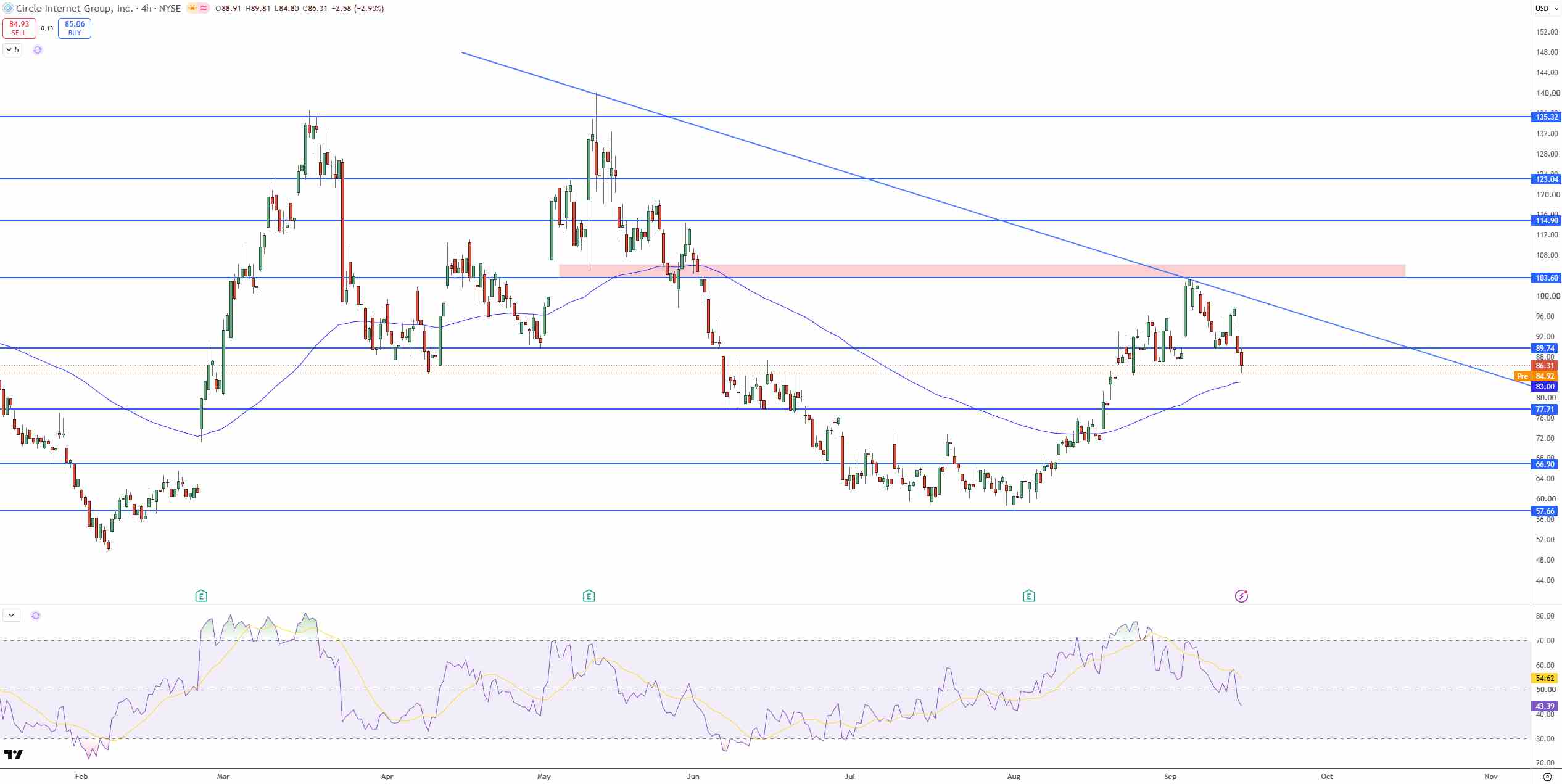
CRCL’s latest close is around $86.30-$86.33, approximately matching the $86.31 provided on the chart following a rejection from the $103.60 resistance zone and a descending trendline. The 4-hour structure has deteriorated with a break below $89.74 and the formation of lower highs.
Circle Price Chart - Source: Tradingview
Currently, RSI at 43 is below its signal line of 55, indicating that for the time being, momentum is in the hands of sellers. RSI is not in oversold territory, so further downside is possible.
The nearest support is around $83.00 and is near the rising moving average. The more important structure support is around $77.71. Breaking $77.71 on a deciding 4-hour basis would reveal $66.90.
From a bull’s perspective, $89.74 is the first area that should be recovered. Beyond that, the descending trendline and the breakout level of $103.60 remain very important. Breaching $103.60 would open up $114.90.
Key Levels
· Recent completed close: $86.30-$86.33
· Immediate support: $83.00
· Major support: $77.71
· Deeper support: $66.90
· First recovery level: $89.74
· Major breakout resistance: $103.60
· Higher target: $114.90
· RSI: Around 43, bearish but not oversold
Why is Circle Internet stock in focus now?
CRCL is in focus after an 11.4% drop after the Senate did not advance the CLARITY Act. This, combined with the Fed announcement, puts further pressure on the stock valuation, as higher rates can pressure CRCL's equity valuation even while improving reserve-income economics. Circle also has Arc public mainnet scheduled to launch today, but the launch had not yet been formally confirmed live at the time of this update.
What level confirms a CRCL recovery?
A recovery would be considered when CRCL reclaims and sustains trade above $89.74. A break of $83.00 further increases the risk of a move toward $77.71.
Bottom Line
Circle has a weak chart with improving long-term fundamentals for its business. Arc has the potential to launch Circle into settlement and financial infrastructure. Tazapay and CPN have also improved the payments infrastructure. The problem is that almost 95% of Q2 total revenue and reserve income came from reserve income, with major competition and high running costs. For now, I am bearish until $89.74 is reclaimed. $83.00 is the next objective for selling to resume. $77.71 would become more likely if $83.00 were to break support.
Recommended Articles










Comments (0)
Click the $ button, enter the symbol, and select to link a stock, ETF, or other ticker.