


Meta Stock Surges on Muse AI Launch as $659 Breakout Comes Into Focus



AI Podcast


Meta rallied 6.55% to close at $653.69, driven by strong Q2 advertising revenue and the introduction of Muse, its new consumer AI agent. While Muse offers a direct AI monetization path via tiered subscriptions, it introduces security risks and high capital expenditures, with 2026 capex projected between $130 billion and $145 billion. Despite a healthy core advertising business, operating margins contracted to 31% due to rising costs. Technically, the stock is overbought with an RSI near 79, eyeing a breakout resistance at $659.05, supported by a bullish hourly structure holding above the $638.72 support level.

TradingKey - Meta opens at $653.69 with a latest completed close nearly matching the chart supplied of $653.47 after a strong 6.55% rally. The stock is now approaching the $658.01-$659.05 resistance level after a series of higher highs and higher lows. Fundamentally, the stock rally is being attributed to the introduction of Muse. As the name suggests, Muse is Meta’s AI agent that can work across email, travel, payments, and other applications. This not only expands how Meta monetizes beyond ads, but also increases the risk related to the AI Meta is building, the security of the algorithms, and the overall AI approaches.
Muse Gives Meta a Direct AI Revenue Model
Muse is a significant divergence from the current state of Meta because instead of utilizing AI to improve advertising and feeds, it has created a virtual assistant that can book travel and sell items and make payments using connected services. Meta has made this assistant available as a free product and two service tiers at $20 and $100 per month for heavy use. This further gives them access to a large user base through WhatsApp.
The success of Muse could validate their move away from ad based products and services to something more AI related. Given that investors have been staying on the sidelines until AI based products were available, the adoption of Muse will prove to be a strong revenue stream from AI.
Security and Reliability Are the Main Muse Risks
The trust required to use this AI is much greater than a standard chatbot. Meta’s AI assistant, Muse, is designed to book travel, send emails, and make purchases, among other things, which will result in actions being taken on behalf of users.
Reuters reported that internal testing uncovered several reliability and security issues, including cases in which the agent exposed or mishandled private information. Meta delayed the product from an earlier planned launch in the hopes of improving safety, and now uses isolated virtual machines combined with system monitoring for some activities.
For me, this is the key functional test. An AI agent which members of the public can interact with, for example, in order to make payments or send emails, becomes more useful the more autonomous it is, but the reputational cost of mistakes becomes greater and much faster.
Advertising Still Funds the Entire AI Bet
Excellent results for Q2 show that Meta's business is performing very well. Revenue was $60.80 billion, up 28% year over year, and the number of Family daily active people rose to 3.60 billion.
Significant performance increases were seen in a rising trend for ad impressions (up 14%) and an increasing average cost for each ad (up 12%). This indicates a notable increase in advertisers wanting to associate themselves with Meta's advertising platforms while improving returns on ads.
Metapositioned its AI offerings differently from other early stage AI companies. As Meta has a large profitable advertisement platform, it is not necessary for AI to become its own profitable business. Whether or not they can develop better ad recommendations, target users and provide creative tools, all will positively impact user ad returns. Meta can fund many experiments and heavy AI usage.
AI Spending Is Now the Biggest Valuation Debate
There is also a big risk of high capital intensity. With record breaking capital expenditures of $31.08 billion in Q2 and $31.86 billion in operating cash, there was a drop to $784 million in free cash flow.
However, management still expects to spend $130 - $145 billion on capital expenditures for the fiscal year 2026 with total expenses expected to be in the range of $165 - $169 billion. During Q3, management still expects revenue to be in the range of $61 - $64 billion with no formal guidance for the downward adjustment.
Investors are very concerned that Meta's returns on its core business are diminishing, and with the large capital investments, investors want to see returns on data centers, chips and AI models, all of which could provide a more positive outlook on Meta's advertisements.
Margins Are the Counterweight to Strong Revenue Growth
In Q2, costs and expenses increased 55% to $42.03B, largely attributable to legal and severance charges. As a result, operating income fell 8% to $18.78B, and operating margin decreased to 31% from 43%.
The margin contraction is worth noting. The advertising engine has remained healthy, however, the cost of developing the subsequent generation of AI products is already evident in the income statement.
In the next earnings release, strong revenue must not be the only metric of concern. I would attribute more attention to CPEX, free cash flow, and whether margins can become stable with continued heavy spending on AI.
Regulation Adds Another Layer of Risk
Along with legacy social media players, Meta is also facing policy pressure. Australia has proposed legislation in which social networks with a significant user base must provide users the choice to control their algorithmic feeds, including a choice to view content from accounts they follow.
For Meta, these rules are important because recommendation algorithms impact the level of user engagement as well as the efficiency of advertisements delivered. Personalization is a key competitive advantage, and laws which weaken it are a concern.
Theai industry is likely to face more scrutiny, especially regarding safety and accountability. This makes Muse’s relevant as a major real-world consumer AI-agent test.
Meta Technical Analysis: $659.05 Is the Breakout Trigger
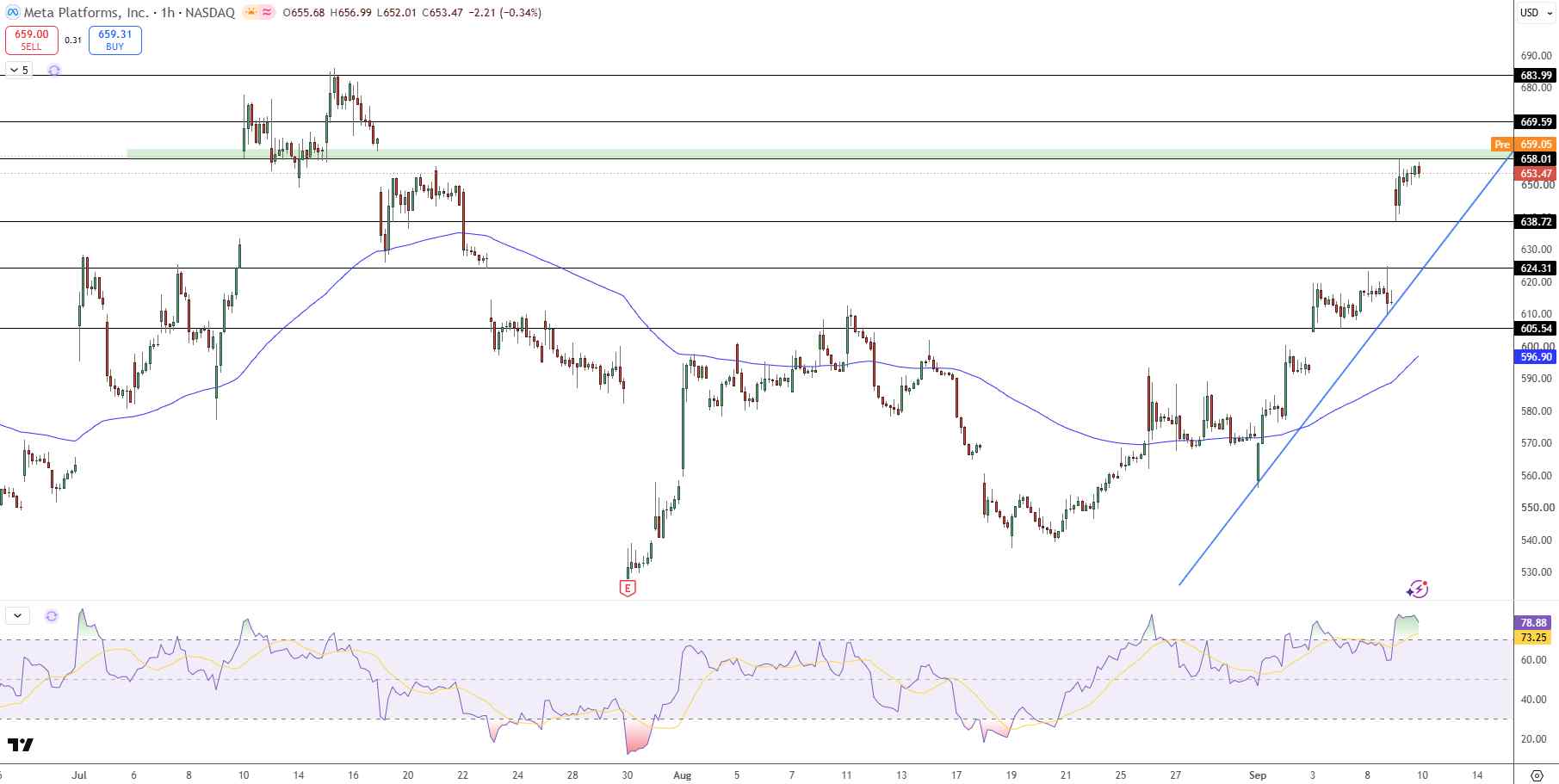
META closed at $653.69, just $0.22 above the reference level at $653.47, after a strong period of consolidation, starting in late August. The 1-hour structure is bullish, with higher highs and higher lows, as well as price trading well above the trend line at around $596.90, and the moving average.
Meta Stock Price Chart - Source: Tradingview
The next resistance is likely to be around $658.01 -$659.05. If this level is broken, price may rise to the next resistance level around $669.59, with $683.99 being the next level after that.
RSI is at around 79, which is above the 70 overbought level, as well as the signal line, around 73. Given the price move, consolidation may be expected. If price falls, support may be found around $638.72. Below this support, price may drop to $624.31 and $605.54.
Key Levels
· Last close: Around $653.69
· Breakout resistance: $658.01 to $659.05
· First bullish target: $669.59
· Second target: $683.99
· First support: $638.72
· Secondary support: $624.31
· Third support: $605.54
· Fourth support: $596.90
· RSI: Around 79, firmly overbought
Why is Meta stock in focus now?
There are two reasons the Meta stock rally is interesting. First is the strong fundamentals for Meta's advertising and the second is the launch of Muse which provides Meta with a direct consumer AI activity path. This path is potentially very large, but in combination with strong advertising fundamentals, security, reliability, and return on the $130-$145 billion 2026 capex plan are of equal concern.
What level confirms further META upside?
A sustained hourly close above $659.05 would confirm that the stock can move past the current resistance zone and justify targeting $669.59 followed by $683.99.
Bottom Line
AI is going to improve advertising for Meta Platforms and that is a positive for the stock. The case for the investment is shifting toward the company's ability to spend tens of billions of dollars on new AI related infrastructure to create new profitable products. The most recent example of this is the launch of Muse. Technically I remain bullish as long as $638.72 holds but $659.05 in combination with RSI near 79 suggests a slight pull back. A clear break above $659.05 would justify targeting $669.59 and then $683.99.
Recommended Articles










Comments (0)
Click the $ button, enter the symbol, and select to link a stock, ETF, or other ticker.