


SpaceX (SPCX) Stock Analysis: AI Revenue Surge, Lock-Up Pressure, and What Comes Next



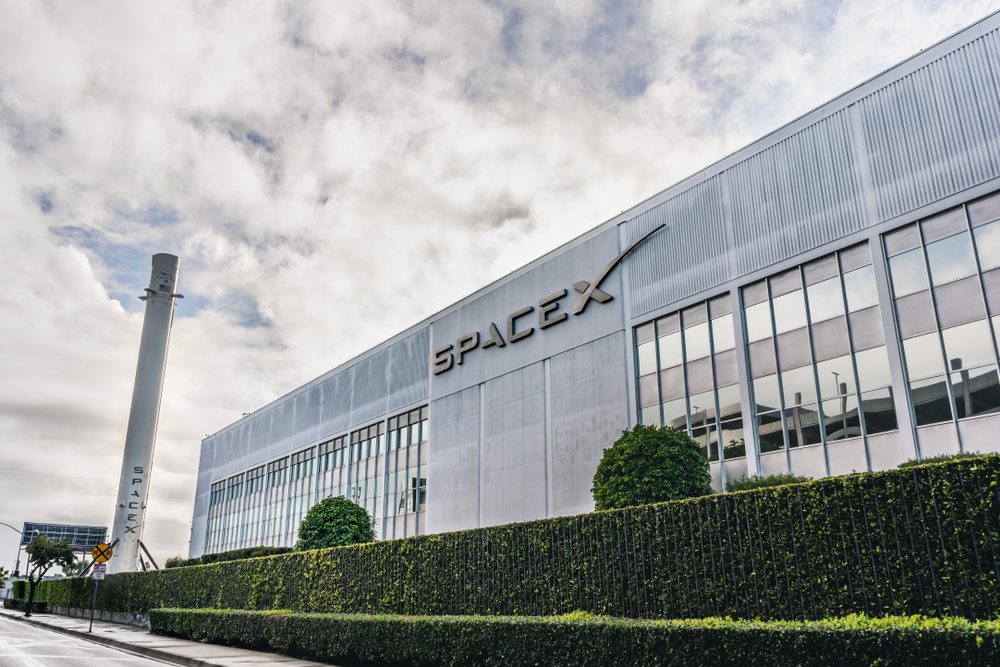
SpaceX (SPCX) delivered a landmark debut earnings report in Q2 2026, with revenue nearly doubling year-over-year and Starlink surpassing 12 million subscribers. Clearly, the fundamentals are strong. But SPCX investors heading into Q4 face a different kind of question: not whether the business is performing, but how the market absorbs a staggered wave of insider supply that has barely begun.
Here is what the data, the lock-up schedule, and the chart are telling us ahead of what could be the most consequential quarter in SPCX's short public history.
Q2 in Numbers: Revenue, Starlink, and the Profitable AI Segment
On August 4, SpaceX reported Q2 revenue of $7.814 billion, up 92% year-over-year, comfortably clearing expectations. The company posted a net loss of $541 million, down from $1 billion a year earlier. Starlink, the company's satellite connectivity business, generated $4.291 billion, a 66% increase, driven by 12 million total subscribers, double the figure from a year earlier. The company also added a record 1.7 million net subscribers in the quarter alone, with enterprise and government connectivity revenue reaching $1.8 billion, supported by Starshield contracts exceeding $6 billion in multi-year commitments.
One thing that caught analysts and investors off guard was the pace of AI growth. The AI infrastructure segment was the standout performer. Revenue of $2.561 billion represented a 247% year-over-year increase, with segment adjusted EBITDA of approximately $1.15 billion, demonstrating that the capital expenditure being deployed into AI compute is already generating profitable returns. Adjusted group EBITDA reached $3.54 billion, up 191%. The $18.37 billion in capex, well above the $13 billion analyst consensus, dwarfed operating cash generation at the group level.
Two additional catalysts emerged around earnings. On August 6, SpaceX and Tesla announced Terafab, a $16.8 billion joint venture to construct a semiconductor manufacturing facility in Grimes County, Texas, spanning 100 million square feet. The facility is designed to supply chips for Tesla's Optimus robots and Cybercabs as well as SpaceX's proposed Starlink data centers, representing Elon Musk's most concrete step yet toward vertical integration of AI hardware. On August 7, Argus Research upgraded SPCX to Buy with a $160 price target, citing the strength of the Starlink subscriber trajectory and the profitability inflection in AI infrastructure.
Taken all together, Q2 marked the moment SpaceX shifted from a high-growth story built on promises to one backed by profitable numbers across multiple business lines.
The Lock-Up Calendar: What Happened in Q3 and What to Expect in Q4
Understanding SPCX's price action in Q3 requires understanding of its lock-up structure, which is unusual by any measure. At IPO on June 12, only approximately 5% of SpaceX's total shares were available for public trading. The remaining 95% are locked, releasing in a staggered schedule through 2027. This is not a standard 180-day cliff; it is a ladder, and investors are currently in the middle of it.
The first major release occurred on August 6, the second full trading day after Q2 earnings. Up to 911.5 million shares held by early investors became eligible for sale. The outcome defied the widely anticipated sell-off: the stock rose approximately 6% on the day, as actual selling pressure proved far lighter than feared. Morgan Stanley interpreted the muted insider selling as a constructive signal, and Argus followed with its upgrade the next morning.
What comes next is more material. Employee and core insider shares unlock in rolling 7% tranches at 70, 90, 105, 120, and 135 days from the IPO date, meaning the supply drip continues through October. The single largest supply event before year-end is tied to Q3 earnings: a 28% release of the 180-day block, approximately 1.3 billion shares, is triggered by the Q3 earnings report expected in late October or November. December 8 marks the full 180-day expiry for all remaining non-Musk, non-extended-investor shares. Elon Musk's approximately 6.4 billion shares, the largest single block, are locked for 366 days with no early release provisions, meaning they do not become transferable until June 12, 2027.
The key takeaway: The August 6 expiry passing without incident is encouraging. But the Q3 earnings-triggered release is a different order of magnitude, and it arrives at the same moment the market will be reassessing the business against elevated expectations. That combination of supply and scrutiny is the central risk heading into Q4.
Technical Setup: Key Levels to Watch
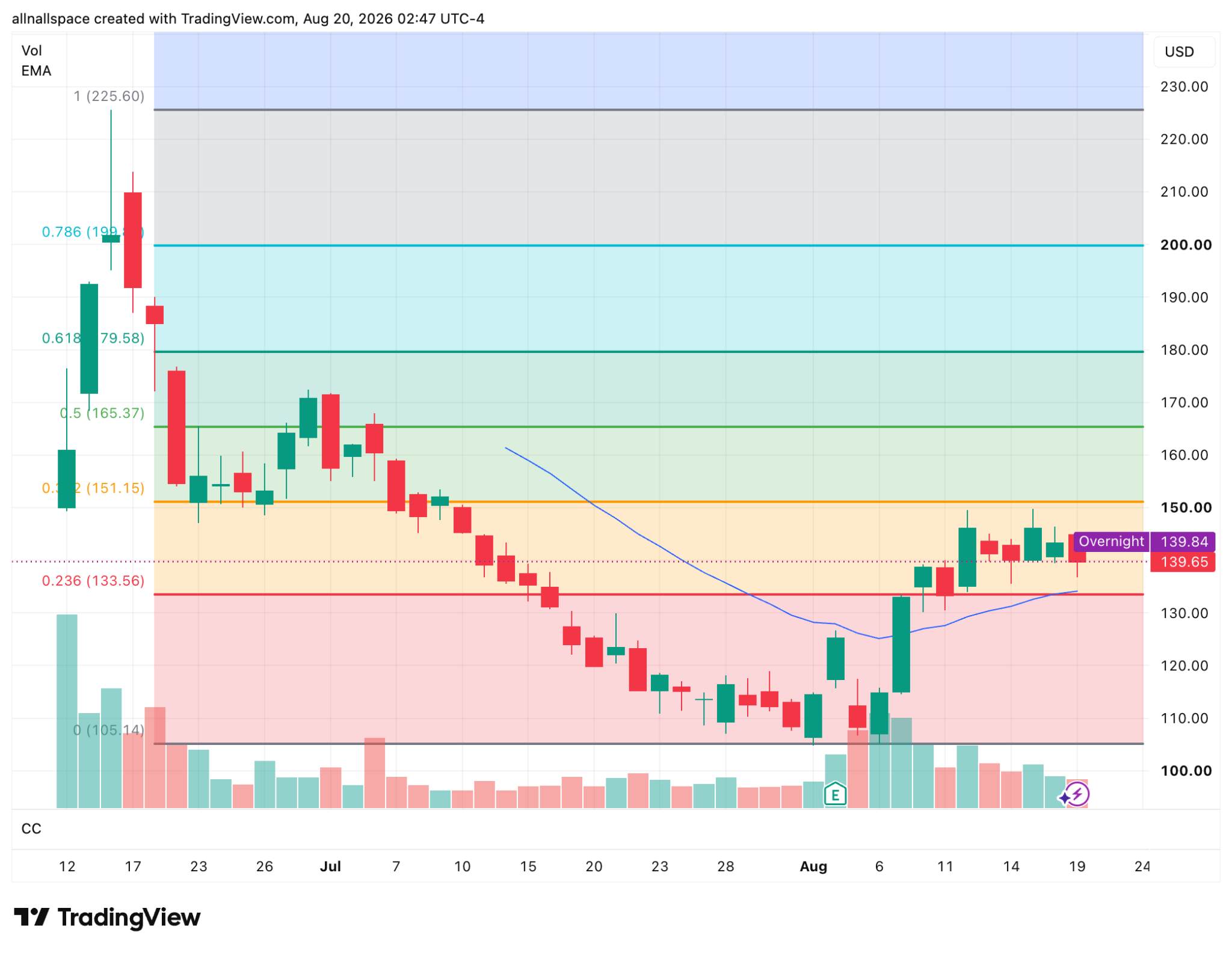
In our analysis, we drew Fibonacci retracement levels on the daily chart from SPCX's all-time high of $225.64, reached on June 16, 2026, to the post-IPO low of $104.83, reached on August 3, 2026. The following levels are based on the daily chart as of August 20, 2026.
Notably, since August 10, SPCX has been consolidating within a defined range, bounded by $133.56 on the downside and $151.15 on the upside. This range reflects the market's uncertainty ahead of the next major lock-up event, with buyers defending the lower boundary and sellers capping rallies at the first Fibonacci resistance level.
Source: TradingView
As you can see from the above chart, the $133.56 level is the most important line to watch heading into Q4. It has held since August 10 and represents the floor of the current consolidation. A sustained break below it, particularly ahead of the Q4 earnings-triggered lock-up release of approximately 1.3 billion shares, would shift the medium-term outlook materially and put SPCX's post-IPO low of $104.83 in play.
On the upside, a confirmed break above $151.15 would be the first technical signal that the recovery is gaining traction, opening the path toward $165.37 as a year-end target.
Key Levels to Watch Ahead of Q4
Here are the key price levels investors should monitor heading into Q4 earnings and the next major lock-up event.
Level | Price | Type | Significance |
Post-IPO low | $104.83 | Support | Maximum downside reference. A break here signals a full round-trip to the IPO price |
23.6% retracement | $133.56 | Support | Lower boundary of the Aug 10 consolidation range, key floor to defend |
38.2% retracement | $151.15 | Resistance | Upper boundary of the current range, must clear to signal recovery momentum |
50% retracement | $165.37 | Resistance | Mid-range recovery target. Realistic Q4 scenario if lock-up absorption holds |
61.8% retracement | $179.58 | Resistance | Bull case year-end target. Requires Q3 earnings and lock-up to clear cleanly |
76.4% retracement | $199.32 | Resistance | Extended bull target: a 2027 story contingent on Starlink growth and capex moderation |
All-time high | $225.64 | Resistance | Full recovery target. Requires sustained fundamental re-rating |
The AI Story: A Long-Term Thesis, Not a Q4 Catalyst
As previously mentioned, SpaceX's AI infrastructure revenue surged 247% in Q2, and the Terafab joint venture signals serious long-term intent to control the semiconductor supply chain for AI compute. These are genuinely significant developments. However, investors should be careful about pricing AI as a near-term SPCX catalyst, for two reasons.
First, Terafab is a construction project. A 100-million-square-foot semiconductor facility in Texas will not produce chips in Q4 2026. The timeline from groundbreaking to meaningful output is measured in years, not quarters. Second, the primary short-term beneficiary of SpaceX's AI capital expenditure may be Nvidia as a supplier rather than SpaceX itself. SpaceX spent $18.4 billion in capex in Q2 alone, and a significant portion of that flows to hardware suppliers upstream.
In short, the AI story for SPCX is compelling, but it is a 2027 and beyond story. It also explains, in part, why SpaceX was willing to pay $60 billion to acquire Cursor, a move that signals how seriously the company is treating AI as a core infrastructure layer, not a side project. For Q4, the focus belongs on Starlink growth, the lock-up calendar, and whether the business can sustain free cash flow as capex remains elevated.
Q3 Earnings and Q4 Outlook: What Investors Should Watch
Q4 is shaping up to be the most important quarter in SPCX's short public history, with fundamental momentum, a critical lock-up event, and key technical levels all converging at once. Here is what traders and investors should be watching closely.
Starlink subscriber trajectory. Adding 1.7 million net subscribers in Q2 was a record. The question for Q4 is whether that cadence is a new baseline or a one-off quarter. Continued growth above 1.5 million net adds per quarter would support the revenue multiple. Any deceleration will attract attention given the current valuation.
Capex and cash generation. The key question for Q3 earnings is whether capex begins to moderate as the initial AI infrastructure build matures, and whether Starlink's segment-level cash generation can offset group-level spending. A further capex increase would raise questions about the sustainability of the AI infrastructure build heading into 2027.
Starship Flight 14. Starship Flight 13 launched successfully on July 24, 2026, from Starbase in Texas. The V3 vehicle deployed 20 next-generation Starlink V3 satellites, completed an in-space Raptor engine relight, and achieved a soft splashdown in the Indian Ocean, a meaningful technical milestone.
Flight 14, tentatively targeted for early September 2026, will attempt something no rocket program has done before: catching the Starship upper stage with the launch tower's Mechazilla arms. A successful catch would be a landmark moment for reusability and a significant positive catalyst for SPCX sentiment heading into Q4 earnings.
The Q3 earnings lock-up trigger. The 28% release of the 180-day block, approximately 1.3 billion shares, is the largest single supply event before December. The market absorbed the August 6 release better than expected. Whether it absorbs a release that is materially larger, arriving simultaneously with Q3 earnings scrutiny, is the most important variable for SPCX price action between now and year-end.
Bottom Line
SpaceX's Q2 results were exceptional. The business is growing at an extraordinary rate, Starlink is profitable, AI infrastructure is scaling faster than expected, and the first lock-up expiry passed without the anticipated selling pressure. The Argus upgrade and the Terafab announcement add further credibility to the long-term thesis.
That said, SPCX does not come without risk. The stock is currently facing downside pressure ahead of the second wave of lock-up expiries, with approximately 1.3 billion shares set to unlock around Q3 earnings, a supply event materially larger than August 6. The elevated valuation remains a concern, with the stock trading at a significant premium on a price-to-earnings basis relative to comparable growth names. Some analysts argue there is considerably more downside risk than the current price implies. For investors considering entry, the P/E argument is worth taking seriously alongside the fundamental momentum.
Looking ahead, Q3 earnings narrows the focus to two things: whether the stock can hold the $133.56 support level as the rolling lock-up tranches continue to add supply, and whether the Q3 earnings-triggered release of approximately 1.3 billion shares, the largest single unlock before December, is absorbed as cleanly as August 6 was. If it is, SPCX's path toward $151.15 and beyond remains open. If it is not, a more meaningful pullback should be expected.
Disclaimer: This analysis is for informational purposes only and does not constitute investment advice. The content represents the views of the AllinAllSpace editorial team and should not be construed as a recommendation to buy, sell, or hold any security. Always conduct your own due diligence before making investment decisions.
Recommended Articles






Comments (0)
Click the $ button, enter the symbol, and select to link a stock, ETF, or other ticker.