


Micron Stock Price Forecast: Memory Supply Tightness to Last Through 2027 as Shares May Return to $1,000



AI Podcast


Micron Technology’s stock has rebounded over 20% since its July 29 low, fueled by a market repricing that BofA views as premature downcycle fears rather than fundamental weakness. Long-term memory demand, particularly for HBM, is expected to remain tight through 2027, with supply-demand gaps potentially widening. While competition from Chinese manufacturers like CXMT is increasing, analysts consider its current impact limited due to a technological gap and domestic-focused positioning. Technically, Micron’s recovery remains in a critical confirmation phase; an effective breakout above the $918–$925 resistance zone is necessary to shift the trend from a rebound to sustained recovery.

TradingKey - Micron Technology ( MU )'s stock price has retreated all the way after hitting an all-time high of $1,254.8 on June 25, and reached a phase low of $737.88 on July 29. BofA analyst Vivek Arya pointed out that the recent repricing of the stock reflects investors positioning themselves early in anticipation of a potential downcycle, "rather than a response to fundamentals"—which he believes are still continuously improving.
As of August 5, Eastern Time, Micron Technology has rebounded to around $915, with a gain of over 20% during the period. Currently, Micron Technology's stock price has climbed back above multiple short- and medium-term moving averages, hovering near the upper boundary of the downward channel. If the stock price moves further upward, it is expected to confirm a technical structural shift from a downward trend to a recovery.
At this critical juncture, whether Micron Technology's stock price can return to an upward trend hinges on whether the tight memory supply and demand dynamics can persist, whether competition from Chinese manufacturers poses a material impact, and whether the technical side can achieve an effective breakout from the downward channel.
Memory Supply Tightness to Persist Until 2027
According to media outlet DIGITIMES, citing industry sources, the 2027 DRAM and High Bandwidth Memory (HBM) capacity of Samsung Electronics, Micron, and SK Hynix has been fully allocated, covering major long-term agreement customers as well as small and medium-sized buyers.
The report noted that the final allocation received by customers is only 60% to 70% of their initial requests. Industry insiders pointed out that 2027 will enter the most severe stage of memory shortage. While allocation volumes have been basically finalized, final shipping pricing will be determined closer to delivery.
Meanwhile, the full-year NAND Flash capacity of Samsung Electronics, Micron, and SanDisk has also been completely pre-sold, while Kioxia and SK Hynix are expected to complete their allocations by the end of August 2026 at the latest.
Goldman Sachs stated that AI server-driven HBM demand continues to outpace supply, while the yield of the latest generation of HBM has declined significantly due to more advanced process nodes and higher stack layers. Coupled with a higher conversion ratio between HBM and conventional DRAM, this makes supply expansion even more difficult. Goldman Sachs expects the HBM supply-demand gap in 2027 to be tighter than this year.
Goldman Sachs further expects that the blended average selling prices (ASPs) of HBM for Samsung Electronics and SK Hynix will rise by approximately 87% and 100% year-on-year, respectively, in 2027, with both approaching $2.9 per Gb. Among this, the price increase for like-for-like products is about 60%, with the remaining increment coming from product mix improvements.
Although major manufacturers have recently opted to expand capacity in response to tight supply—Samsung plans a 50% capacity expansion, SK Hynix is significantly increasing capital expenditure, pushing forward a $26.5 billion IPO and over $880 billion in domestic industrial investments in South Korea, while Micron has committed to investing $250 billion in the US by 2035.
However, Morningstar analysts warned that capacity from newly built fabs takes 2 to 3 years to come online, and when peak output coincides with a slowdown in demand, there will be a significant risk of oversupply.
Impact of CXMT Limited to Chinese Domestic Market
With ChangXin Memory Technologies (CXMT) completing its listing on July 27, it has officially initiated competition with Micron, Samsung, and SK Hynix. Investors are concerned that Chinese memory manufacturers may impact the global supply and demand landscape.
Reports indicate that Apple has begun testing DRAM chips from ChangXin Memory Technologies (CXMT). According to other recent reports, major PC manufacturers have started sourcing CXMT's DRAM chips for certain laptop models to cope with the ongoing memory shortage.
However, Goldman Sachs believes that CXMT's expansion will primarily target domestic demand, posing a limited material impact on the tight global supply and demand landscape. Regarding the technology gap, Goldman Sachs cited TrendForce data, pointing out that CXMT's current mainstream process is equivalent to the 1z node, while Samsung and Hynix are in the transition phase from 1a/1b to 1c nodes.
In terms of product mix, about 70% of CXMT's mobile DRAM shipments are LPDDR4(X), whereas LPDDR5(X) already accounts for 75% to 85% of Samsung's and Hynix's mobile DRAM, indicating a clear divergence in product positioning.
BofA believes that China's ChangXin Memory Technologies (CXMT) "does not yet pose a threat" in the field of artificial intelligence, as it primarily supplies standard DRAM rather than High Bandwidth Memory (HBM).
Micron Stock Price Forecast: Poised to Return to $1,000
Looking at Micron's stock price chart, the recovery has continued since rebounding from its interim low of $737.88, with the price reclaiming several short- and medium-term moving averages and returning above the 0.618 Fibonacci retracement level ($907.09).
Short-term bulls still retain a certain advantage, but the current price is testing the upper boundary of the long-term descending channel, leaving the trend in a critical confirmation phase of whether the "continuation of the rebound" can be upgraded to a "trend recovery."
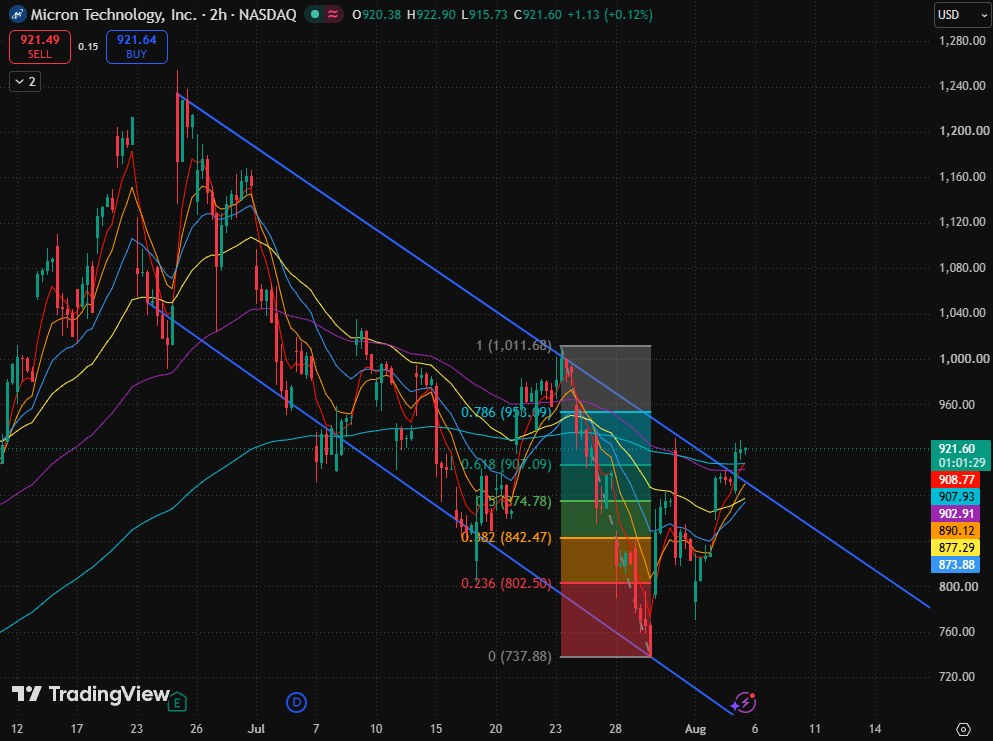
Micron 2-hour stock chart, Source: TradingView
From a pattern perspective, the stock price is currently trading close to the upper boundary of the descending channel, with the area around $918–$925 constrained by both channel resistance and a previous high-volume congestion zone. If the stock price can consistently stay above this range, it would signal that the descending channel may be officially broken; conversely, if it pulls back after testing higher levels, the move should still be viewed as a rebound recovery within the channel.
The primary short-term support lies at the 0.618 Fibonacci retracement level ($907.09), which is also close to the 80-period moving average and the recent moving average support band, serving as the core dividing line between strength and weakness for the current rebound structure. If this level holds upon a pullback, the stock price will still have the opportunity to challenge the upper boundary of the channel and the 0.786 Fibonacci retracement level ($953.30) on the upside.
The second support level below is at the 0.5 Fibonacci retracement level ($874.78), a break below which would suggest that the momentum of this round of rebound is significantly weakening; further down, attention should be paid to the 0.382 Fibonacci retracement level ($842.47).
The greatest risk at present is that, although Micron has reclaimed its major moving averages, it has not yet achieved an effective breakout above the upper boundary of the descending channel. If the price repeatedly faces resistance in the $918–$925 area, short-term profit-taking could drive the price to retest $907.09. Only a high-volume consolidation above the upper boundary of the channel, accompanied by a further break above the 0.786 Fibonacci retracement level ($953.30), would more strongly confirm that the medium-term technical structure is shifting from a downtrend to a recovery.
This content was translated using AI and reviewed for clarity. It is for informational purposes only.
Recommended Articles










Comments (0)
Click the $ button, enter the symbol, and select to link a stock, ETF, or other ticker.