


Costco (COST) Stock Forecast: Cooling Sales Growth, Lawsuit, and Premium Valuation in Focus



AI Podcast


Costco stock has declined roughly 17% from its 52-week high, recently pressured by slowing comparable-sales growth that missed analyst expectations. Despite strong e-commerce performance and high membership renewal rates, investors are increasingly cautious regarding its premium valuation. Further uncertainty stems from a proposed class-action lawsuit concerning heavy metals in a protein product. While Wall Street remains broadly bullish, analysts are increasingly divided, citing limited upside given a high forward P/E ratio. Investors are now focused on upcoming July sales data and Q4 earnings to determine if this cooling growth signals a broader valuation reset.

TradingKey - Costco Wholesale Corporation (NASDAQ: COST) is down nearly 4.5% over the last week and about 17% from its 52-week high of $1,096.50 to trade around $915.
The recent drop came after the company's sales update in June. The overall figures were solid, but investors were more interested in the weaker comparable-sales growth and indications that momentum could be fading. For a stock that has gained more than 175% over the past five years thanks largely to its highly successful membership model, even a modest slowdown can raise questions, especially with the shares still trading at a premium valuation.
Strong Sales, But Growth Continues to Cool
Costco reported net sales of $29.24 billion for the five weeks ended July 5, an increase of 10.6% from a year earlier. Company-wide comparable sales rose 8.8%, extending the retailer's strong growth streak.
The market, however, didn't pay as much attention to the figures as to the growth rate. Comparable sales slowed from 12.5% in May and 11.6% in April, while also falling short of some Wall Street expectations. Telsey Advisory, for example, had projected company-wide comparable growth of 10.6%.
There were also regional differences in performance. Comparable sales in the U.S. held steady at 10.6%, while international markets rose 4.7% and Canada declined by 3.7% sharply. Investors reacted by driving the stock down almost 4.5% in the days after the report.
One segment that remained prominent was an e-commerce. Online sales climbed 20.9% during the month and are now up 21.5% year to date, suggesting Costco's digital business continues to expand without hurting traffic at its warehouse stores.
The Membership Model is Costco's Greatest Asset
Despite concerns over slowing sales growth, Costco's core business remains largely unchanged.
Most of the company's profits come from membership fees, enabling Costco to keep its retail margins extremely low while maintaining its low price strategy. Renewal rates are actually among the highest in retail, at close to 90% worldwide and at above 93% in the U.S. and Canada.
Executive members, who pay roughly three times as much as regular members, also make up an increasing percentage of customers. Costco still enjoys one of the strongest competitive advantages in retail, with 80 million members and more than 60% of the U.S. warehouse club market.
One of the primary reasons that many analysts keep defending the company's premium valuation despite slow sales growth is the recurring revenue that the company generates from membership.
Lawsuit Adds Another Headwind
Adding to investor concerns, Costco was recently named in a proposed class-action lawsuit filed in federal court in Washington.
The lawsuit states that Orgain Organic Protein Powder, available in the Vanilla Bean and Creamy Chocolate Fudge flavors at Costco, contained high levels of lead, cadmium and arsenic. The filing of the complaint by the 7 plaintiffs from six states is based on independent laboratory testing and a prior Consumer Reports investigation.
Orgain has denied the allegations, stating its products meet applicable food safety standards, and no product recall has been announced.
While the claims haven't been substantiated, the lawsuit came at a time when investors were already processing slightly weaker June sales, making the stock more questionable.
Wall Street Is Becoming More Divided
Analysts remain generally positive on Costco, although opinions have become more mixed in recent weeks.
J.P. Morgan held its Buy rating and slightly lowered its price target to $1,100 from $1,110. Goldman Sachs also has a Buy rating, with a price target of $1,159, referring to strong customer foot traffic and little signs of fading demand from consumers.
But not everyone is as optimistic. Citi resumed coverage with a Neutral rating and a $1,020 price target, Roth MKM continues to rate the stock Sell, while Wells Fargo remains on Hold. Wolfe Research, Guggenheim, and D.A. Davidson have also adopted more cautious views, arguing that Costco's forward price-to-earnings ratio in the low-40s leaves limited room for disappointment if growth continues to moderate.
Still, Wall Street's overall sentiment remains bullish, with over 14 analysts rated Buy-equivalent and an average 12-month price target of $1096.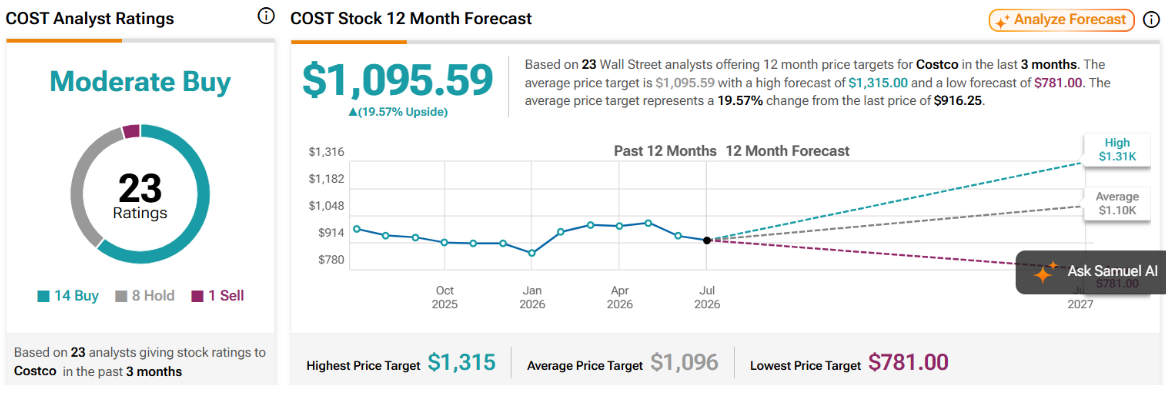
Image Source: tipranks
Key Levels and Upcoming Catalysts
Analyst price targets currently range from Citi's $1,020 to Goldman's $1,159, highlighting the growing debate over Costco's valuation.
From a technical perspective, the first resistance level sits around $936.63, followed by $968.25. Any move above either level will improve short term momentum. The downside support is close to $912.97 while the stronger support is around this week's intraday low of $907.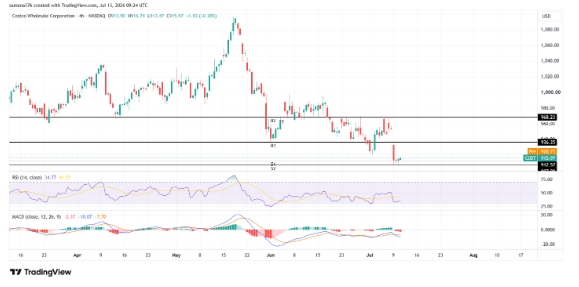
Costco (COST) Stock Forecast - Source: Tradingview
In the coming weeks, investors will closely watch Costco's July comparable-sales update in early August, followed by the company's fiscal fourth-quarter earnings report in September. Those changes should give a better sense of whether June was a blip or the start of an extended period of growth slowdowns.
Costco also continues to return cash to shareholders. Its quarterly dividend of $1.47 is still unchanged and is due on Aug. 7 to shareholders of record on July 24.
The stock is still far off its May record high of $1,094.32, so the next few months will be helpful in deciding if the recent weakness is a good opportunity to buy or the beginning of a wider valuation reset for one of the most valued retail stocks.
Recommended Articles







Comments (0)
Click the $ button, enter the symbol, and select to link a stock, ETF, or other ticker.