


SpaceX Enters a Defining Week as Nasdaq-100 Buying Nears — Can $163 Finally Break?



AI Podcast


SpaceX (SPCX) is currently consolidating between $149.66 and $163.27, following the successful completion of a $25 billion bond offering. A primary catalyst is the July 7 Nasdaq-100 inclusion, which mandates forced index buying. Given SpaceX’s low free float, this mechanical demand may trigger significant upward volatility. Fundamental tailwinds include a massive $920 million monthly compute deal with Google and potential expansion into the mobile phone market. Investors should monitor the $163.30 breakout level, targeting $172.00. However, risks remain regarding the August 6 earnings report and subsequent insider lockup expirations that will increase share supply.
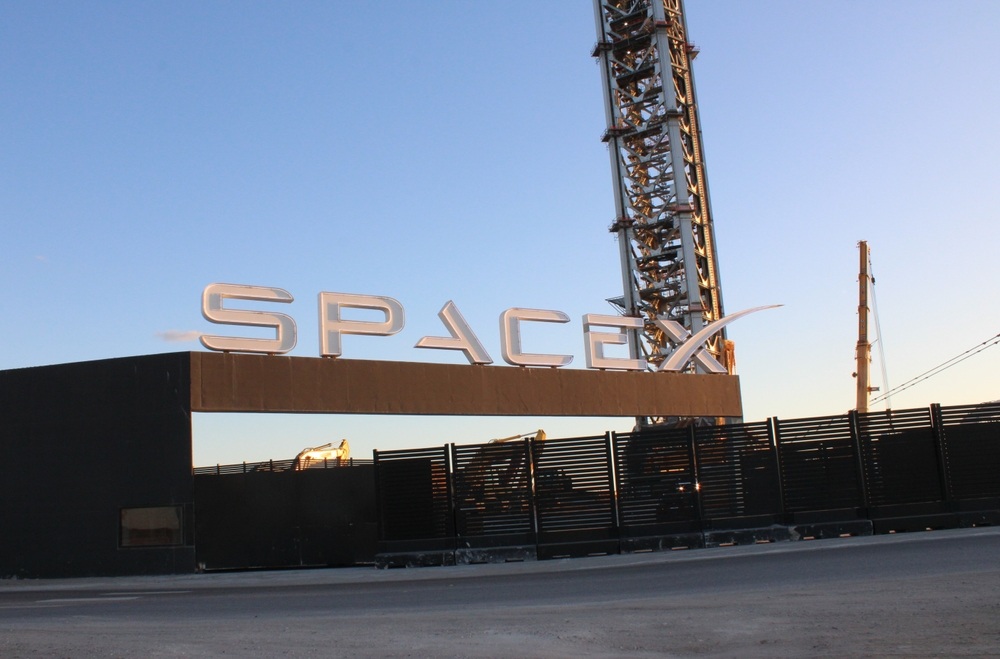
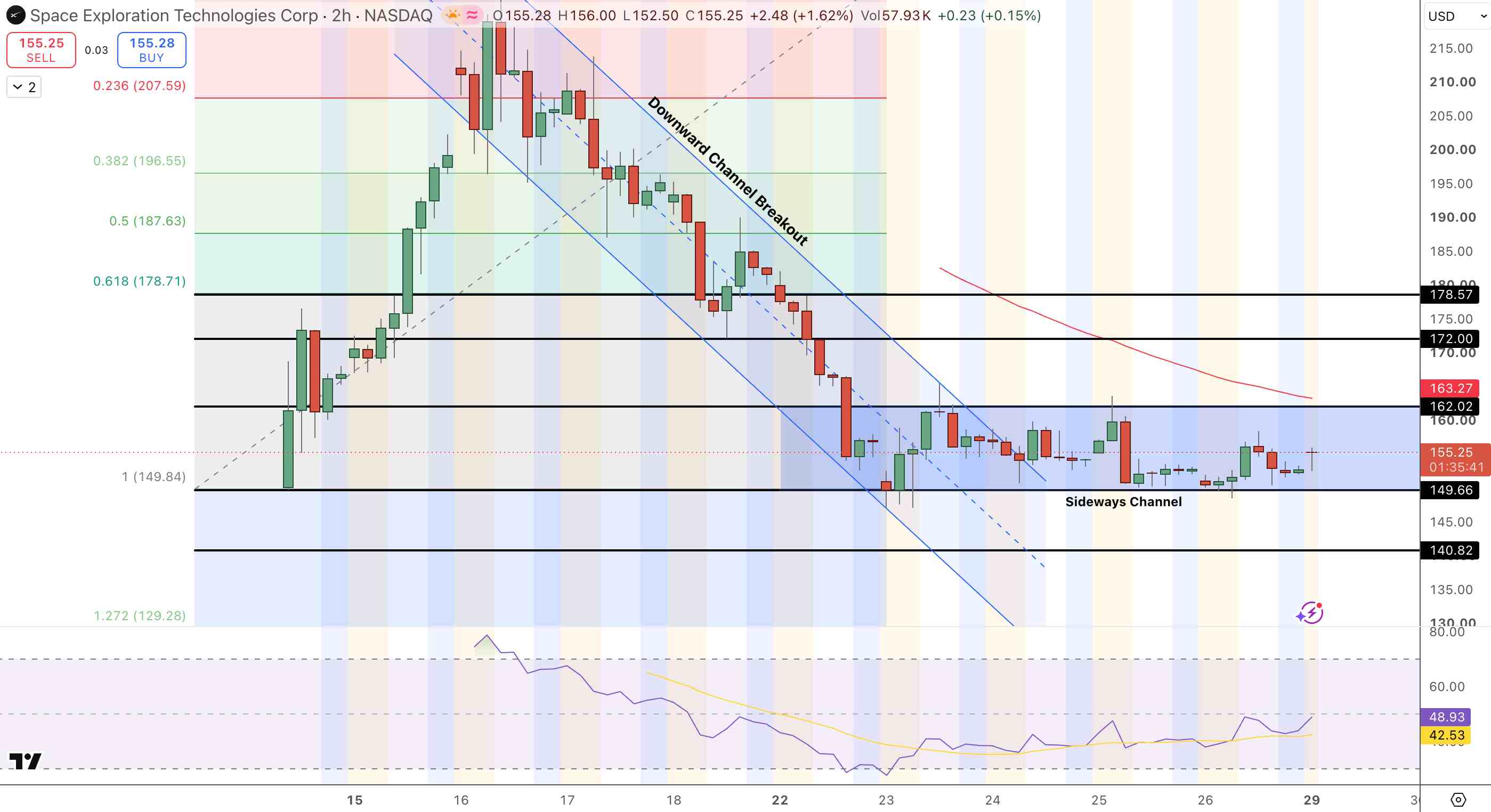
TradingKey - SpaceX (NASDAQ: SPCX) sits at $155.25, having found a floor within a horizontal blue channel following the $25 billion bond offering that completed on June 26 and extinguished the September 2027 bridge loan, the stock’s key structural burden during the stock’s decline from $225.64 to the $147.11 intraday low. This week, two new catalysts have emerged for the next trend: SpaceX will enter the Nasdaq-100 index starting July 7, a mechanical event that will require index funds tracking the QQQ and Nasdaq-100 products to buy SPCX shares at any price, and Argus Research established a Hold rating on Friday, June 27, the first formal analyst rating on the stock since its initial public offering, a move suggesting that the stock is now maturing toward the institutional analyst coverage stage that comes before institutional ownership. RSI at 42.53 is neutral and has room left to run. The horizontal channel between $149.66 and $163.27 represents a consolidation phase where the Nasdaq-100 index rebalancing event could produce a resolution.
The Nasdaq-100 Inclusion on July 7 — What Forced Index Buying Actually Means
Nasdaq-100 entry isn’t an analyst opinion or an investor sentiment event; it’s a forced buy event. Every institution, ETF, or derivative vehicle that tracks the Nasdaq-100 index will be required to hold SpaceX shares at their respective index weights on the July 7 reconstitution date. The Invesco QQQ Trust holds over $300 billion in AUM. Other Nasdaq-100 vehicles, ranging from leveraged ETFs to index mutual funds to structured notes, bring hundreds of billions in additional assets in that must buy SPCX shares irrespective of price, or analyst views, or the state of the market when the index rebalances. Of course, the actual size of the buying depends on the weight that SpaceX holds on the Nasdaq-100, which will reflect its float-adjusted market cap as compared to other components in the index.
Because SpaceX has a free float of roughly 4 to 5%, the remainder of the stock is still locked in through the post-IPO staggered lockup that expires 70 days to 180 days after the initial public offering, SpaceX’s float-adjusted market cap is restricted. This explains why the initial S&P 500 fast-track attempt in June was denied: SpaceX didn’t meet the free float requirements. The Nasdaq-100 does not have the same requirements; Reuters confirms that SpaceX will be added to the index starting July 7.
The low-float scenario also implies that buying from even a modestly sized index rebalancing will have limited float supply to absorb, creating the low-float-plus-index-inclusion squeeze situation that has consistently produced larger-than-expected stock price moves. The most similar recent example is Rocket Lab (RKLB), which joined the Nasdaq-100 on June 22; that Nasdaq-100 event was one of the unique differences in the structural make up behind RKLB outperforming SPCX that month.
What Else Is New — Starlink Mobile Phone, Google $920M Per Month, and the Lockup Calendar
To fill out the fundamental picture, here are 3 more things that have come to light this week. The Wall Street Journal says Starlink is planning a Starlink-branded mobile phone offering in the US for customers, which puts Starlink right into the direct competition with mobile operators by adding consumer mobile service to their satellite Direct-to-Cell connectivity partnerships with T-Mobile. Adding consumer mobile to the Starlink segment would provide a whole other stream of revenue to what is currently only modeled to include broadband, maritime, aviation, enterprise and government, and potentially expand the total addressable subscriber pool 10x if successful. Neither pricing nor launch dates have yet been announced.
Google is reportedly paying SpaceX $920M per month for a compute arrangement. That alone annualizes to $11.04 billion per year, which is more than total 2026 Starlink revenue, and adds to previously announced Anthropic and ReflectionAI compute deals for the xAI segment. Then, there is the lockup calendar: ~20% of insider shares will begin to be available for sale following the Aug. 6 first earnings report, with remaining portions unlocked between 70 days and 135 days after IPO and a substantial portion at 180 days in December 2026. Since the July 7 Nasdaq-100 index rebalance will occur before any lockup expirations begin, the index buyer will be locked out of any meaningful supply from a low float until Aug. 6 at the very earliest.
SPCX Technical Setup — Sideways Channel at $155, Resistance $163.27, Target $172
The 2H chart for SPCX currently sits at $155.25. After breaking out to the downside from a previous down trend channel, the price has entered into a sideways channel (blue) between $149.66 support and $163.27 resistance; the current RSI is neutral (42.53), has room to go either direction, is not exhibiting any significant divergence; the market has neutral momentum, which is characteristic of a sideways pre-break pattern.
SpaceX Price Chart - Source: Tradingview
There is also low volume inside the trading range; the low volume is consistent with pre-break volume characteristics. If price closes above $163.30, the target will be set at $172.00 (sideways channel breakout).
If price falls below $149.70 (lower bound of the sideways channel, the target will open up at $140.82. The Jul 7 Nasdaq-100 rebalance is the catalyst most likely to provide the volume and price movement to push price up and through the sideways channel.
- Entry: Long above $163.30 — sideways channel upper boundary cleared
- Target: $172.00 — channel breakout extension
- Support: $149.66–$149.70 — lower channel boundary
- Stop Loss: Close below $149.70 — lower boundary fails, $140.82 opens
- Nasdaq-100 inclusion: July 7, 2026 — forced index buying event
- Next earnings: August 6, 2026 — first lockup early-release trigger
Bottom Line
The $155.25 SPCX price action has been stuck in a range bound pattern, since the bond settlement has removed the Sept. 2027 bridge loan risk, with two developments setting up the next leg higher in:
- July 7 inclusion in the Nasdaq 100 forces mechanically compelled index buying with constrained supply into a low-float stock
- Google’s compute deal at $920M per month annualizes to $11 billion per year, which is more than all projected 2026 revenue of Starlink.
The July 7 trigger will mark the commencement of the Argus Hold rating. The Starlink mobile phone launch and the Aug. 6 earnings report (which triggers the first lockup early release) should follow July 7. Buy stop for $172.00 above $163.30 Support $149.70, stop under $149.70.
Recommended Articles






Comments (0)
Click the $ button, enter the symbol, and select to link a stock, ETF, or other ticker.