


Kospi Slumps 2% Below 5,000, Nikkei Drops for Fourth Day; Kioxia Plunges Over 5%, Samsung and SoftBank Fall Over 3%



AI Podcast


During the Asian trading session on November 17, Japanese and South Korean equities tumbled broadly, driven by tightening U.S. export controls on AI chips and escalating supply-chain risks. The South Korean KOSPI Index fell 2.59% to 4,968.48, while Japan’s Nikkei 225 declined 1.34% to 58,860.38, extending consecutive losses. Heavyweights like Samsung, SK Hynix, and Kioxia suffered significant declines. Markets remain highly cautious ahead of Nvidia’s upcoming earnings report, which will heavily influence semiconductor sector momentum, alongside ongoing foreign exchange volatility risks tied to the Japanese yen.

TradingKey - Japanese and South Korean stocks tumbled across the board at the close, with South Korean equities breaking below the 5,000 mark and Kioxia plunging over 5%, as markets await Nvidia's earnings report tonight.
During the Asian trading session on November 17, Japanese and South Korean equity markets collectively gapped down at the open and remained in a pronounced pattern of volatile trading at lower levels and weak base-building throughout the day. Following yesterday's 3% tumble, selling pressure on South Korea's KOSPI Index continued to be unleashed today, with the benchmark sliding 2.59% to break below the 5,000-point threshold and close at 4,968.48 points.
The two heavyweight bellwethers continued to fall, with Samsung Electronics sliding 3.05% to narrowly hold the 190,000-won level and close at 190,800 won, while SK Hynix fell 1.79% to 1,100,000 won.
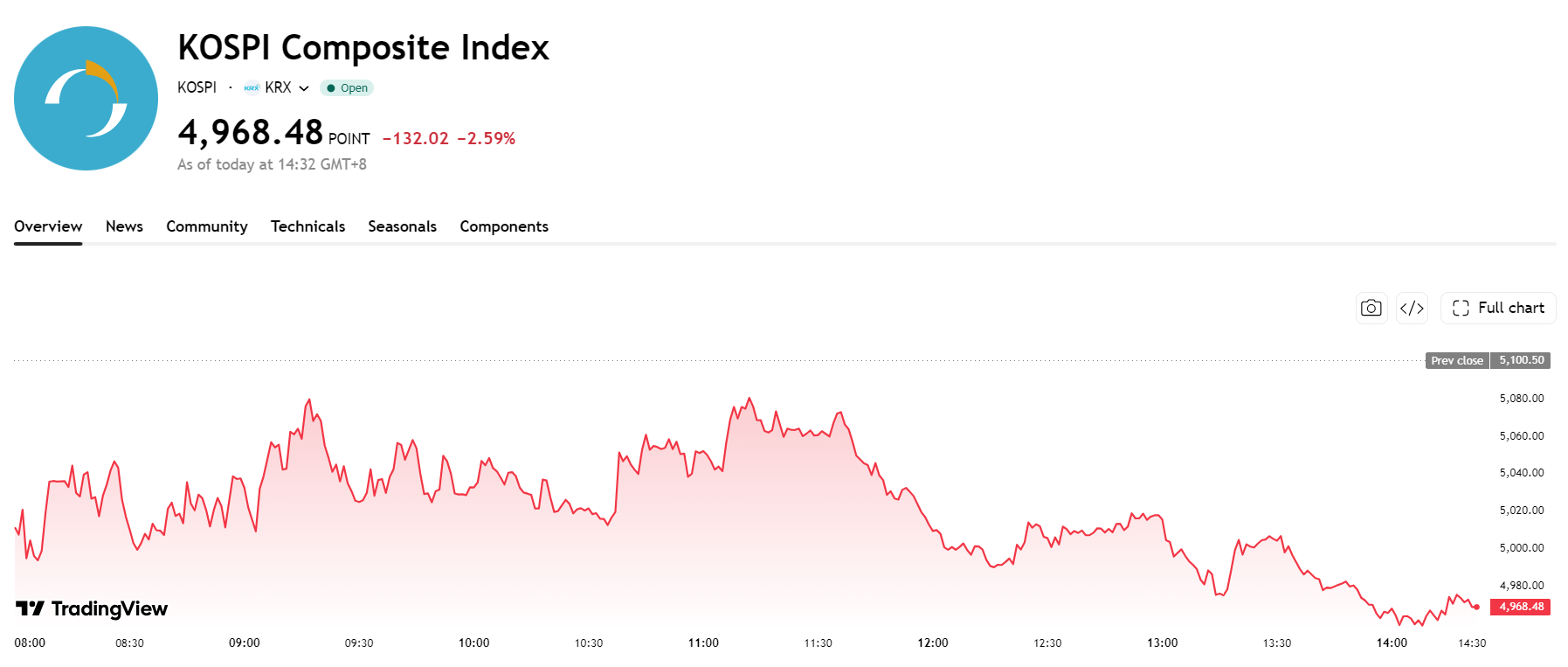
KOSPI Index Chart, Source: TradingView
The Nikkei 225 Index opened lower today and continued to trend downward in choppy trading throughout the session, ultimately shedding 1.34% to close at 58,860.38 points, suffering heavy losses for four consecutive trading days and officially breaching the key 60,000-point mark; Kioxia plunged 5.08% to surrender the 8,000 level and close at 7,966 yen, while SoftBank fell 3.95% to 3,281 yen.
The U.S. government's plan to further tighten export restrictions on Chinese companies' access to advanced artificial intelligence computing chips has exacerbated order and compliance risks for Asia-Pacific semiconductor equipment makers and memory manufacturers, prompting institutional investors to sharply lower supply-chain earnings estimates for the fourth quarter and the first quarter of next year, dragging down U.S. chip stocks and weighing on Japanese and South Korean equities.
In addition, SK Hynix plans to invest 1.4 trillion won (approximately $1.05 billion) over the next five years to support domestic South Korean suppliers of semiconductor materials, components, and equipment. However, this provided minimal direct upside for its share price and was even viewed by the market as an added short-term capital expenditure burden, causing its stock to pull back after a brief spike.
Nvidia's upcoming latest quarterly earnings report, shipment guidance for Blackwell/next-generation chips, and management succession details will directly determine whether the Philadelphia Semiconductor Index and South Korea's two semiconductor giants can stage a sharp rebound tomorrow or continue testing lower levels. In addition, depreciation pressure on the yen and policy rhetoric from the Bank of Japan (BoJ) will continue to influence Japanese equities, underscoring the need to guard against sharp short-term volatility in Japanese stocks should Japan's Ministry of Finance intervene in the foreign exchange market at any moment.
This content was translated using AI and reviewed for clarity. It is for informational purposes only.
Recommended Articles









Comments (0)
Click the $ button, enter the symbol, and select to link a stock, ETF, or other ticker.