


Japanese and South Korean Stocks Slump as Kospi Falls Over 5%, SK Hynix Drops Over 10%, Kioxia Down Over 13%



AI Podcast


On October 13, Japanese and South Korean stock markets tumbled, led by heavy sell-offs in semiconductor giants like Samsung Electronics and SK Hynix, as South Korea’s VKOSPI panic index surged 23%. The synchronized decline reflects growing investor anxiety over the sustainability of the memory chip upcycle, rising competition from emerging players like CXMT, and concerns regarding AI infrastructure financing costs and return on investment amid high interest rates. Industry leaders warn that debt-financed AI buildouts face increasing pressure, exposing vulnerabilities in highly concentrated tech investments.

TradingKey - On October 13, Japanese and South Korean stock markets fell sharply. South Korea's KOSPI index closed down 5.46% at 6,035.36 points, setting a new closing low since August after dipping to as low as 5,911.11 points intraday; Japan's Nikkei 225 Index closed down 1.82% at 67,777.47 points.
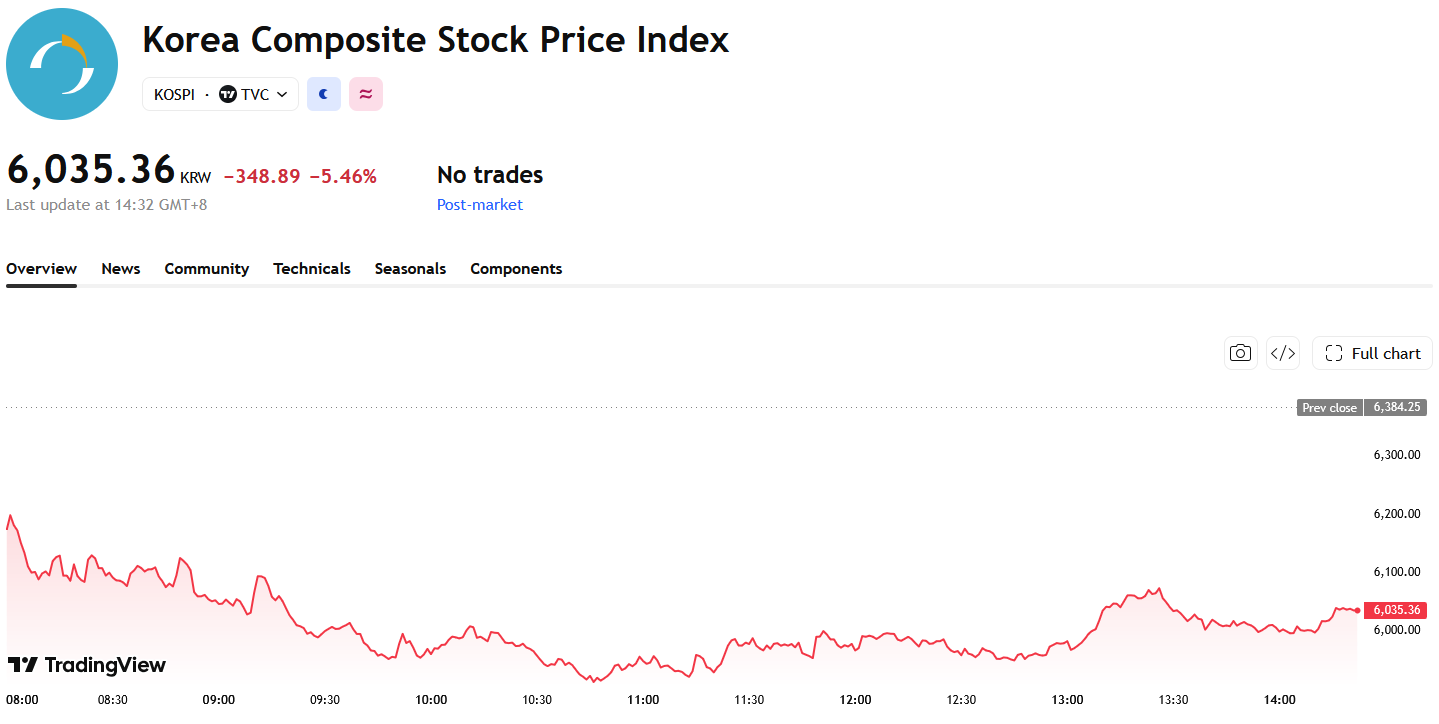
Source: TradingView
South Korean semiconductor leaders faced concentrated sell-offs, with Samsung Electronics falling 7.39% to 232,000 won (about $173) and SK Hynix plummeting 10.09% to 1.443 million won. In the Japanese market, Kioxia closed down 13.28% at 15,180 yen (about $96), while SoftBank Group fell 8.50% to 5,310 yen. The synchronized heavy sell-off in Japanese and South Korean tech stocks indicates that market concerns over the AI supply chain are broadening.
The VKOSPI, known as South Korea's fear index, rose about 23% intraday to reach 51 points, marking its largest single-day gain since March 4 and reflecting a significant rise in investor concerns over heightened market volatility ahead.
Ha Seok-keun, chief investment officer at Eugene Asset Management, stated that the valuations and stock prices of South Korean chipmakers are being impacted by a key question: whether the memory chip industry's upcycle can persist through 2028 and beyond.
Previously, Samsung Electronics and SK Hynix benefited from the boom in AI infrastructure investment, becoming key targets for investors positioning in the AI sector. However, as the market reassesses the sustainability of industry growth, this highly concentrated investment structure is also starting to expose risks.
Cao Kanyu, president of Chinese memory chipmaker ChangXin Memory Technologies (CXMT), recently revealed that the company has made significant progress in its next-generation 4F² memory cell architecture and plans to launch related server memory products before the end of 2026. This progress has heightened market concerns about changes in the competitive landscape of the memory chip industry.
Meanwhile, the market has also grown more cautious about the financing costs and investment returns of AI infrastructure buildouts. Broadcom (AVGO) CEO Hock Tan recently compared current market sentiment to a casino and warned that the financing required for AI buildout could become a bigger challenge for the industry, even surpassing chip shortages. He believes that some investors have overly high expectations for the AI industry without necessarily fully understanding the actual value of related investments. As the high interest rate environment persists, large-scale debt financing projects are also facing greater pressure.
This content was translated using AI and reviewed for clarity. It is for informational purposes only.
Recommended Articles







Comments (0)
Click the $ button, enter the symbol, and select to link a stock, ETF, or other ticker.