


Japan, South Korea Stocks Open Higher and Extend Gains; KOSPI Reclaims 6,600, SoftBank Surges Over 7%, Samsung and SK Hynix Jump Over 2%



AI Podcast


On September 4, Japanese and South Korean stock markets opened strongly higher, driven by stabilizing overnight US equities and easing Federal Reserve rate hike expectations. South Korea's KOSPI index gained 1.53% to reclaim 6,600 points, led by rallies in Samsung Electronics and SK Hynix. Japan's Nikkei 225 also advanced, bolstered by a 7.06% surge in SoftBank and gains in Kioxia. The strong performance of US semiconductor and AI tech giants injected capital confidence into these tech-dependent regional supply chains, though the Nikkei's early gains later narrowed.

TradingKey - Japanese and South Korean stock markets open strongly higher; KOSPI reclaims 6,600 points; SoftBank surges 7%; chip stocks like Samsung and SK Hynix rally across the board.
In Asian trading on September 4, stock markets in Japan and South Korea both rebounded in early trading, opening higher and pushing further up. South Korea's KOSPI Index opened up 1.53%, reclaiming the 6,600 level and trading temporarily at 6,680.44 points. Core tech chip stocks also opened higher and gained further momentum, with Samsung Electronics rising 2% to trade temporarily at 255,000 KRW, and SK Hynix advancing 2.82% to trade temporarily at 1,641,000 KRW.
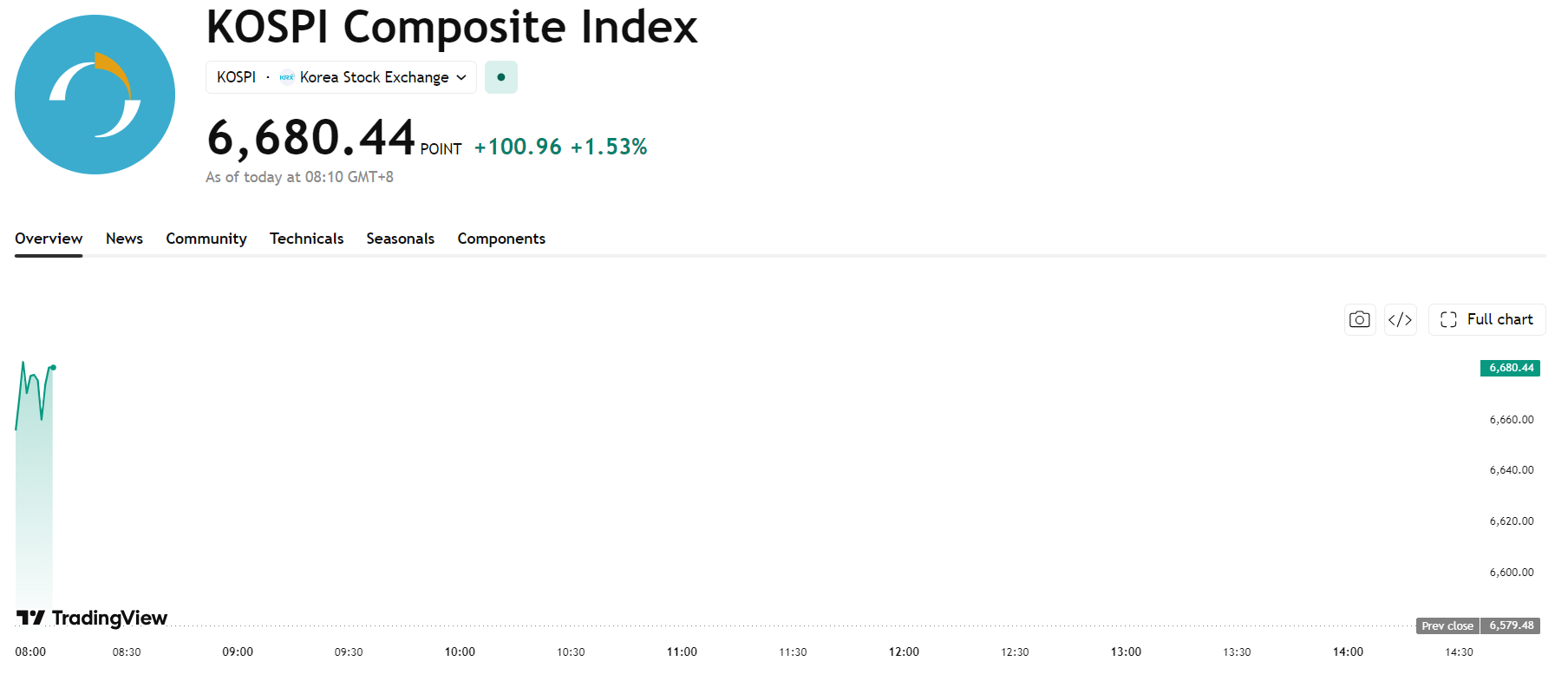 KOSPI index chart, source: TradingView
The Nikkei 225 Index opened 0.44% higher, with gains currently narrowing to 0.24%, trading temporarily at 64,369.88 points. Both major heavyweight stocks advanced: SoftBank's stock price surged 7.06%, strongly breaking through the 5,000 mark to trade temporarily at 5,354 JPY; Kioxia rose 1.26% to trade temporarily at 52,320 JPY.
Market expectations for subsequent Federal Reserve rate hikes dropped significantly, while US Treasury yields and the US Dollar Index pulled back slightly, allowing overnight US stocks to stabilize. In particular, strong performance by US semiconductor and AI tech giants injected capital confidence into the Japanese and South Korean markets, both of which are highly dependent on the electronics and semiconductor supply chains.
This content was translated using AI and reviewed for clarity. It is for informational purposes only.
Recommended Articles









Comments (0)
Click the $ button, enter the symbol, and select to link a stock, ETF, or other ticker.