


US-Iran Tensions Persist, Brent Crude Rises Above $95 a Barrel for First Time in Six Weeks



Geopolitical tensions in the Middle East have driven a surge in international oil prices, with WTI and Brent crude futures recently reaching $88.17 and $95 per barrel, respectively. Strained US-Iran relations, exacerbated by threats regarding Iran's nuclear facilities, have forced markets to reprice supply risks and inflation expectations. Analysts warn that with diplomatic progress stalled and military posturing intensifying, the geopolitical risk premium will remain elevated. While informal communication channels persist, the lack of substantive de-escalation suggests continued volatility and upward pressure on oil prices, heightening concerns over potential global stagflation.

TradingKey - As tensions in the Middle East continue to escalate, the international crude oil market has once again been hit hard. Driven by rising geopolitical risks, international oil prices surged on the 22nd, with WTI crude oil futures ( USOIL-F) rose as much as 4.28% to $88.17 per barrel; Brent crude oil futures ( UKOIL-F) broke through $95 per barrel, returning to this level for the first time since June 11.
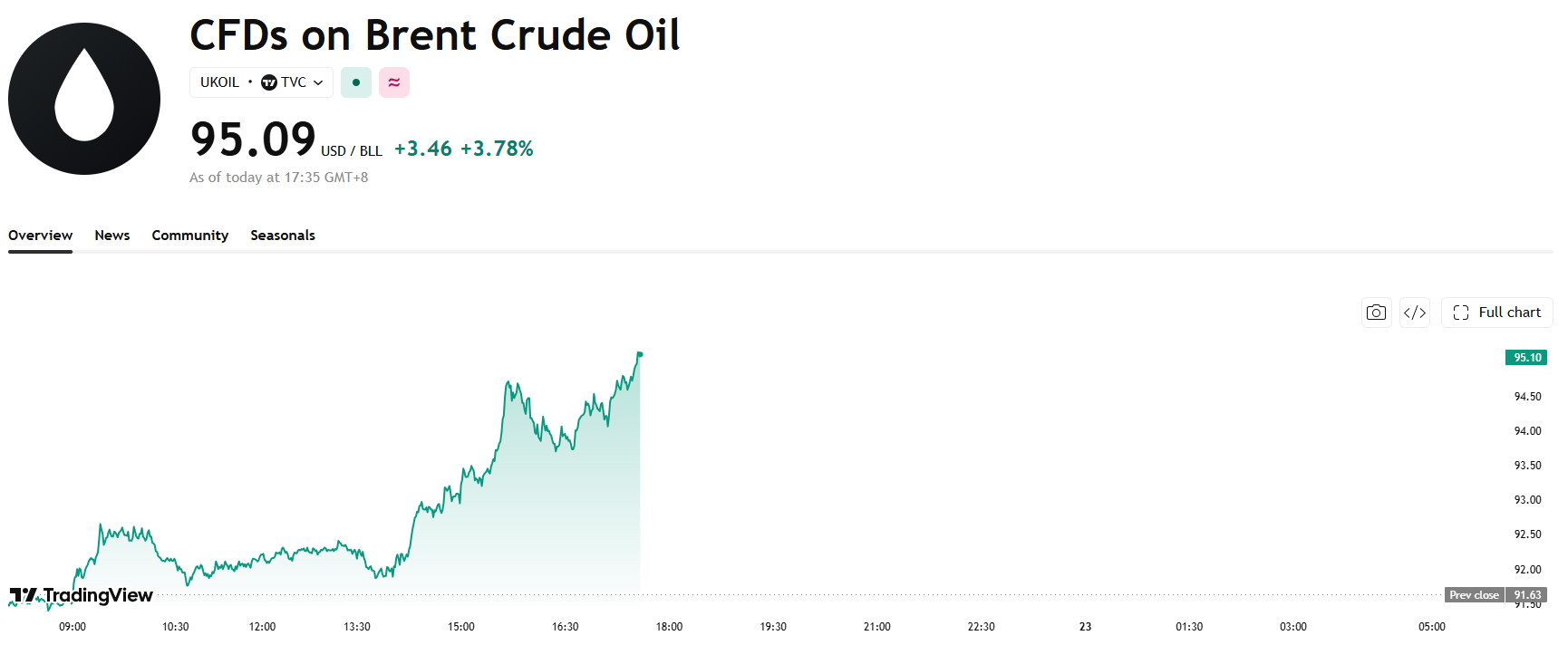
Source: TradingView
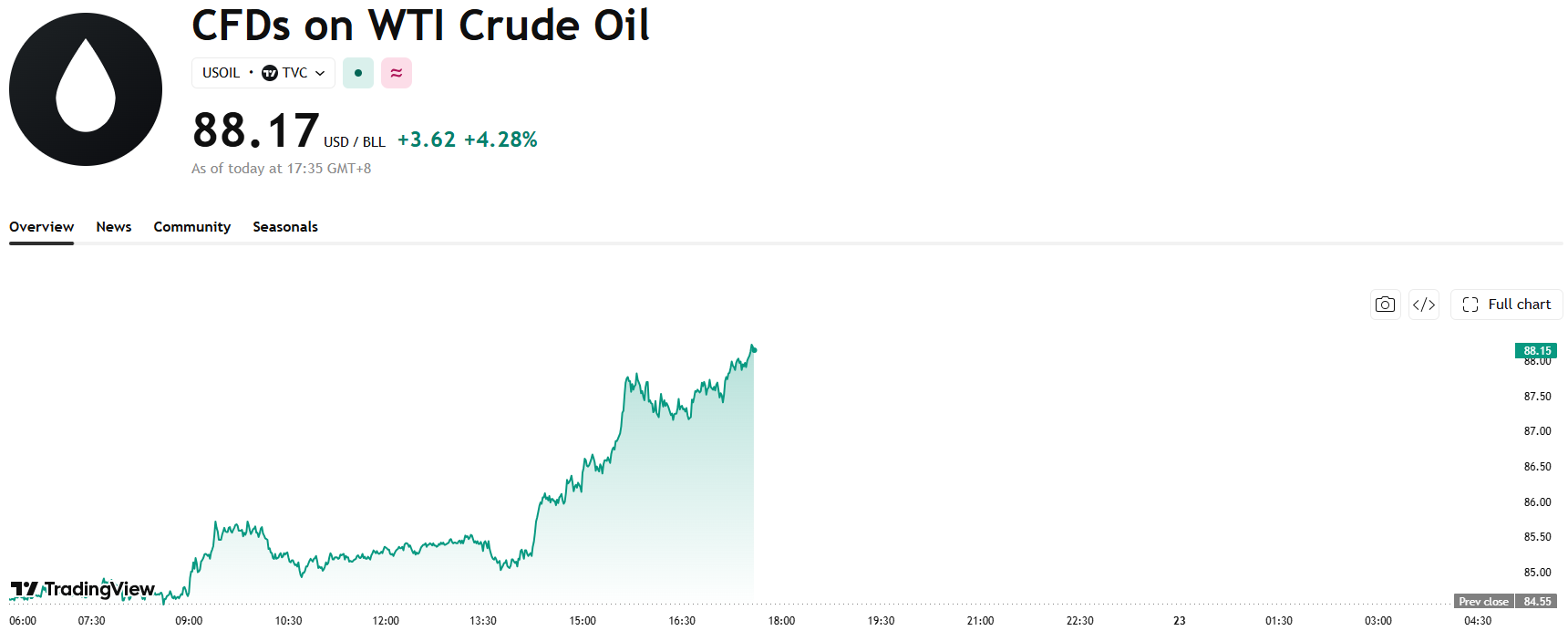
Source: TradingView
US and Iran Hardline Stance, Conflict Risk Continues to Build
During the ASEAN Foreign Ministers' Meeting held in the Philippines, US Secretary of State Marco Rubio emphasized that the US still prioritizes diplomatic avenues, but simultaneously accused Iran of violating previous consensus on strait security, warning that if Tehran has no intention of pursuing meaningful negotiations, the US will take necessary measures to safeguard the interests of the US and its allies.
Meanwhile, the latest remarks by US President Trump have once again shifted public attention from the Strait of Hormuz to the Iranian nuclear issue.
He stated that the US is closely monitoring the latest developments at Iran's nuclear facilities. If Iran resumes construction of relevant nuclear facilities, the US will not hesitate to launch strikes, targeting not only the so-called "Kuh-e Kolang Gaz" underground nuclear facility, but also any targets that could serve Iran's nuclear program.
In response, Iran reacted swiftly. The Khatam al-Anbiya Central Headquarters of the Iranian Armed Forces stated that any US attack on Iranian nuclear facilities would be viewed as a further escalation of regional conflict and could trigger a larger-scale military response. As rhetoric from both sides continues to escalate, market concerns over a further deterioration of the Middle East situation continue to mount.
The "Kuh-e Kolang Gaz" facility mentioned by Trump is located about 220 kilometers south of Tehran, only about 2 kilometers away from the Natanz uranium enrichment facility. Natanz was attacked twice during several past rounds of regional conflicts, and construction of the "Kuh-e Kolang Gaz" facility was initiated after Natanz suffered damage.
Publicly available information indicates that construction of the project began in 2020. Iran hopes to utilize the natural mountain barrier to build a more secure nuclear facility for the production and deployment of advanced centrifuges.
An analysis by the Institute for Science and International Security (ISIS), a US think tank, suggests that the facility is buried more than 100 meters underground, features multiple entrances and exits, and may utilize a multi-level structure. Its protective capabilities are far superior to ordinary underground facilities, making it a critical component of Iran's nuclear program.
As Trump publicly singled out the facility, external concerns are mounting that the Iranian nuclear issue could once again become a new flashpoint for the escalation of regional tensions.
Peace Talks Stall, Markets Reprice Inflation Risk
Analysts believe that against the backdrop of a prolonged lack of substantive progress in US-Iran negotiations, market trading logic has returned once again to supply risks and inflation expectations.
Deutsche Bank analyst Jim Reid pointed out that Brent crude reclaimed $90 a barrel after more than a month and briefly broke above $92, reflecting that the market is repricing the Middle East geopolitical risk premium.
Meanwhile, the continued expansion of military operations by the US military has also left oil prices with little momentum for a pullback in the short term, while investor concerns over a rebound in global inflation and stagflation risks have mounted.
However, Iran has still sent limited signals of de-escalation. A spokesman for the Iranian Interior Ministry stated that while the two sides have not initiated formal negotiations, communication through informal channels remains possible. This means that although the diplomatic window has not completely closed, US-Iran relations are still unlikely to see substantive improvement in the short term, and international oil prices may continue to be dominated by developments in the Middle East.
This content was translated using AI and reviewed for clarity. It is for informational purposes only.
Recommended Articles






Comments (0)
Click the $ button, enter the symbol, and select to link a stock, ETF, or other ticker.