


Strait of Hormuz May Be Blocked Again. Brent Crude Surges Over 7% Nearing $80, Trump Says Military Strike on Iran Tonight



AI Podcast


On July 8, Eastern Time, Brent and WTI crude oil futures surged approximately 7% as escalating U.S.-Iran geopolitical tensions stoked supply fears. President Trump signaled potential further strikes, while Iran threatened to block the Strait of Hormuz in retaliation. Compounding market anxiety, U.S. EIA data showed Strategic Petroleum Reserve inventories reaching their lowest levels since 1983. Shipping data confirms significant disruptions in the Strait of Hormuz, with traffic well below pre-conflict averages. These heightened risks of military confrontation and supply chain blockades remain the primary drivers of the recent volatility in global crude oil markets.

Tradingkey - On July 8, Eastern Time, the two major crude oil futures surged violently, with Brent crude on the verge of returning to $80, reclaiming its mid-June highs. It is reported that during his participation in the NATO summit in Turkey, U.S. President Trump stated that the U.S. military may launch another military strike against Iran tonight.
As of press time, Brent crude rose over 7% to $79.41, peaking at $79.93; WTI crude futures rose about 7% to $75.23.
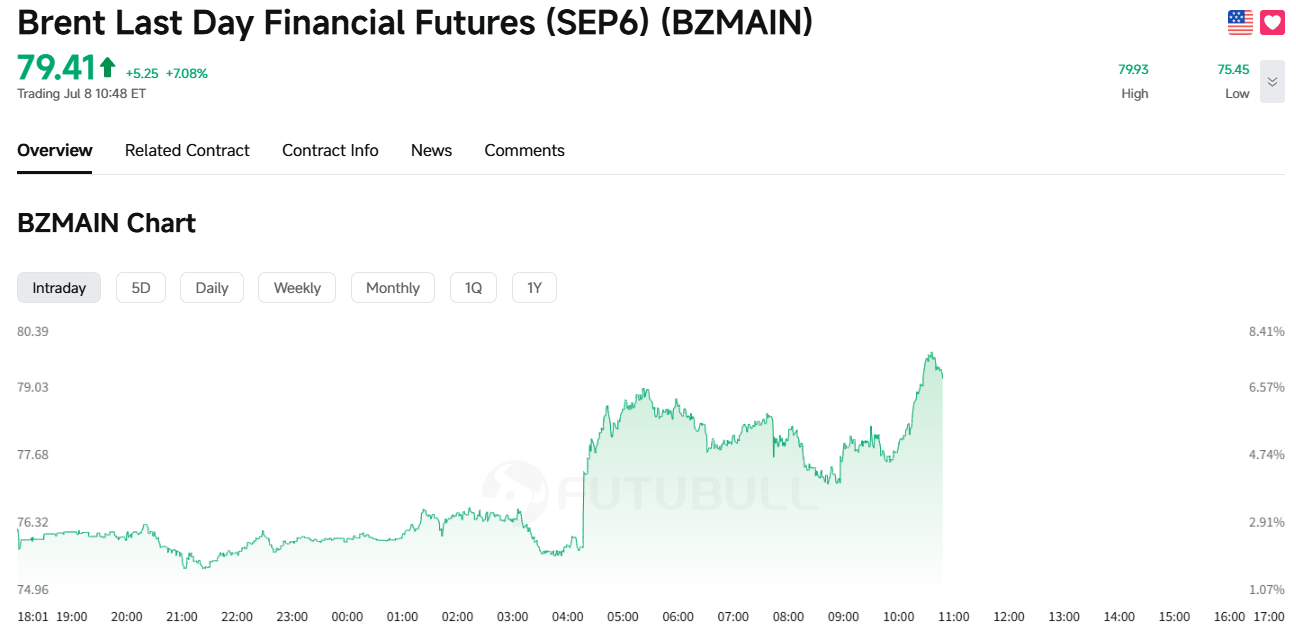
[Source: FutuBull]
Trump stated that the U.S. military dealt a heavy blow to Iran last night. He noted that the core of the issue lies in nuclear weapons, rather than regime change. He admitted that it remains uncertain whether an agreement can be reached, and the U.S. side may act unilaterally without an agreement. Currently, Iran has been severely hit.
The U.S. side did not attack the highest-level targets (such as bridges), but will escalate strikes if necessary, or take over Kharg Island, and does not rule out striking desalination plants. Trump also stated that the Strait of Hormuz could be blockaded again, with the blockade targeting only Iran.
In response, Iran issued a strong counter-warning, stating that it would close the Strait of Hormuz if attacked again. According to Iran's Press TV, a source familiar with Iran's security sector said that Iran would also strike enemy targets, doing so at a ratio of at least "two-to-one." Iran will reopen the strait under its own arrangements in accordance with the Islamabad Memorandum of Understanding. If Iran faces any new attacks, it will close the Strait of Hormuz. Iran will not back down on the management of the Strait of Hormuz. Every threat from the enemy will receive a powerful response, and on this issue, Iran will not make a distinction between the U.S. and its regional partners.
In addition, the newly released U.S. EIA Strategic Petroleum Reserve inventory for the week was -6.166 million barrels, the lowest since the week of April 29, 1983, compared to the previous value of -5.536 million barrels.
Research firm Rystad stated in a report that navigation through the Strait of Hormuz has essentially ground to a complete halt. This tangible suspension of shipping reflects the current level of risk far more than any official statements from either the U.S. or Iran. According to shipping data provider Kpler, only four tankers have successfully passed through the strait so far today.
Shipping data agency Kpler stated that since the U.S. and Iran finalized a 60-day ceasefire agreement on June 17, approximately 32 tankers have passed through the Strait of Hormuz daily. This figure is roughly three times the daily average traffic during the period from the outbreak of the conflict in February to the signing of the agreement in mid-June, though it still remains significantly below normal levels prior to the outbreak of the conflict.
This content was translated using AI and reviewed for clarity. It is for informational purposes only.
Recommended Articles









Comments (0)
Click the $ button, enter the symbol, and select to link a stock, ETF, or other ticker.