


Ripple Price Forecast: XRP risks deeper correction after stretched momentum



- XRP reverses gains, trading around $1.48 on Monday, following a rejection at $1.70.
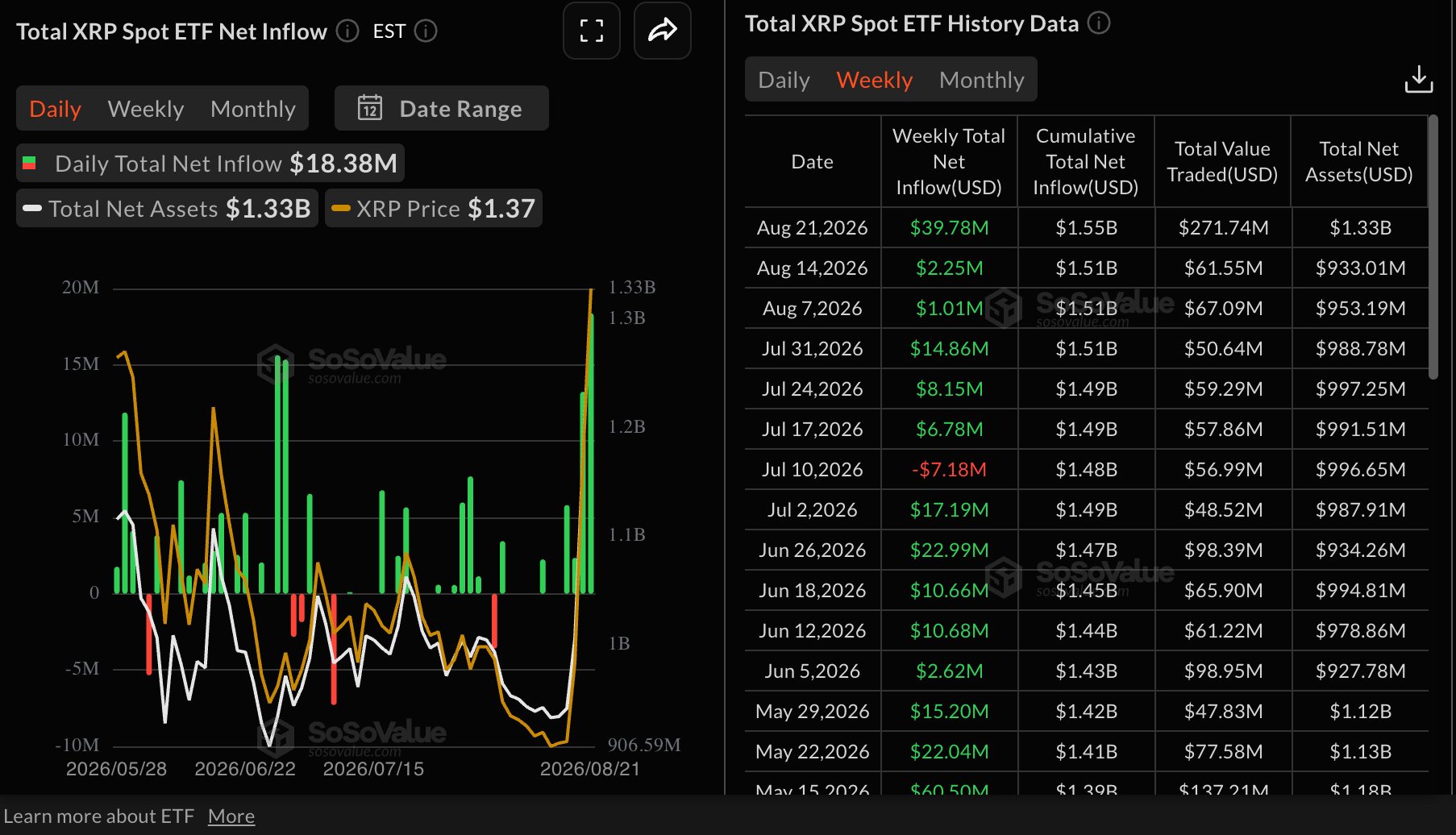
- Risk-on sentiment remains elevated, as evidenced by $40 million in US-listed XRP ETF inflows last week.
- XRP’s momentum shows signs of buyer exhaustion, with the RSI pulling back.
Ripple (XRP) is correcting on Monday, trading around $1.48, a 13% drop from last week’s peak of $1.70. The remittance token surged about 72% from $1.00 last week, in line with the broader crypto market’s bullish outlook.
A higher support level would go a long way toward reasserting bullish control. However, if profit-taking continues, XRP could be forced to give back some gains as it seeks a more robust support level.
XRP attracts growing ETF inflows
US-listed XRP spot Exchange-Traded Funds (ETFs) extended their bullish streak for the sixth consecutive week, with inflows of approximately $40 million through Friday. This marks a major jump from the $2.25 million recorded during the week ending on August 14.
Meanwhile, cumulative inflows stand at $1.55 billion, rising from $1.51 billion over the same period. SoSoValue data shows total assets under management at $1.33 billion, up from $933 billion.
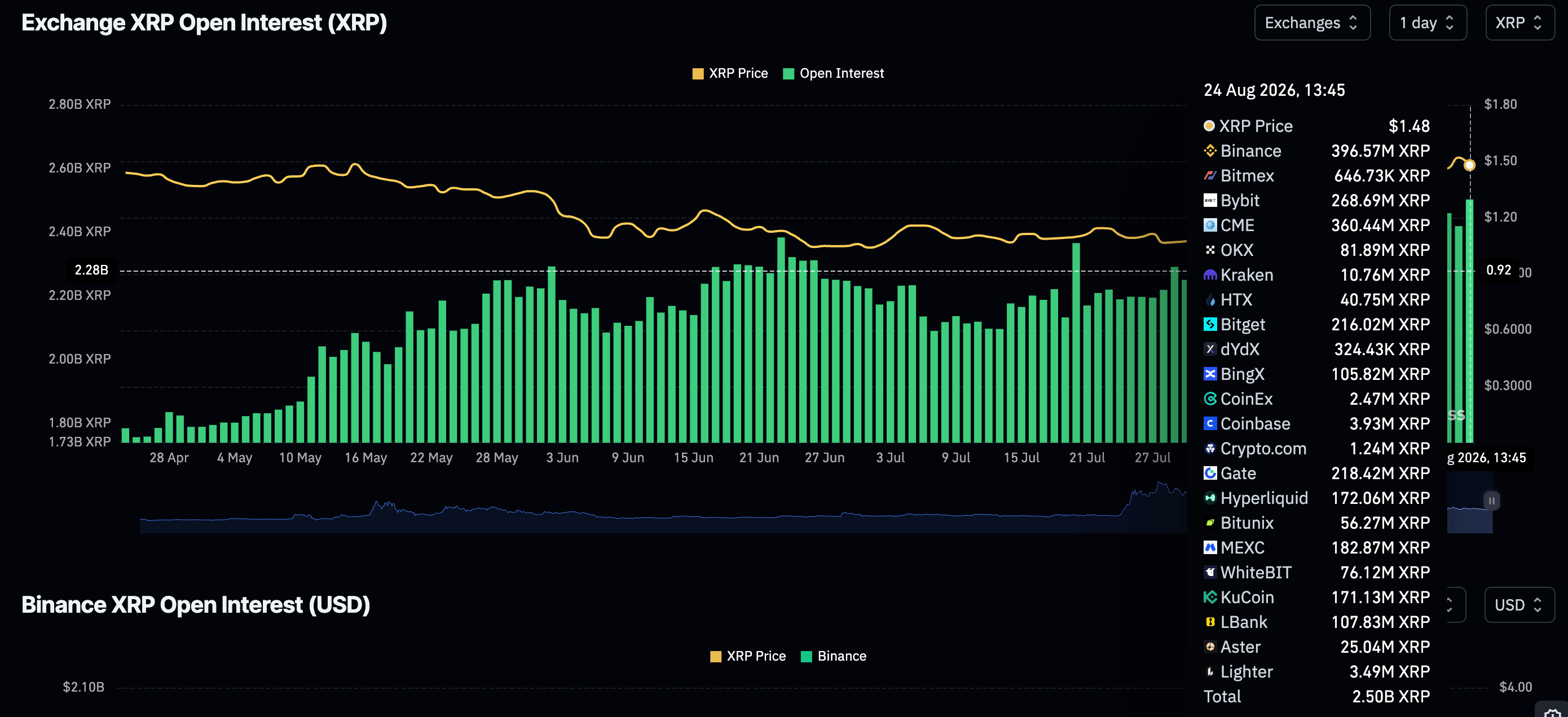
Retail demand remains relatively elevated with perpetual futures Open Interest (OI) at 2.5 billion XRP on Monday, up from 2.42 billion the previous day. If OI continues to expand, it could offset sell-side pressure amid possible profit-taking after last week’s rally.
"The more realistic marker to watch isn't last summer's $3.65 peak but the 1.40–1.50 zone, the range XRP held for much of early 2026 before this year's breakdown; reclaiming it would mark real recovered ground rather than a fresh high,” Iliya Kalchev, Nexo’s Dispatch Analyst, told FXStreet.
Technical analysis: XRP rally takes a breather
XRP trades around $1.48 after a rejection at last week's highs of $1.70. Despite the rejection, the remittance token extends a strong bullish phase after breaking well above its key Exponential Moving Averages (EMAs). The 200-day EMA at $1.35 now underpins the advance, with the 100-day EMA at $1.18 and the 50-day EMA at $1.14 reinforcing a stacked bullish structure below price.
The SuperTrend line at $1.25 also sits comfortably below the market, suggesting the broader uptrend remains intact. Momentum is stretched, as the Relative Strength Index (RSI) holds in overbought territory at 80, while the Moving Average Convergence Divergence (MACD) stays positive, suggesting the bullish impulse is strong but increasingly vulnerable to a corrective pullback.
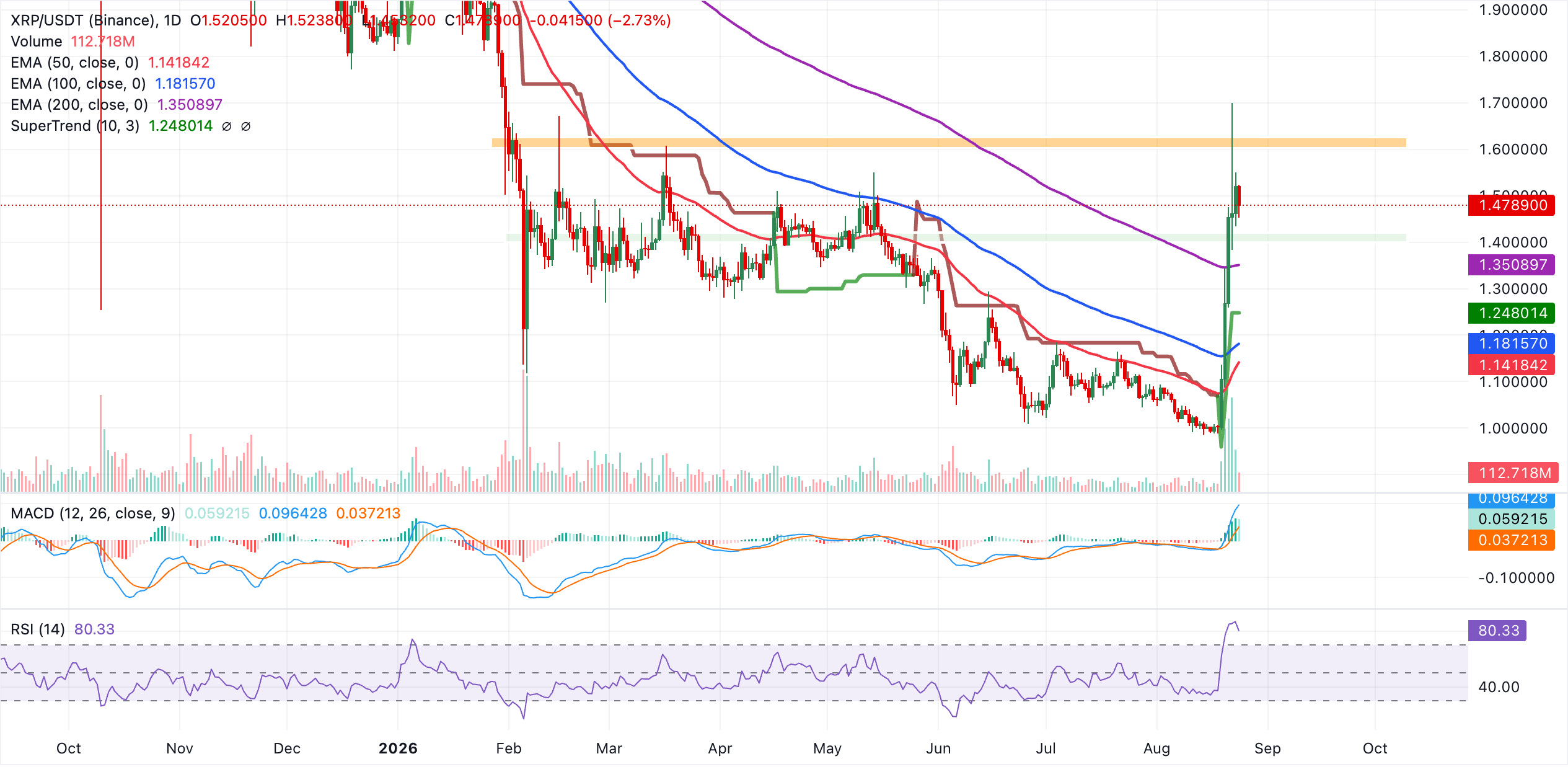
Immediate support lies at the recent price zone around $1.48, followed by firmer technical demand at the 200-day EMA near $1.35. Below that, SuperTrend support at $1.25 and the 100-day and 50-day EMAs at $1.18 and $1.14, respectively, define a broader bullish base that would likely attract buyers on deeper dips. As long as XRP holds above these clustered supports, the near-term bias remains constructive, although the overbought RSI warns that consolidation or a retracement toward the $1.35-$1.25 area cannot be ruled out before the next directional leg.
(The technical analysis of this story was written with the help of an AI tool. Know more.)
Crypto ETF FAQs
An Exchange-Traded Fund (ETF) is an investment vehicle or an index that tracks the price of an underlying asset. ETFs can not only track a single asset, but a group of assets and sectors. For example, a Bitcoin ETF tracks Bitcoin’s price. ETF is a tool used by investors to gain exposure to a certain asset.
Yes. The first Bitcoin futures ETF in the US was approved by the US Securities & Exchange Commission in October 2021. A total of seven Bitcoin futures ETFs have been approved, with more than 20 still waiting for the regulator’s permission. The SEC says that the cryptocurrency industry is new and subject to manipulation, which is why it has been delaying crypto-related futures ETFs for the last few years.
Yes. The SEC approved in January 2024 the listing and trading of several Bitcoin spot Exchange-Traded Funds, opening the door to institutional capital and mainstream investors to trade the main crypto currency. The decision was hailed by the industry as a game changer.
The main advantage of crypto ETFs is the possibility of gaining exposure to a cryptocurrency without ownership, reducing the risk and cost of holding the asset. Other pros are a lower learning curve and higher security for investors since ETFs take charge of securing the underlying asset holdings. As for the main drawbacks, the main one is that as an investor you can’t have direct ownership of the asset, or, as they say in crypto, “not your keys, not your coins.” Other disadvantages are higher costs associated with holding crypto since ETFs charge fees for active management. Finally, even though investing in ETFs reduces the risk of holding an asset, price swings in the underlying cryptocurrency are likely to be reflected in the investment vehicle too.
Recommended Articles









Comments (0)
Click the $ button, enter the symbol, and select to link a stock, ETF, or other ticker.