


Prediction: Kevin Warsh and the Federal Open Market Committee (FOMC) Will Not Raise Interest Rates in 2026



Key Points
New Fed Chair Kevin Warsh has been clear that he still thinks prices are too high.
The Federal Open Market Committee removed easing bias from its most recent policy statement.
The Fed has to balance inflationary pressure with the risks of implementing another hike and the long-term ramifications.
Inflation has now been above the Federal Reserve's 2% target for over five years. Consumers are also feeling the pinch from soaring oil prices, which have driven higher prices at the pump. Affordability remains a top issue in the country.
Kevin Warsh, the new chair of the Federal Reserve's Board of Governors, has kicked off his tenure with a hawkish tone, saying earlier this month that "prices are too high."
Where to invest $1,000 right now? Our analyst team just revealed what they believe are the 10 best stocks to buy right now, when you join Stock Advisor. See the stocks »
Warsh has also vowed to make inflation "a thing of the past," adding that Fed policy makers "have no tolerance for persistently elevated inflation."
Despite all of this, I still think the Federal Open Market Committee (FOMC), the group at the Fed tasked with setting monetary policy, will wait as long as possible before hiking interest rates. Therefore, my prediction is that the Fed will not hike rates this year.
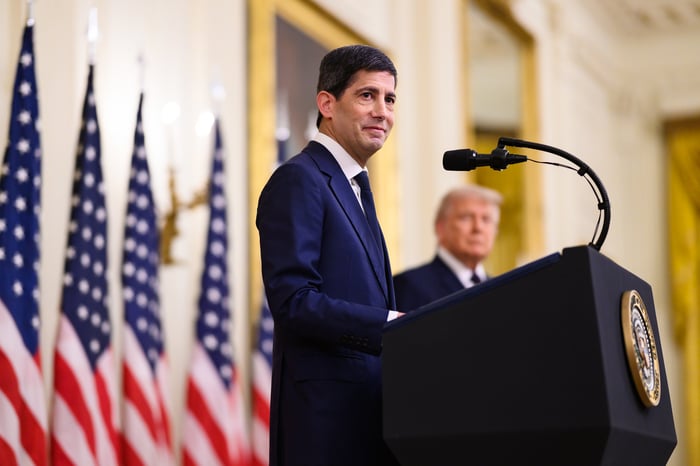
Fed Chair Kevin Warsh. Official White House photo by Daniel Torok.
The state of inflation
After peaking at around 9% in 2022, the Fed, realizing it was behind the eight ball, reacted quickly and instituted a series of jumbo rate hikes, several of which were 0.75% increases.
This has helped slow inflation, but getting it down to the Fed's preferred 2% level has proven elusive. There have, of course, been other events that have slowed the Fed's efforts.
Some believe President Donald Trump's tariffs have contributed to elevated inflation, and the Iran war and high gas prices have certainly contributed.
While inflation soared in May, the economy got a needed reprieve from the June inflation data, which the market strongly believes will keep the FOMC on pause at its July meeting. In June, headline year-over-year inflation slowed to 3.5%, while core inflation, stripping out more volatile food and energy prices, slowed to 2.6%.

US Consumer Price Index YoY data by YCharts.
Warsh is keeping his cards close to his chest
Warsh is expected to implement a "regime change" at the Fed, and he kicked things off at the FOMC's June meeting by not participating in the Fed's Summary of Economic Projections (SEP).
The SEP essentially provides forward guidance on how FOMC members view the trajectory of interest rates and other key economic metrics, such as gross domestic product (GDP).
In fact, Warsh has made it clear he doesn't want the Fed to be as transparent as it has in the past, as he believes it's not healthy for markets. This is why I think he is holding his cards close to his chest, making it much more difficult to know his true intentions.
Warsh has been highly critical of the Fed in the past and believes the agency may need to reassess the lens through which it views inflation.
Notably, Warsh has advocated for the "trimmed averages" method. This measure of inflation removes the most volatile price changes from a basket of consumer prices and then takes a weighted average.
Had the Fed used this method for its preferred gauge of inflation, the Personal Consumption Expenditures (PCE) Index, inflation would have read 2.3% in February, a full half-point below the headline PCE.
Warsh has also launched five new task forces to examine Fed policy, including one to look at how the Fed measures inflation.
So, while Warsh has publicly and repeatedly said prices are too high, he's also advocated a way to measure inflation that clocks it much closer to 2% than the current methodology. Warsh also said in his first press conference that he still views the Fed's 2% target as a good barometer.
Why I think the Fed stays on hold
The market sees a roughly 56% chance that the Fed hikes rates at its September meeting (as of July 22). The odds that the Fed hikes rates before 2027 are about 64% on Kalshi. Keep in mind that both of these numbers tend to change frequently.
Ultimately, there are two reasons I am playing contrarian here. First, inflation is largely being driven right now by the Iran war and higher oil and gas prices, which do have a way of funneling into other parts of the economy.
But high gas prices are mostly supply driven right now due to the closure or heavy reduction in the passage of oil tankers through the Strait of Hormuz, a narrow waterway through which one-fifth of oil travels daily in normal times. Rate hikes are less effective at solving supply-driven shocks.
In fact, it's quite possible that higher oil and gas prices may end up slowing prices on their own.
Furthermore, raising rates too early poses a significant risk to the Fed. It can take roughly six months for a rate hike to work its way through the economy, and a rate hike may add pressure on an economy that has proven resilient yet has also shown plenty of cracks.
Many experts thought the Fed's intense rate-hiking campaign in 2022 and 2023 would tip the economy into a recession. It hasn't yet, but the longer rates remain elevated, the longer the recession risk remains.
The second reason concerns Warsh and his many past comments on inflation. While his tone has changed since becoming chair, I still don't view him as a hawk just yet.
Finally, I suspect inflation data will remain murky, and the Iran war will have many fits and starts, keeping the Fed on hold at least for the rest of the year.
Where to invest $1,000 right now
When our analyst team has a stock tip, it can pay to listen. After all, Stock Advisor’s total average return is 892%* — a market-crushing outperformance compared to 206% for the S&P 500.
They just revealed what they believe are the 10 best stocks for investors to buy right now, available when you join Stock Advisor.
*Stock Advisor returns as of July 25, 2026.
The Motley Fool has a disclosure policy.
Recommended Articles





Comments (0)
Click the $ button, enter the symbol, and select to link a stock, ETF, or other ticker.