


Better Defense Stock to Own in 2026: PLTR vs. LMT



Key Points
Palantir is becoming the military's AI brain. Its software is moving from pilot projects to core defense infrastructure, giving it a growing role in how modern wars are fought.
Lockheed has the contracts investors love. Massive multiyear missile-defense awards and a record backlog provide unusually strong visibility into future revenue.
Palantir may have the faster long-term growth story, but Lockheed's combination of funded programs, predictable cash flow, and a lower valuation makes it the stronger defense stock for 2026.
The defense trade of the past few years has split into two stories. One is about software -- the code that turns a flood of sensor data into a targeting decision. The other is about steel -- the interceptors, aircraft, and factories that fill a shooting war's shopping list.
Palantir Technologies (NASDAQ: PLTR) owns the first story. Lockheed Martin (NYSE: LMT) owns the second. Both are winning work, and the contrast between them says a lot about where defense budgets are heading in 2026.
Missed Nvidia in 2009? This Rare Signal Is Flashing Again. In 2009, a "Double Down" signal flashed for a little-known chipmaker called Nvidia. For the first time in years, that same "Total Conviction" signal is flashing for a company 1/100th the size of Nvidia. Continue »
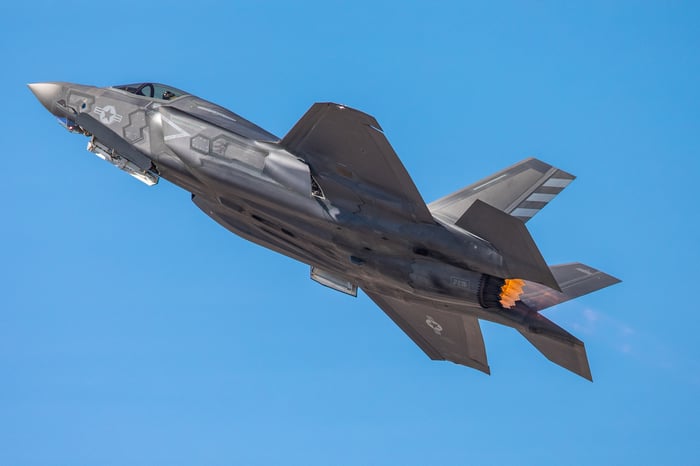
Image source: Getty Images.
What Palantir is doing in defense
Palantir has moved from a data vendor to the decision layer of the U.S. and allied militaries. Its Maven Smart System is built on the company's Artificial Intelligence Platform, which sifts sensor feeds and flags targets, and the Pentagon made it an official program of record in 2026.
That status matters because it signals lasting, budgeted demand rather than a pilot that could vanish. The Army folded some 75 separate contracts into a single enterprise agreement with a $10 billion ceiling over 10 years, the largest deal in the company's history, and both NATO and the U.K. have signed on for their own Maven deployments. Palantir is embedding itself as the software spine that other systems plug into, a durable place to sit as warfare becomes software-defined.
What Lockheed Martin is doing in defense
Lockheed Martin is building the hardware as needed. The center of gravity is the Golden Dome, the national missile shield that has become the defining U.S. defense program of the decade.
Lockheed landed a $35.5 billion award to produce THAAD interceptors, agreed to triple PAC-3 output and quadruple THAAD production under multiyear deals, and won prototype work on space-based interceptors designed to strike missiles after launch. Around the shield, the company keeps upgrading the F-35 with new sensors and electronic warfare capabilities, pairs the jet with autonomous drone wingmen, and pushes ahead with hypersonic weapons. It closed 2025 with a backlog of nearly $194 billion, more than two and a half years of sales on the books at the year's start.
The case for each defense stock, and the risks
Palantir's momentum is real, and its software could ride every platform in the field. The catch is that the stock trades at a level that assumes years of flawless growth, so a single quarter that misses the bar can punish the shares. It sells software into budgets that fund hardware first, which caps how large the defense slice can grow in a given year.
Lockheed carries its own scars. It lost the next-generation fighter contract to a rival, its fixed-price programs have a history of cost overruns, and the space-interceptor race for the Golden Dome includes a dozen competitors chasing the same dollars.
Neither name is a clean bet, and an investor should weigh the flaws in both before choosing.
The better defense stock to own in 2026
The tiebreaker for me is what 2026 funds. The money in this budget cycle flows to the missile shield and the magazines of interceptors behind it, and Lockheed Martin sits at the center of both, with multiyear contracts and a backlog that turns today's headlines into years of booked revenue.
Palantir may prove the better business over a longer arc, and its software keeps spreading across the same programs Lockheed builds. For the year ahead, though, the visibility of funded programs and the price an investor pays to own them tilt the decision toward the hardware maker.
Palantir is also caught up in the broader AI trade, where any stock with an artificial intelligence story gets bid higher on the theme rather than the results underneath it. That link cuts both ways: If sentiment around AI names cools, Palantir could sell off alongside them even if its defense contracts keep landing on schedule.
This means Lockheed Martin is the better defense stock to own in 2026, with Palantir as the one to watch as the software layer continues to grow. Investors who want defense exposure with a clear line of sight into next year's revenue have the stronger setup in Lockheed. Those who buy Palantir should size their positions to its valuation and treat the swings as the cost of admission.
Should you buy stock in Lockheed Martin right now?
Before you buy stock in Lockheed Martin, consider this:
The Motley Fool Stock Advisor analyst team just identified what they believe are the 10 best stocks for investors to buy now… and Lockheed Martin wasn’t one of them. The 10 stocks that made the cut could produce monster returns in the coming years.
Consider when Netflix made this list on December 17, 2004... if you invested $1,000 at the time of our recommendation, you’d have $418,761!* Or when Nvidia made this list on April 15, 2005... if you invested $1,000 at the time of our recommendation, you’d have $1,195,804!*
Now, it’s worth noting Stock Advisor’s total average return is 918% — a market-crushing outperformance compared to 208% for the S&P 500. Don't miss the latest top 10 list, available with Stock Advisor, and join an investing community built by individual investors for individual investors.
*Stock Advisor returns as of July 7, 2026.
Micah Zimmerman has no position in any of the stocks mentioned. The Motley Fool has positions in and recommends Palantir Technologies. The Motley Fool recommends Lockheed Martin. The Motley Fool has a disclosure policy.
Recommended Articles





Comments (0)
Click the $ button, enter the symbol, and select to link a stock, ETF, or other ticker.