


Warren Buffett Just Offered 11 Words of Warning That Could Reshape Your Investing Strategy



Key Points
The Shiller CAPE ratio indicates that U.S. stocks are historically expensive right now.
The emergence of leveraged single stock and complex option income strategies in the ETF marketplaces is a dangerous development for most investors.
Earlier this year, Buffett criticized the current mood of Wall Street and the number of people "gambling" with their money.
Warren Buffett hasn't really hidden the fact that he's not a big fan of the current market environment.
He's said that investing in U.S. stocks at current valuation levels is like "playing with fire." He said that the recent pullback in the S&P 500 (SNPINDEX: ^GSPC) earlier this year was "nothing" and not even close to the level that would have motivated him to put Berkshire Hathaway's cash to use.
Missed Nvidia in 2009? This Rare Signal Is Flashing Again. In 2009, a "Double Down" signal flashed for a little-known chipmaker called Nvidia. For the first time in years, that same "Total Conviction" signal is flashing for a company 1/100th the size of Nvidia. Continue »
At the 2026 Berkshire Hathaway shareholder meeting, the now-retired CEO added another quote to the growing list in case anybody was still unsure of his position: "We've never had people in a more gambling mood than now."
Now, to be clear, I don't consider those who buy stocks or exchange-traded funds as part of an automatic investment plan, such as a 401(k), gamblers. They're simply following a long-term strategy that just involves steady investing regardless of price. That's logical.
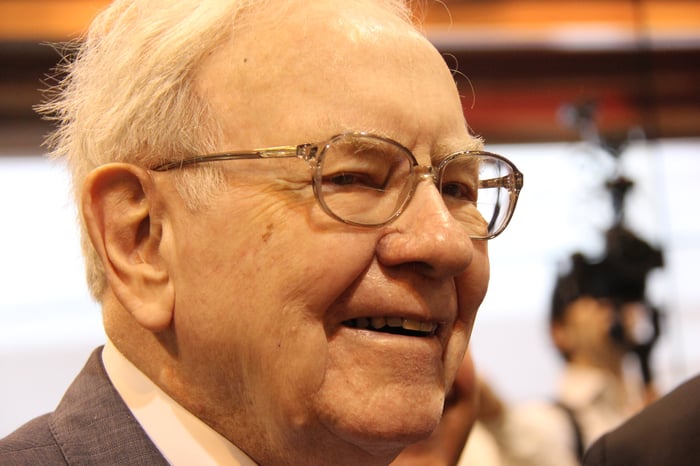
Image source: The Motley Fool.
But you have other investors who are potentially taking undue risks with their investment choices, and they can be split into two groups.
The expensive stock pickers
Ignoring fundamentals can be a risky choice. Investors can get carried away with high-flying artificial intelligence stocks or recent winners, especially if they don't check valuations before investing. Momentum can be a powerful factor in choosing stocks, but you have to be careful.
Buying stocks with high price-to-earnings (P/E) multiples or other valuation metrics can limit upside potential. There may still be further gains in these stocks, but it might be more difficult if investors are already paying a large premium for the shares.
The Shiller CAPE ratio, a popular metric that divides the S&P 500's price by the 10-year average inflation-adjusted earnings, is currently near an all-time high. So investors should at least consider valuations.

S&P 500 Shiller CAPE Ratio data by YCharts
The short-term leverage/option gamblers
This is where we get into true casino-worthy behavior. There have been nearly 700 new ETFs launched so far in 2026. Roughly 200 would be categorized as either "leveraged" or "inverse." The vast majority of these are based on single stocks.
Since the beginning of 2025, more than 200 ETFs have been launched under the "synthetic income" label, which includes the zero-days-to-expiration (0DTE) option-income strategy and other ultra-high-yield objectives.
At best, these products could be described as short-term trading strategies. At worst, they're complex, derivative-based strategies that most investors can't describe how they work. With these products, investors are seduced by the prospect of magnified upside returns or ridiculously high yields (in some cases, issuers quote distribution rates of 100% or more).
Putting your money in these could qualify as gambling. They're complex and often confusing, which makes them inappropriate for most portfolios.
What long-term investors should focus on instead
The simple and obvious answer is to invest in what you know. The prevalence of these ETFs shows it's more important than ever for investors to do their due diligence when choosing stocks and ETFs. Keeping a long-term outlook is key to mitigating investing risk.
Well-constructed portfolios should hold a variety of asset classes that align with an investor's objectives, risk tolerance, and time horizon. Focusing on quality and always being mindful of risk exposures will generally lead to favorable outcomes.
It's a strategy that Buffett would almost certainly agree with.
Should you buy stock in S&P 500 Index right now?
Before you buy stock in S&P 500 Index, consider this:
The Motley Fool Stock Advisor analyst team just identified what they believe are the 10 best stocks for investors to buy now… and S&P 500 Index wasn’t one of them. The 10 stocks that made the cut could produce monster returns in the coming years.
Consider when Netflix made this list on December 17, 2004... if you invested $1,000 at the time of our recommendation, you’d have $418,761!* Or when Nvidia made this list on April 15, 2005... if you invested $1,000 at the time of our recommendation, you’d have $1,195,804!*
Now, it’s worth noting Stock Advisor’s total average return is 918% — a market-crushing outperformance compared to 208% for the S&P 500. Don't miss the latest top 10 list, available with Stock Advisor, and join an investing community built by individual investors for individual investors.
*Stock Advisor returns as of July 5, 2026.
David Dierking has no position in any of the stocks mentioned. The Motley Fool has positions in and recommends Berkshire Hathaway. The Motley Fool has a disclosure policy.
Recommended Articles






Comments (0)
Click the $ button, enter the symbol, and select to link a stock, ETF, or other ticker.