


 Discount


Mitsubishi UFJ Financial Group Inc Stock (MUFG) Moved Up by 3.75% on Nov 23: What Investors Need To Know


Mitsubishi UFJ Financial Group Inc (MUFG) moved up by 3.75%. The Banking & Investment Services sector is up by 2.95%. The company outperformed the industry. Top 3 stocks by turnover in the sector: Goldman Sachs Group Inc (GS) up 4.33%; JPMorgan Chase & Co (JPM) up 2.44%; Citigroup Inc (C) up 3.96%.
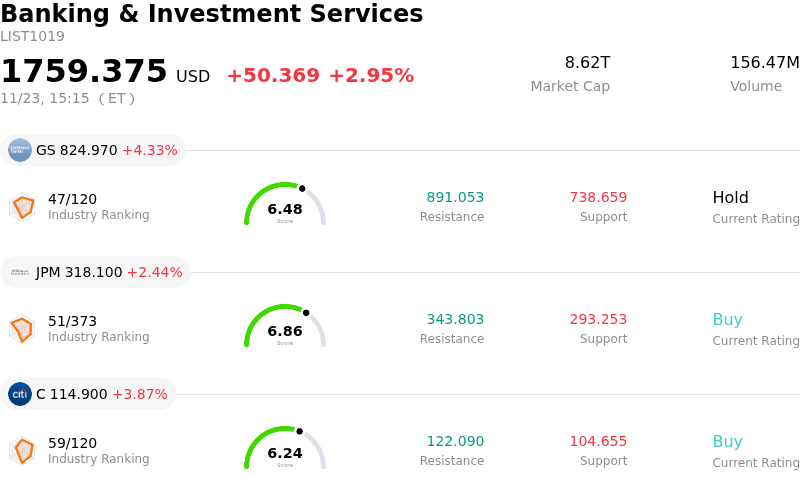
What is driving Mitsubishi UFJ Financial Group Inc (MUFG)’s stock price up today?
Mitsubishi UFJ Financial Group experienced strong upward momentum, primarily driven by intensifying expectations surrounding Bank of Japan monetary policy normalization and favorable yield dynamics. With benchmark Japanese government bond yields pushing higher amid persistent inflationary signals and wage growth data, market participants are pricing in an accelerated timeline for further policy rate increases. As Japan’s largest financial institution, MUFG stands as the chief beneficiary of domestic rate normalization, which directly expands net interest margins across its massive yen-denominated loan and deposit base, unlocking profitability that had been constrained for years under negative and zero-rate regimes.
Fundamental strength and proactive shareholder return strategies have provided further fuel for the rally. Recent financial updates from the group underscored solid credit demand across domestic corporate borrowers and expanding fee income generated by wealth management and investment banking activities. Strong capital generation continues to support the management team's aggressive capital return program, highlighted by ongoing share repurchase authorizations and progressive dividend hikes. Furthermore, the bank’s strategic partnership with Morgan Stanley continues to yield robust equity and advisory revenues, insulating its broader portfolio against regional volatility and reinforcing institutional investor confidence.
Currency market movements and broader asset allocation trends also played a critical role in the stock’s advance. As international funds adjust their global portfolios, Japanese equities, and particularly large-cap financial institutions, have experienced sustained net foreign inflows. Investors seeking exposure to rising interest rate beneficiaries in Asia have positioned heavily in megabanks as an attractive value play with sound balance sheets and negligible asset quality deterioration. With credit costs remaining exceptionally well contained and domestic monetary conditions shifting structurally in favor of lenders, sentiment toward MUFG remains distinctly positive.
Technical Analysis of Mitsubishi UFJ Financial Group Inc (MUFG)
Technically, Mitsubishi UFJ Financial Group Inc (MUFG) shows a MACD (12,26,9) value of -0.463, indicating a sell signal. The RSI at 34.305 suggests neutral condition and the Williams %R at 77.438 suggests sell condition. Please monitor closely.
Fundamental Analysis of Mitsubishi UFJ Financial Group Inc (MUFG)
Mitsubishi UFJ Financial Group Inc (MUFG) is in the Banking & Investment Services industry. Its latest annual revenue is $42.22B, ranking 10 in the industry. The net profit is $11.47B, ranking 8 in the industry. Company Profile
Over the past month, multiple analysts have rated the company as Strong Buy, with an average price target of $26.53, a high of $26.53, and a low of $26.53.
More details about Mitsubishi UFJ Financial Group Inc (MUFG)
Company Specific Risks:
- Underwhelming Capital Return Relative to Megabank Peers: Institutional sentiment deteriorated as MUFG's ¥200 billion share buyback authorization notably lagged behind domestic competitors Sumitomo Mitsui and Mizuho (both authorizing ¥400 billion repurchases), raising analyst concerns that tighter Common Equity Tier 1 (CET1) capital constraints will limit the bank's flexibility for competitive shareholder returns.
- Concentrated Credit Risk in Tech and Data Center Project Finance: Investor scrutiny has intensified regarding MUFG’s estimated ¥3.3 trillion exposure to data center project financing and syndicated technology infrastructure loans, creating heightened balance sheet vulnerability and expected credit cost risks should hyperscaler capital expenditures slow.
- Domestic Margin Compression from JGB Yield Softening: Selling pressure accelerated following a pullback in benchmark Japanese Government Bond (JGB) yields and shifting Bank of Japan interest rate expectations, threatening the momentum of net interest margin (NIM) expansion across core domestic deposit and corporate lending divisions.
- Balance Sheet Headwinds from Bond Portfolio Unrealized Losses: Market participants remain focused on underlying capital adequacy risks stemming from over ¥1.2 trillion in unrealized held-to-maturity domestic bond portfolio losses alongside an elevated debt-to-equity ratio, constraining regulatory capital buffers amid foreign exchange and global rates volatility.
This article may include AI-generated content that is human-reviewed, which is for reference and general information purposes only and does not constitute investment advice.
Recommended Articles








Comments (0)
Click the $ button, enter the symbol, and select to link a stock, ETF, or other ticker.