


 Discount


Amazon.com Inc Stock (AMZN) Moved Down by 3.19% on Nov 19: What Signal Does It Send?


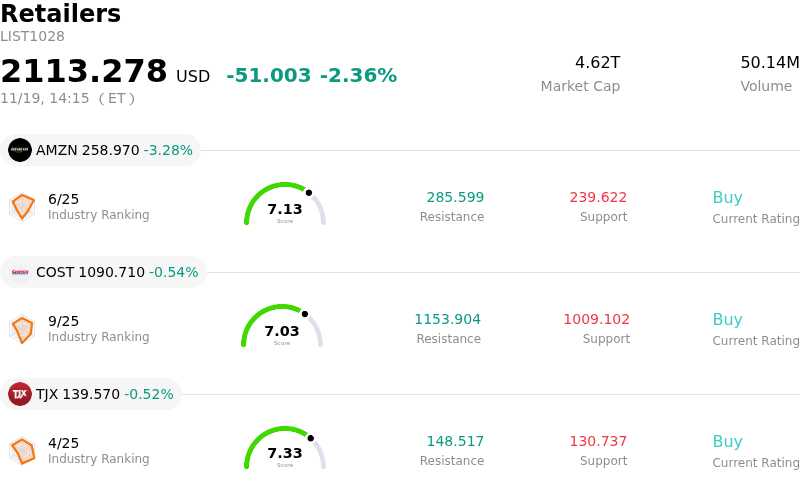
Amazon.com Inc (AMZN) moved down by 3.19%. The Retailers sector is down by 2.36%. The company underperformed the industry. Top 3 stocks by turnover in the sector: Amazon.com Inc (AMZN) down 3.19%; Costco Wholesale Corp (COST) down 0.54%; TJX Companies Inc (TJX) down 0.52%.
What is driving Amazon.com Inc (AMZN)’s stock price down today?
Amazon experienced notable downside pressure during the session, driven by a convergence of macroeconomic headwinds, sector-wide multiple compression across mega-cap technology, and heightened scrutiny over near-term operational expenditure. As broader equity markets grappled with rising sovereign yields and a recalibration of Federal Reserve interest rate expectations, long-duration growth assets faced generalized institutional de-risking, disproportionately affecting large-cap platform leaders.
A primary catalyst for the weakness centers on investor sentiment surrounding capital allocation and return on invested capital within Amazon Web Services. Market participants continue to closely assess the scale of elevated capital expenditures dedicated to generative artificial intelligence infrastructure, high-performance computing clusters, and data center buildouts. While enterprise cloud demand remains structurally intact, concerns regarding the timeline of AI monetization relative to accelerating depreciation and operating costs have led several institutional desks to trim overweight positioning in favor of cash preservation.
Simultaneously, the core e-commerce and retail operations are navigating cautious consumer sentiment ahead of the peak holiday promotional window. High cumulative inflation and tightening household budgets have created an intensely competitive environment, forcing major retail platforms to absorb elevated promotional discounts to defend market share. In addition, persistent labor and last-mile fulfillment expenses continue to pose modest headwinds to international retail operating margins, tempering consensus expectations for near-term operating income upside.
Regulatory and competitive dynamics in cross-border digital commerce have also added a layer of caution. Market share encroachment from low-cost discount marketplaces, coupled with ongoing antitrust scrutiny over third-party seller practices and advertising dominance across key jurisdictions, continues to exert an overhang on the stock's valuation multiple.
From a trading flow perspective, the intraday pullback was magnified by systematic de-leveraging and algorithmic selling once key technical support levels were breached. Trend-following funds and systematic strategies accelerated sell orders during high-volume periods, driving an expansion in intraday volatility. While Amazon’s long-term competitive moat across cloud computing, digital advertising, and retail fulfillment remains formidable, the near-term trajectory reflects market-wide valuation recalibration and profit-taking amid macro uncertainty.
Technical Analysis of Amazon.com Inc (AMZN)
Technically, Amazon.com Inc (AMZN) shows a MACD (12,26,9) value of 0.246, indicating a buy signal. The RSI at 50.276 suggests neutral condition and the Williams %R at 48.669 suggests neutral condition. Please monitor closely.
Media Coverage of Amazon.com Inc (AMZN)
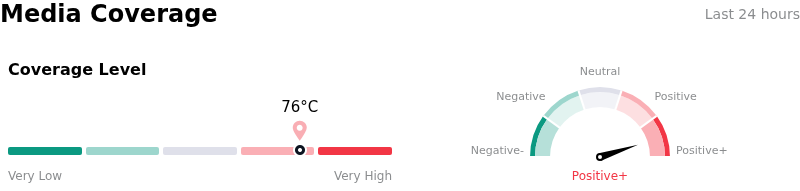
In terms of media coverage, Amazon.com Inc (AMZN) shows a coverage score of 76, indicating a high level of media attention. The overall market sentiment index is currently in extremely bullish zone.
Fundamental Analysis of Amazon.com Inc (AMZN)
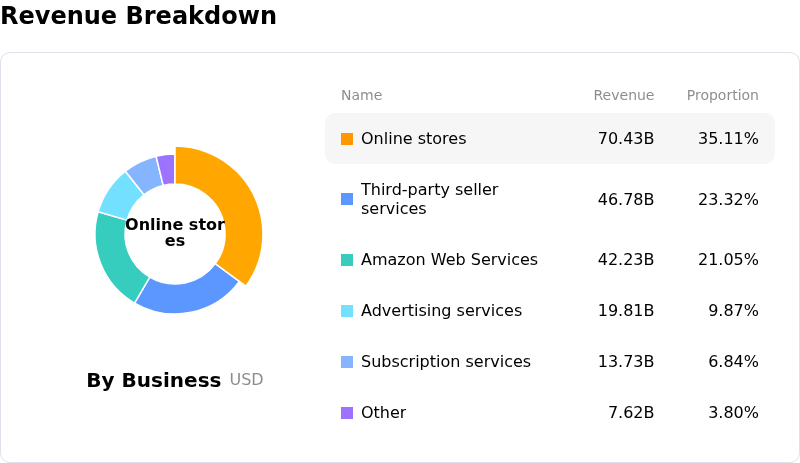
Amazon.com Inc (AMZN) is in the Retailers industry. Its latest annual revenue is $716.92B, ranking 1 in the industry. The net profit is $77.67B, ranking 1 in the industry. Company Profile
Over the past month, multiple analysts have rated the company as Buy, with an average price target of $323.05, a high of $405.00, and a low of $207.00.
More details about Amazon.com Inc (AMZN)
Company Specific Risks:
- Surging AI Infrastructure Capex and Free Cash Flow Deficit: Institutional analysts have escalated concerns over Amazon's aggressive ~$220 billion capital spending trajectory for data centers and AI hardware, which has driven free cash flow into negative territory and increased debt dependence, leaving the stock vulnerable to multiple compression if high-cost capacity fails to yield immediate returns.
- Project Leo Satellite Launch Failures and Regulatory Deadlines: The recent loss of 40 Amazon Leo satellites due to a United Launch Alliance Vulcan rocket failure threatens rollout timelines, amplifying execution risk as the company faces a strict Federal Communications Commission mandate requiring 1,600 operational satellites in orbit by mid-2026.
- Cloud Export Restrictions and Power Capacity Bottlenecks: Newly imposed export rules on advanced AI computing infrastructure shift rigorous compliance burdens directly onto cloud operators like AWS, while persistent electrical grid power shortages delay the deployment of high-density clusters, curbing near-term cloud monetization.
- Regulatory Probes into Core Advertising Monetization: Prolonged legal headwinds led by Federal Trade Commission allegations regarding deceptive ad-auction mechanics and undisclosed soft-reserve pricing threaten structural margin degradation within Amazon's fast-growing, high-margin advertising division.
This article may include AI-generated content that is human-reviewed, which is for reference and general information purposes only and does not constitute investment advice.
Recommended Articles







Comments (0)
Click the $ button, enter the symbol, and select to link a stock, ETF, or other ticker.