


 Discount


SAP SE Stock (SAP) Moved Down by 3.18% on Nov 19: Drivers Behind the Movement


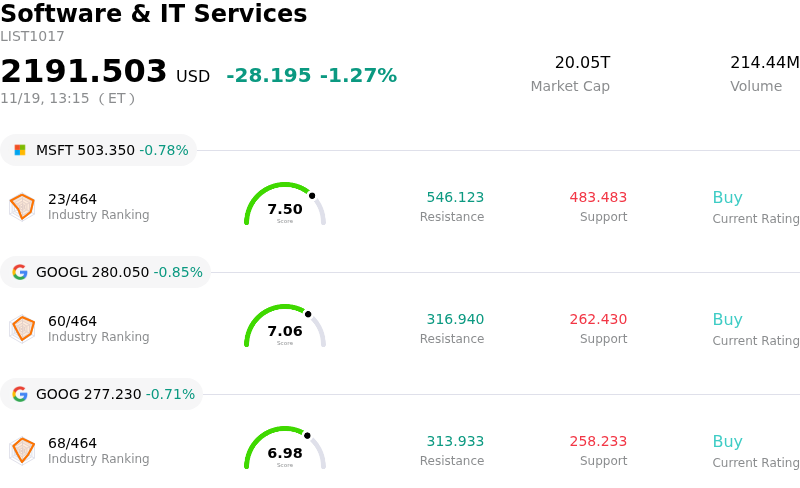
SAP SE (SAP) moved down by 3.18%. The Software & IT Services sector is down by 1.27%. The company underperformed the industry. Top 3 stocks by turnover in the sector: Microsoft Corp (MSFT) down 0.82%; Alphabet Inc Class A (GOOGL) down 0.90%; Alphabet Inc Class C (GOOG) down 0.71%.
What is driving SAP SE (SAP)’s stock price down today?
SAP faced noticeable downward pressure as broader enterprise software equities confronted a wave of portfolio de-risking and sector-wide multiple compression. Following an extended period of outperformance fueled by strong market enthusiasm for cloud modernization and enterprise artificial intelligence monetization, institutional investors engaged in tactical profit-taking. A broader rotation across global equity markets away from rich software valuations, combined with renewed volatility in benchmark sovereign yields, prompted institutional desks to trim exposure to large-cap enterprise application providers.
Compounding the macro-driven multiple contraction, heightened scrutiny surrounding global corporate IT spending continues to temper sentiment across the enterprise resource planning landscape. Although SAP maintains a robust long-term pipeline for its cloud transition initiatives, corporate procurement teams in both North America and Europe have shown increasing budget conservatism, leading to extended decision-making cycles for large-scale enterprise deployments. This dynamic has amplified market sensitivity regarding the near-term trajectory of current cloud backlog expansion and renewal rates, as investors recalibrate expectations for billings acceleration.
Foreign exchange dynamics also introduced friction for U.S.-listed shares. Fluctuations in the euro relative to the U.S. dollar, alongside broader European macroeconomic headwinds, weighed on cross-border sentiment and dampened ADR performance. At the same time, competitive pressures in the cloud infrastructure and enterprise software arena have kept margin expansion under close market observation, particularly as ongoing investments in artificial intelligence capabilities and cloud delivery infrastructure require sustained capital discipline.
Despite these immediate headwinds, SAP’s underlying operational profile remains supported by high proportions of predictable, recurring revenue and a sticky corporate customer base undergoing multi-year digital transformation programs. Nevertheless, in the near term, share price performance is likely to remain constrained by broader tech multiple stabilization, interest rate expectations, and market demand for tangible evidence of resilient enterprise software bookings.
Technical Analysis of SAP SE (SAP)
Technically, SAP SE (SAP) shows a MACD (12,26,9) value of -8.147, indicating a neutral signal. The RSI at 29.043 suggests sell condition and the Williams %R at 98.238 suggests oversold condition. Please monitor closely.
Fundamental Analysis of SAP SE (SAP)
SAP SE (SAP) is in the Software & IT Services industry. Its latest annual revenue is $41.49B, ranking 15 in the industry. The net profit is $8.07B, ranking 14 in the industry. Company Profile
Over the past month, multiple analysts have rated the company as Buy, with an average price target of $278.90, a high of $367.98, and a low of $210.00.
More details about SAP SE (SAP)
Company Specific Risks:
- Executive Board Leadership Disruption: The unexpected announcement that Chief Customer Officer and 20-year veteran Thomas Saueressig is departing the Executive Board introduces immediate leadership instability, creating operational headwinds for client retention and critical ongoing RISE with SAP migration programs.
- Generative AI Margin Dilution: Institutional commentary and executive disclosures at recent technology conferences highlight rising operational cost pressures tied to deploying Business AI and Joule agents, prompting management to evaluate cheaper underlying AI model architectures to mitigate cloud gross margin compression.
- Elevated Valuation Multiple Vulnerability: Carrying a high multiple of approximately 28x to 29x forward earnings, the equity has triggered sharp institutional de-risking and heavy downside volatility as broader enterprise application software suffers sector-wide multiple compression.
- Deceleration Risk in Core Cloud Backlog: Analyst scrutiny has intensified over the underlying durability of current cloud backlog expansion following disclosures that recent momentum was partially boosted by non-recurring catch-up effects, leaving revenue vulnerable as legacy software licensing and maintenance streams continue to contract.
This article may include AI-generated content that is human-reviewed, which is for reference and general information purposes only and does not constitute investment advice.
Recommended Articles






Comments (0)
Click the $ button, enter the symbol, and select to link a stock, ETF, or other ticker.