


Deutsche Bank AG Stock (DB) Moved Down by 5.27% on Nov 17: Key Drivers Unveiled


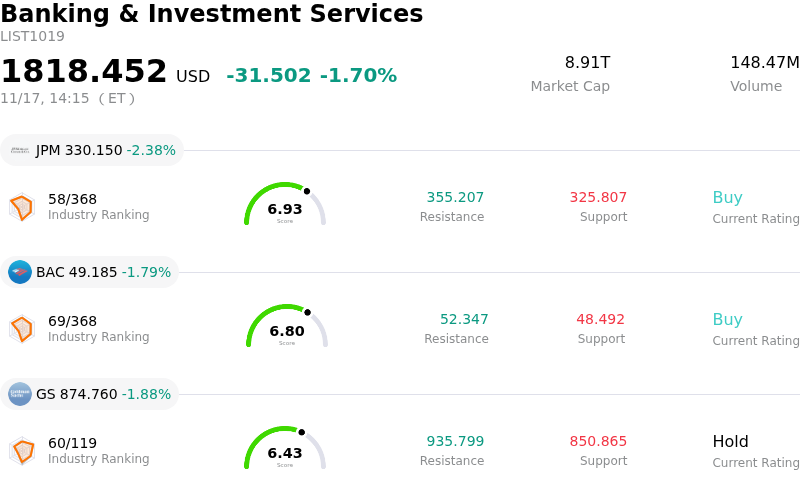
Deutsche Bank AG (DB) moved down by 5.27%. The Banking & Investment Services sector is down by 1.70%. The company underperformed the industry. Top 3 stocks by turnover in the sector: JPMorgan Chase & Co (JPM) down 2.38%; Bank of America Corp (BAC) down 1.76%; Goldman Sachs Group Inc (GS) down 1.88%.
What is driving Deutsche Bank AG (DB)’s stock price down today?
Deutsche Bank came under pronounced selling pressure during the session, driven by a confluence of macroeconomic headwinds across European banking, mounting concerns over credit quality, and broader risk-off sentiment in the financial sector. As an institution heavily exposed to European sovereign debt, corporate credit cycles, and cross-border commercial real estate, the bank remains particularly sensitive to shifting interest rate expectations and regional economic slowdowns.
A primary catalyst weighing on the stock is the ongoing compression in net interest margins as monetary policy normalization reaches a plateau. Expectations of accelerated rate cuts by the European Central Bank have intensified margin pressure across traditional lending divisions. While higher rates previously provided a solid tailwind to retail and corporate banking profitability, investors are now pricing in a more rapid erosion of lending spreads, which dampens medium-term revenue forecasts.
Concurrently, credit risk provisions have re-emerged as a core point of investor caution. Weakening macroeconomic indicators in Germany and the wider eurozone, characterized by sluggish industrial output and persistent domestic demand softness, are raising fears of deterioration in corporate loan books. In addition, continued scrutiny surrounding global commercial real estate exposures, particularly in the United States and selected European urban hubs, continues to cast a shadow over asset quality, prompting institutional funds to rebalance away from higher-beta European lenders.
Market dynamics and operational volatility also played a decisive role in the pullback. Deutsche Bank’s investment banking division, while historically a key earnings driver, faces headwinds from subdued debt origination and uneven trading volumes amidst heightened market uncertainty. When broader financial market volatility rises, institutional investors frequently rotate capital out of leveraged European diversified financials and into more defensive, domestic balance sheets or cash-equivalent instruments.
From a structural standpoint, long-standing market sensitivity to regulatory and litigation developments keeps a lid on Deutsche Bank’s valuation multiple relative to its global peers. Until clearer signals emerge regarding stabilizing credit provisions, sustained capital return milestones, and an inflection in European economic momentum, the stock is likely to remain vulnerable to elevated macro-driven volatility and periodic profit-taking.
Technical Analysis of Deutsche Bank AG (DB)
Technically, Deutsche Bank AG (DB) shows a MACD (12,26,9) value of 0.239, indicating a buy signal. The RSI at 44.581 suggests neutral condition and the Williams %R at 85.361 suggests oversold condition. Please monitor closely.
Fundamental Analysis of Deutsche Bank AG (DB)
Deutsche Bank AG (DB) is in the Banking & Investment Services industry. Its latest annual revenue is $38.36B, ranking 12 in the industry. The net profit is $7.39B, ranking 15 in the industry. Company Profile
Over the past month, multiple analysts have rated the company as Buy, with an average price target of $43.00, a high of $43.00, and a low of $43.00.
More details about Deutsche Bank AG (DB)
Company Specific Risks:
- Massive Data Leak Triggering Regulatory and Enforcement Scrutiny: An international media consortium published the "Inside Deutsche Bank" investigation based on over 15 million leaked internal documents, triggering an intraday stock decline of up to 6% amid allegations of systemic compliance breakdowns, ignored internal warnings, and renewed exposure to investigations and fines from regulators including BaFin and U.S. authorities.
- Heightened Legal and Financial Exposure from Undisclosed Epstein Transactions: The leaked files revealed that the bank processed $582 million in suspicious payments linked to Jeffrey Epstein—a substantially larger volume than previously acknowledged—resurfacing severe anti-money laundering compliance scrutiny and the risk of fresh litigation and civil penalties.
- Sanctions Compliance and Reputational Vulnerabilities from Russia Ties: Internal communications show leadership pursued expansion strategies with Kremlin-aligned entities and high-risk oligarchs leading up to the 2022 invasion of Ukraine despite explicit compliance objections, sparking acute regulatory concerns over sanctions adherence and the bank's prolonged, incomplete exit from the Russian market.
- Persistent Governance Deficiencies and Delayed Risk Offboarding: Revelations indicate the lender failed to offboard approximately 28,000 flagged, problematic investment banking clients and inadvertently leaked sensitive client tax documents, reinforcing warnings from independent monitors that risk appetite and commercial priorities continue to outstrip internal control capabilities.
This article may include AI-generated content that is human-reviewed, which is for reference and general information purposes only and does not constitute investment advice.
Recommended Articles









Comments (0)
Click the $ button, enter the symbol, and select to link a stock, ETF, or other ticker.