


BHP Group Ltd Stock (BHP) Moved Down by 3.67% on Nov 16: Facts Behind the Movement


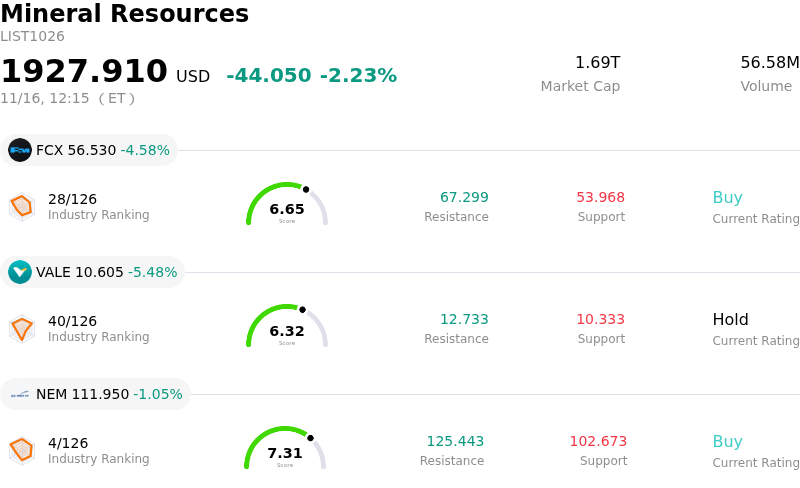
BHP Group Ltd (BHP) moved down by 3.67%. The Mineral Resources sector is down by 2.23%. The company underperformed the industry. Top 3 stocks by turnover in the sector: Freeport-McMoRan Inc (FCX) down 4.56%; Vale SA (VALE) down 5.48%; Newmont Corporation (NEM) down 1.06%.
What is driving BHP Group Ltd (BHP)’s stock price down today?
BHP experienced notable downward pressure during the session, primarily driven by broad weakness across the basic materials sector and softer underlying commodity benchmarks. As the world’s largest diversified miner, BHP’s earnings profile remains intimately tethered to industrial metals, particularly iron ore and copper. A pullback in seaborne iron ore prices, coupled with renewed softness in copper contracts, weighed heavily on investor sentiment. Heightened sensitivity to global demand indicators, particularly sluggish manufacturing momentum and persistent property sector headwinds in China, continues to undermine near-term demand expectations for bulk commodities and steelmaking inputs.
Compounding commodity weakness, broader macroeconomic factors and foreign exchange dynamics exerted secondary pressure on the company's American Depositary Receipts. A firming U.S. dollar typically creates headwinds for commodity-linked equities by making raw materials more expensive for non-dollar purchasers, thereby dampening physical import appetite across major consuming hubs. Furthermore, elevated global bond yields and cautious central bank rhetoric have sustained risk-off positioning among institutional allocators, prompting rotations out of capital-intensive, cyclical equities and into defensive asset classes.
From an operational standpoint, market participants also remain watchful regarding capital expenditure discipline and unit-cost trajectories amid ongoing mine expansion and decarbonization initiatives. While BHP maintains one of the industry’s most resilient balance sheets, premier low-cost assets, and compelling long-term leverage to the global energy transition via its copper and potash portfolios, near-term trading is being dominated by cyclical commodity fluctuations. In the absence of a sustained recovery in end-market consumption or robust fiscal stimulus to accelerate industrial activity abroad, institutional capital continues to take a measured stance, treating recent price action as a reflection of broader macroeconomic and trade crosscurrents.
Technical Analysis of BHP Group Ltd (BHP)
Technically, BHP Group Ltd (BHP) shows a MACD (12,26,9) value of -0.002, indicating a sell signal. The RSI at 38.031 suggests neutral condition and the Williams %R at 99.050 suggests oversold condition. Please monitor closely.
Fundamental Analysis of BHP Group Ltd (BHP)
BHP Group Ltd (BHP) is in the Mineral Resources industry. Its latest annual revenue is $58.76B, ranking 2 in the industry. The net profit is $9.83B, ranking 2 in the industry. Company Profile
Over the past month, multiple analysts have rated the company as Hold, with an average price target of $77.25, a high of $96.00, and a low of $61.50.
More details about BHP Group Ltd (BHP)
Company Specific Risks:
- Copper Asset Execution and Grade Decline: Recent operational data confirmed a 19% year-on-year decline in copper output caused by ore grade depletion and disruptions at key Chilean assets like Escondida and Spence; with copper recently rising to 54% of group underlying EBITDA, any inability to execute the steep production recovery planned for the second half of the fiscal year creates direct downside earnings volatility.
- Iron Ore Margin Compression and Offtake Headwinds: Weakening Chinese steel demand has driven benchmark iron ore prices down below $92 per tonne, threatening cash generation at Western Australia Iron Ore (WAIO) and forcing management to initiate operational overhauls to cut costs across its domestic iron ore network.
- Cross-Border Labor Disputes and Legal Exposure: Ongoing legal actions against unionized workers over unsanctioned work stoppages at the Spence copper mine in Chile, coupled with unresolved union negotiations and union-backed class-action litigation spanning Australian port operations, introduce recurring operational stoppage risks and compounding legal liabilities.
- Capital Outlay and Execution Strain on Megaprojects: Committing more than 55% of annual capital expenditure toward high-risk copper expansions and the multi-billion-dollar Jansen potash development raises capital-allocation execution risk, leaving free cash flow vulnerable to inflation and cost overruns during periods of broader commodity price weakness.
This article may include AI-generated content that is human-reviewed, which is for reference and general information purposes only and does not constitute investment advice.
Recommended Articles








Comments (0)
Click the $ button, enter the symbol, and select to link a stock, ETF, or other ticker.