


CVS Health Corp Stock (CVS) Moved Up by 3.18% on Nov 10: Drivers Behind the Movement


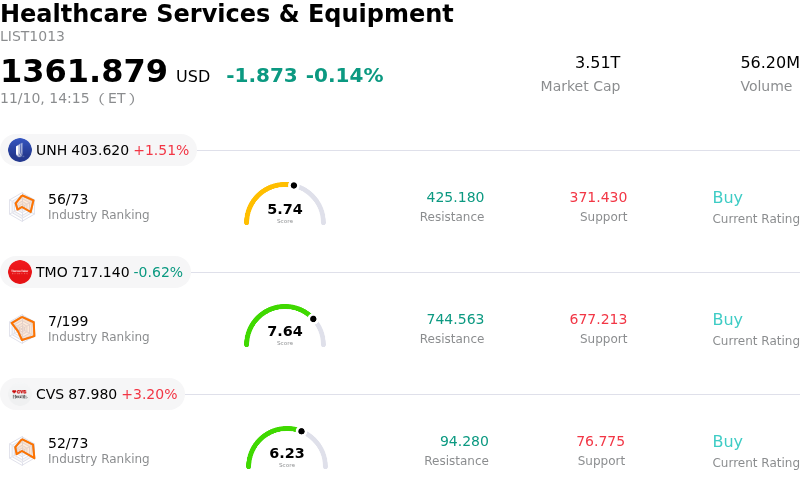
CVS Health Corp (CVS) moved up by 3.18%. The Healthcare Services & Equipment sector is down by 0.14%. The company outperformed the industry. Top 3 stocks by turnover in the sector: Unitedhealth Group Inc (UNH) up 1.53%; Thermo Fisher Scientific Inc (TMO) down 0.62%; CVS Health Corp (CVS) up 3.20%.
What is driving CVS Health Corp (CVS)’s stock price up today?
CVS Health demonstrated positive upward momentum during the trading session, reflecting improving investor sentiment around the company's operational turnaround and strategic stabilization efforts. Following a turbulent period characterized by elevated medical loss ratios and persistent utilization headwinds within its Aetna health benefits franchise, market participants are increasingly viewing the risk-reward profile as favorable, supported by historically compressed valuation multiples and proactive management interventions.
A critical driver of recent institutional demand is growing confidence in leadership restructuring and underwriting discipline. Under Chief Executive David Joyner, the appointment of seasoned managed care leadership to oversee Aetna signals a concerted push to regain pricing power and operational control. By front-loading charges through premium deficiency reserves and thoroughly resetting baseline expectations, management has helped eliminate major forecasting overhangs. Investors are responding constructively to concrete corrective measures, such as exiting unprofitable Medicare Advantage geographies, recalibrating plan benefits, and implementing targeted commercial rate increases to restore margin stability.
Market sentiment has also been reinforced by heightened focus on enterprise-level portfolio optimization and activist engagement. Continued regulatory scrutiny across the healthcare supply chain, combined with pressure to simplify complex conglomerate structures, has driven ongoing market speculation regarding strategic separation options for the company's retail pharmacy and care delivery assets. Concurrently, management's commitment to multi-year cost containment initiatives provides a tangible roadmap for non-medical expense reduction, bolstering visibility into future cash flow generation.
From a capital flows perspective, CVS is attracting rotation from value-oriented investors seeking defensive healthcare exposure with turnaround optionality. The steady performance and robust cash generation of the pharmacy services and consumer wellness units continue to offset near-term insurance volatility. With sentiment reaching washed-out levels earlier in the cycle, institutional short covering and fundamental accumulation have aligned to drive the stock higher.
Technical Analysis of CVS Health Corp (CVS)
Technically, CVS Health Corp (CVS) shows a MACD (12,26,9) value of -1.086, indicating a sell signal. The RSI at 49.058 suggests neutral condition and the Williams %R at 39.189 suggests buy condition. Please monitor closely.
Fundamental Analysis of CVS Health Corp (CVS)
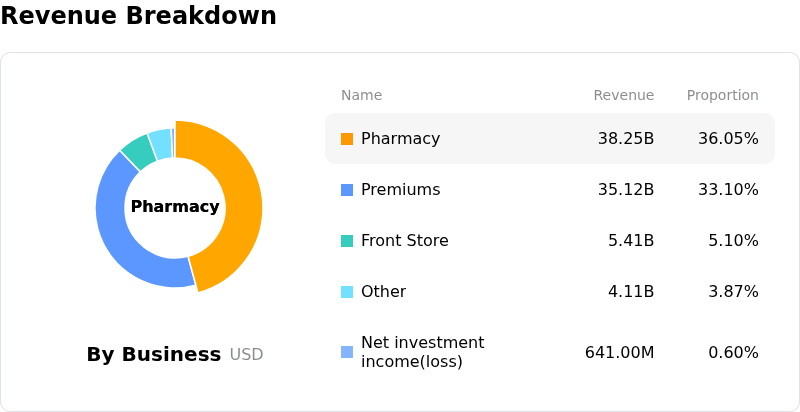
CVS Health Corp (CVS) is in the Healthcare Services & Equipment industry. Its latest annual revenue is $402.07B, ranking 2 in the industry. The net profit is $1.77B, ranking 5 in the industry. Company Profile
Over the past month, multiple analysts have rated the company as Buy, with an average price target of $111.25, a high of $123.00, and a low of $94.96.
More details about CVS Health Corp (CVS)
Company Specific Risks:
- Corporate Breakup Execution and Dis-synergy Costs: Management's unexpected plan to dismantle its vertically integrated model by spinning off its ~9,000 retail pharmacies from Aetna and Caremark introduces multi-year execution friction, substantial duplicate overhead expenses, and deep market uncertainty regarding how outstanding debt and dividend payouts will be divided.
- Pharmacy Services 2027 Trough Guidance: In conjunction with the restructuring announcement, management signaled that 2027 will act as a trough year for the pharmacy services division, driving multiple brokerages—including Leerink Partners and Barclays—to slash price targets due to medium-term earnings deceleration.
- Intensified Regulatory Scrutiny on PBM Integration: The decision to decouple pharmacy benefit management from retail operations reflects heightened federal and antitrust pressure targeting vertical cross-ownership, leaving Caremark exposed to impending regulatory restrictions on formulary placement and rebate retention practices.
- Retail Division Standalone Vulnerability: Separating the capital-intensive retail pharmacy and MinuteClinic business strips it of the countercyclical cash flows and underwriting support provided by Aetna, exposing the standalone entity to ongoing pharmacy reimbursement compression and front-store consumer spending headwinds.
This article may include AI-generated content that is human-reviewed, which is for reference and general information purposes only and does not constitute investment advice.
Recommended Articles







Comments (0)
Click the $ button, enter the symbol, and select to link a stock, ETF, or other ticker.